Early this year, a video of 19-year-old Daniel Iskandar being washed like a corpse as ‘punishment’ for stealing a donation box in a Selangor mosque went viral. The video initially sparked public outrage, but perceptions quickly changed when news broke that the teen was found to be positive for drugs at the time of the recording. He was swiftly labelled with derogatory terms such as ‘kaki dadah’ and ‘penagih’.
Reactions towards Daniel’s case is just one example of the long-standing stigma towards Persons Who Use Drugs (PWUDs) in Malaysia. His case is not isolated; similar reactions can also be seen, for example, to a 7-minute video published by local NGO Peluang in which a PWUD shares her traumatic experience with the country’s legal process after committing a minor drug offence.
* We previously wrote about the impact of the over-incarceration of minor drug offenders on prison overcrowding in Malaysia here.
Person Who Use Drugs (PWUD) is an umbrella term that encompasses the spectrum of drug users ranging from minor drug offenders to drug users who suffer from substance abuse or addiction disorder.
Negative public perception towards PWUDs is hardly anything surprising in Malaysia, where decades of a war on drugs waged by authorities have inevitably left a lasting impression on the people. This sentiment, however, comes with consequences that go far beyond name-calling; research on the impact of stigma against PWUDs show that it significantly harms their recovery as well as reintegration into society.
Malaysia is not the only country with a history of a tough approach towards drugs. Ever since President Richard Nixon declared drugs as America’s ‘public enemy number one’ in 1971, countries around the world have followed suit and waged their own wars against drugs. A key aspect to supporting the anti-drug campaign has been messaging, which has helped shape negative public opinion towards not only drugs, but also drug dependents and drug offenders. Policy documents, traditional media, and – nowadays – social media are some of the channels through which this sentiment has been shaped. Research has shown that wars on drugs are sustained through rigorous messages in government campaigns and the media, which in turn are used to justify harsher penalties for drug offences.
In Malaysia, ever since drugs were declared as the ‘Main Threat to Society’ in 1983, the government’s messaging effort has focused on creating a hostile rhetoric towards drugs through the adoption of fear tactics — as seen in national campaigns such as ‘The More You Use The Less You Live’ and ‘Perangi Dadah Habis-Habisan’. To date, the national policy on drugs still reflects the same, punitive narrative towards drug use which tends to frame PWUDs as potential criminals who would commit crime to finance their addiction.
Such narratives do not end at the policy level. Media reports of PWUD-related cases have long been profiling them as potential criminals or socially problematic individuals by nature. An analysis of 904 drug-related news articles that we conducted between August 2019 and January 2020 — after former Health Minister Datuk Seri Dr. Dzulkefly Ahmad announced the Pakatan Harapan government’s plan to decriminalise drug possession for personal use — shows that media attention is primarily focused on the criminal aspect of drug-related issues; we found that 41% of news reports are on capture and arrest, 28% on raids by law enforcement, and only a mere 7% covered drug policy related topics:
On top of that, around 21% of all news reports highlight drug use prominently despite it being an indicidental factor to other crimes; 12% of all news reports also highlight the convict’s previous drug charges, further framing and suggesting an association between ‘drugs’ and ‘crime’ to the audience. While it has been some time since our analysis was conducted, recent headlines suggest that our findings unfortunately still hold.
Such messaging approaches, both by the government and the media, only stand to reinforce an already hardened societal stigma towards PWUDs. A 2020 study found that stigmatising language such as ‘addicts’ and ‘abusers’ create more barriers for PWUDs to either get help or reintegrate into society. In the case of Malaysia, PWUDs struggle to access opportunities such as employment, education, housing, and loans. Stories from formerly incarcerated PWUDs would describe the hardship they face in finding shelter after being released from prison, causing them to go homeless. With the lack of social support, many end up reverting to old habits — as reflected in the steady increase of recidivism rate among drug offenders in Malaysia since 2015.
Today, as policymakers consider more science-backed and rehabilitative approaches to dealing with drug-related issues in Malaysia, we believe that the way PWUDs are portrayed in government and media messaging efforts should also change. As a start, there is a need to be more discerning about the socioeconomic factors that contribute to drug use – an aspect the news media tend to overlook when reporting on drug related matters. A more holistic and constructive reporting method when it comes to drug related matters could help change the way society views PWUDs. As observed in the case of Canada, reforming the way the media reports news (by emphasising public health instead of crime perspectives when reporting on drug cases, for example) can and does bring about shifts in public discourse about drugs and PWUDs.
Understanding the factors associated with drug use – socioeconomic (as mentioned above) as well as demographic – would also give policymakers a chance to better strategise their preventive effort in the future and tailor more fitting preventive programs to different targeted populations. It could be a first step towards eliminating societal stigma surrounding PWUDs.
Beyond preventive efforts, education is key in the long run. Educating the public with facts about drugs could empower them to form more informed opinions. This approach brought about a favourable outcome in Iceland, where the country saw a significant reduction of adolescent substance abuse after incorporating a multifaceted prevention program at the school level. The Icelandic government not only focused on compulsory substance abuse education, but also emphasised on strengthening community and family support networks through various state-sponsored after school programs — something we could perhaps learn from to foster a more inclusive and rehabilitative environment for PWUDs.
Ultimately, people hear what they are told to hear when it comes to drugs and PWUDs. It will undeniably take considerable effort to reform the way we think about them as a society, but one that is important and long overdue. Until this changes, however, we should remember that those like Daniel deserve empathy, not derogation.
Home affordability is a perennial issue affecting Malaysians, particularly young Malaysians. Aspects of the affordability issue have been frequently highlighted, including by The Centre in a primer published last year. One key fact worth reiterating here is the yawning chasm between median house prices and annual median household income – this disparity has nearly tripled from 2002 to 2019.
Even so, every consecutive Malaysian administration has continued to encourage home ownership. Most housing-related policies – ranging from subsidised home loans to large-scale government-subsidised projects like PR1MA – have focused on supplying homes for purchase and reducing obstacles to home ownership, especially for the younger generation.
However, given long-standing stagnant wages and rising household debt levels, should home ownership continue to be the overwhelming focus of government housing policy? Or should greater policy attention be directed towards those who cannot afford to buy a house and have resorted to renting, such as the proposed Residential Tenancy Act? And finally, might there be shifts in housing preferences towards long-term renting, especially by the young, if there were greater protections and incentives?
These are the questions we ask in our new research series which delves into Malaysian youths’ housing aspirations. We seek to understand the push and pull factors associated with home renting versus home owning. We also aim to recommend policies befitting a fair society comprising both renters and owners.
In this first instalment of the research series, we first look into the ownership versus renting landscape in Malaysia, and present findings from a preliminary poll on housing aspirations.
Home ownership and housing policy in Malaysia
Like many countries around the world, home ownership is the predominant mode of housing1 in Malaysia. The 2019 Household Income and Basic Amenities Survey shows that home ownership in Malaysia is high and has continued to rise since 2010, albeit slowly: from 72.5% in 2010, to 76.3% in 2016, and most recently to 76.9% in 20192.
Within the context of Southeast Asia, the rate of home ownership in Malaysia is not unusual; only the Philippines has a lower home ownership rate at 64.1% (2019). Other ASEAN neighbours have comparably high rates of home ownership such as Thailand (77.4%, 2010), Indonesia (81.1%, 2021), Myanmar (85.5%, 2014), Vietnam (88.1%, 2019) and Singapore (88.9%, 2020)3.
Malaysia’s and these ASEAN countries’ home ownership rates are quite high in comparison to developed countries such as the United States (65.5%, 2021), the United Kingdom (65.2%, 2018), Japan (61.2%, 2018), Germany (50.4%, 2020), and France (64.0%, 2020). Switzerland, interestingly, only has a 42.3% home ownership rate (2020)!4
In the 1960s, the Malaysian government’s housing priority had largely focused on providing shelter for low-income households especially in urban areas. Public-funded low-cost housing, such as the Projek Perumahan Rakyat (PPR), allowed low-income households to rent or own a property at a subsidised cost.5 After the New Economic Policy was introduced in 1970, a 30% Bumiputera quota for the sale of new housing stock, as well as a 5 percent discount, were introduced to facilitate the community’s urbanisation and home ownership.
As the Malaysian middle class continued to grow in number, the demand for better affordable housing continued to rise in tandem, driven by an environment of rising house prices and cost of living. This has led to a significant shift in government policy over the past two decades – ensuring supply and ownership of homes not only among low-income households, but also among middle-income families.
Apart from increasing the supply of ‘affordable’ housing via new programs such as PR1MA, various financing incentives were introduced to facilitate ownership such as the My First Home Scheme6, Youth Housing Scheme, the Home Ownership Campaign7, the Private Affordable Ownership Housing Scheme (MyHome)8 and MyDeposit.
However, Malaysia’s household debt has risen to levels unseen before, from only 47% of GDP in 2000 to 93% in 2020. Given these high levels of household debt – which are likely an understatement of total household borrowings9 – it is questionable whether further policy support towards home ownership via easier financing is a good idea.
The ‘hidden’ renter-households
Malaysia’s relatively high home ownership rate masks an important fact: there is a significant proportion of households that do not own homes in the Klang Valley. As of 2019, home ownership rates in Selangor and Kuala Lumpur are 69.7% and 63.3% respectively, which are considerably lower than the national average of 76.9% (Figure 1).
Breaking down the data according to household income reveals a more stark reality. Only 52.5% and 45.3% of B40 households in Selangor and Kuala Lumpur own their own homes, which is much lower than the average home ownership rate for B40 households nationally which stands at 73.1% (Figure 2).10
The picture is similar for M40 Klang Valley households; only 65.4% and 51.2% M40 households in Selangor and Kuala Lumpur respectively own the homes that they live in. In comparison, the home ownership rate for M40 households nationally is 75.5%.
At higher incomes however, the home ownership gap between Klang Valley households and Malaysia overall closes. Overall, 87.0% of Malaysia’s T20 households own homes compared to 86.6% of T20 households in Selangor and 77.9% in Kuala Lumpur.
Thus, the data shows that a sizable proportion of B40 and M40 households in Klang Valley are renting relative to the rest of the country. Renting is likely driven by the lack of affordability in particular locations but are there other factors at play? To get a fuller picture of renting patterns and its determinants, we collaborated with market research firm Dattel on a short poll in January 2022 comprising an urban sample of 809 respondents.
Who rents?
Geography
Our short January 2022 poll presented a pattern similar to DOSM’s 2019 home ownership data, though because our sample is mainly concentrated in urban centres, it resulted in smaller differences between regions. The poll results showed that renting is more prevalent in Klang Valley (41.0%), the South Peninsular states (38.4%) and East Malaysia (35.1%). This is followed by those living in East Peninsular states (27.3%) and North Peninsular states (26.6%) (Figure 3). In all regions, except for North Peninsular and East Peninsular, the percentage of respondents who are renting is higher than those living in their own homes.
In terms of home ownership, the highest percentage is among respondents from North Peninsular states at 37.3%. This is followed by East Peninsular states (34.9%), South Peninsular states (31.7%), Klang Valley (29.3%) and East Malaysia (24.0%).
Respondents who are staying with their parents or relatives are quite substantial in all regions, ranging from 26.3% in South Peninsular to 36.6% in East Malaysia.
Age
Unsurprisingly, renting is higher among younger respondents compared to older respondents. 38.9% of respondents aged 20-29 are currently renting, followed by those aged 30-39 at 35.4% (Figure 4). It is interesting to note that a quite significant proportion of older respondents, i.e. those aged between 40 and 59, are also renting. The survey found that 34.1% and 25.9% of respondents aged 40-49 and 50-59 respectively are currently renting their homes.
A substantial percentage of younger respondents are staying with their parents or relatives. 45.8% and 31.2% of respondents aged 20-29 and 30-39 respectively do so compared to much lower rates among respondents aged 40-49 (20.2%) and 50-59 (5.8%). Staying with relatives become more common again among the oldest respondent band, those aged 60-69 (18.6%), perhaps due to ageing and caregiving needs.
Unsurprisingly, home ownership increases with age. The percentage of respondents who live in their own property is 42.8% for 40-49 age group, 60.7% for 50-59, and 67.6% for 60-69 compared to 12.2% and 30.5% among the 20-29 and 30-39 age groups respectively.
Top Reasons for Renting
The biggest reason for renting is the unaffordability of down payment, cited by 44.5% of respondents who are currently renting (Figure 5). However, preferring to live in a particular location is also a relatively big reason, chosen by 23.9% of renting respondents. 17.2% of renting respondents said that they were unable to qualify for a home loan. And lastly, 7.2% of renting respondents said they chose to rent due to the flexibility it offers.
Unaffordability of down payment is the clearest reason for renting across all age groups, except for the 40-49 age band (Figure 6). Location preference is a relatively important reason for the 30-39 age band as well as the 40-49 age band compared to other age groups. Inability to qualify for home loans is not a top reason across all age groups, which runs counter to many policy prescriptions on loosening loan qualifying criteria. Flexibility is the least chosen reason among most age groups though curiously, it is quite an important reason for the 50-59 age group (the small sample size of renters within this age group may be one reason for this result).
While down payment unaffordability is the most cited reason in all regions (36.2% to 48.4%), location preferences is quite an important reason for renting in Klang Valley (30.7%) and East Malaysia (25.1%) (Figure 7). Meanwhile, inability to qualify for a home loan is a relatively strong reason in South Peninsular (25.2%) and East Peninsular states (28.5%), compared to other regions.
Flexibility, curiously, is quite a significant reason for renting in the North Peninsular (14.2%) and East Malaysia (14.1%). One possible reason could be that respondents in those regions do not have a long-term residence expectation and plan to relocate to other, perhaps more urbanised, regions in the future.
Future Housing Aspirations
Overall, 44.3% of respondents aspire to buy their own home while 27.4% intend to continue living in their own home. 12.7% of respondents plan to stay indefinitely with their parents or relatives, while 12.0% look to rent long-term as a housing option.
Aspiration towards home ownership is higher among younger respondents at 59.7% and 46.0% among the 20-29 and 30-39 age groups followed by 38.0% of 40-49 years old respondents (Figure 8). The proportion drops drastically for respondents aged 50 and above, at 13.5% and 8.3% for the 50-59 and 60-69 age groups – unsurprisingly, given higher rates of home ownership amongst older respondents.
Therefore, it is also not surprising that the percentage of respondents who want to continue living in their own home is higher in older age groups. 70.6% and 65.6% of 60-69 and 50-59 years old respondents want to continue living in their own home. The figure drops to 38.5% among 40-49 years old respondents, followed by 24.8% among the 30-39 age group and 6.7% among the 20-29 age group.
Renting long-term is not a popular choice among younger respondents compared to older respondents, which we found surprising. Long-term renting as an option makes up only 12.4% and 13.7% respectively for the 20-29 and 30-39 age groups. A relatively high proportion of respondents aged 50-59, however, do intend to rent long-term (18.3%).
The preference for home ownership holds when we look at the responses from the perspective of regional location. Respondents with plans to buy a home or continue living in one’s property range from 69.1% to 78.2% across all regions (Figure 9).
The same predominance in preference for home ownership holds when we look at the pattern across gender categories. It is interesting to note that the percentage of male respondents (14.9%) who intend to rent long-term is higher than the percentage of female respondents (9.0%) (Figure 10).
Conclusion
The policy bias towards home ownership is a common one, particularly amongst Asian countries. One reason is home ownership’s tangible wealth effect, as property prices tend to appreciate in the long-run. Asian societies also traditionally view home ownership as a positional good which provides respectable social standing. From the policymakers’ perspective, home ownership contributes to social stability and rootedness in a state or country.
And yet, this policy bias is not without problems. Societal pressures towards home ownership, in a situation of relatively high house prices and stagnant wages, would likely result in even more unsustainable levels of household debt and stress. The bias towards home ownership also arguably takes away policy attention on making rents affordable and fair.
Based on DOSM data and our short preliminary poll, there is a significant segment of Malaysians who do not own homes, mostly out of necessity, but some also out of choice. Overzealousness in promoting home ownership will neglect the needs of citizens who are currently renting, and may ignore the needs of changing values around long-term renting in future.
Policy attention should not be confined to ‘upgrading’ tenants to homeowners, particularly when renting disproportionately affects low-income families in the cities; half of B40 families in Klang Valley are renting, perhaps for the foreseeable future, and thus require greater renter protection. Attention must be directed towards strengthening the legal and institutional frameworks underlying the rental market, which was also pointed out by Bank Negara Malaysia back in 2017.
The government is beginning to make this a priority. The Ministry of Housing and Local Government is proposing an enactment of the Residential Tenancy Act to prepare legal provisions to protect homeowners’ and tenants’ rights, prepare a uniform template for residential tenancy agreements, and to resolve disputes between parties involved in residential-tenancy transactions. Interestingly, it includes a proposal to create a new government entity to handle security deposits. While the enactment is in its early consultative phase (and has received pushback from developers and landlords amongst others), it is a timely intervention to regulate this long-neglected area.
In Part 2 of this research series, we will look into policies adopted by other countries and cities to make renting a viable long-term practice. Stay tuned.
It must be noted that in Malaysia, the official home ownership rate includes informal housing, which is defined as houses built without development orders (i.e. this includes houses illegally built on non-private lands or on river bank reserves, or “kampung” houses built by the local community.) Such houses are common in rural areas, and are usually built haphazardly without complying to approved housing standards and regulations. Nevertheless, they are still considered as part of the stock of household-owned homes in the official data. This may not be the case for other countries.
Source: 2010 figure, Khazanah Research Institute (2015); 2016 figure, Department of Statistics Malaysia’s Household Income and Basic Amenities 2016 Survey.
Projek Perumahan Rakyat (PPR) flats can be rented for RM128 per month, or bought for RM35,000 in Peninsular Malaysia and RM42,000 in West Malaysia. Prospective tenants or owners must meet certain eligibility criteria such as a household income not exceeding RM3,000 per month.
The My First Home Scheme, introduced in the 2011 Budget, allowed first-time buyers to obtain loan financing up to 110% of the purchase price without needing to pay any down payment. This scheme was guaranteed by Cagamas, the National Mortgage Corporation.
The Home Ownership Campaign, first introduced in 2019, and eventually extended to December 2021, was introduced to encourage home ownership by reducing cost of property purchase. Qualified participants would enjoy full exemption on stamp duty for properties up to RM1 million, partial exemption on stamp duty for properties up to RM2.5 million, and Instrument of Securing Loan stamp duty exemption for properties of up to RM2.5 million. On top of that, buyers can enjoy a 10% discount for properties listed under the scheme.
The MyHome scheme, introduced in the 2014 Budget and lasted until November 2020, allowed eligible homebuyers to have their down payment paid by the government. The MyDeposit scheme, introduced in 2016 and which lasted until October 2021, offered a rebate of 10% of the house price or RM30,000, whichever was lower, to first-house buyers of properties priced below RM500,000.
Unclassified borrowings such as ‘buy now pay later’ schemes are not yet included in household borrowing statistics
B40, M40, and T20 Malaysia refer to the household income classification in Malaysia. B40 represents the Bottom 40%, M40 represents the middle 40%, whereas T20 represents the top 20% of Malaysian household income.
Dalam Bahagian 1 siri penyelidikan ini, kami menggariskan masalah-masalah pokok tentang hutang pinjaman pendidikan di Malaysia. Untuk menampung usaha pengkorporatan universiti awam dan perkembangan pesat universiti swasta, pinjaman pendidikan diperkenalkan untuk membiayai kos pendidikan tinggi serentak dengan perkembangan bilangan pelajar. Sejak penubuhan PTPTN pada 1997, sebanyak RM62.5 bilion pinjaman pendidikan telah dikeluarkan kepada 3.5 juta peminjam. Keadaan ini mungkin munasabah sekiranya negara dan masyarakat mendapat pulangan positif secara meluas daripada pendidikan tinggi. Walau bagaimanapun, mobiliti sosial tidak direalisasikan secara sekata. Dalam erti kata yang lain, ramai peminjam tidak mendapat pekerjaan dan pendapatan yang setimpal dengan pendidikan mereka.
Dalam Bahagian 2, kami mengemukakan tiga dasar progresif untuk menangani isu berkaitan dengan hutang pinjaman pendidikan yang tertunggak pada masa ini: penghapusan pinjaman atau pengampunan hutang pendidikan secara bersasar, pembayaran balik berasaskan pendapatan, dan pengawasan yang lebih meluas terhadap operasi dan pembiayaan PTPTN. Mengkategorikan para peminjam mengikut keupayaan mereka untuk membayar balik merupakan tonggak utama cadangan-cadangan ini.
Dalam bahagian ketiga ini, kami melontarkan beberapa idea untuk memperbaharui cara rakyat Malaysia membiayai pendidikan tinggi mereka. Antara intipati penting dalam perbincangan ini adalah perlunya kita menyedari bahawa landskap pendidikan tinggi kini kian berubah, dan ijazah tradisional bukan lagi satu-satunya jalan untuk mendapatkan pendidikan tinggi. Satu lagi aspek penting pembaharuan ini adalah perubahan yang diperlukan dalam struktur institusi, atau bagaimana untuk menyemak semula kaedah pembiayaan pendidikan. Selanjutnya, idea pembaharuan kami turut melibatkan cadangan untuk menyediakan langkah pembiayaan pendidikan yang lebih adil untuk keluarga yang kurang berkemampuan supaya kebergantungan meluas kita pada pinjaman pendidikan dapat dikurangkan.
Dalam artikel-artikel sebelum ini, kami telah soroti laporan media mengenai graduan dan anak muda Malaysia yang terperangkap dalam pekerjaan bergaji rendah selepas mengumpul hutang pendidikan yang besar untuk membiayai pengajian tinggi mereka. Ini konsisten dengan survei yang kami jalankan dari Ogos hingga September 2021. Satu pertiga daripada responden kami berkata pendidikan mereka tidak berbaloi dengan hutang pendidikan yang ditanggung. 59% berkata hutang pinjaman pendidikan menyumbang kepada tekanan kewangan manakala 57% berkata hutang pinjaman pendidikan menyumbang kepada kelewatan membeli rumah. 77% daripada responden bersetuju bahawa anak muda tidak sepatutnya perlu berhutang untuk mencapai pendidikan tinggi, dan majoriti yang lebih besar, 82% berpendapat bahawa tidak wajar golongan miskin perlu berhutang.
Beban hutang pinjaman pendidikan mendapat perhatian dalam Bajet 2022, di mana diskaun pembayaran balik telah diumumkan. Walaupun ia adalah petanda positif bahawa kerajaan memberi perhatian kepada isu pinjaman pendidikan, diskaun yang ditawarkan lebih bermanfaat untuk peminjam yang mempunyai kemampuan untuk membuat penyelesaian pinjaman yang besar atau untuk peminjam yang mampu membuat potongan gaji berjadual. Secara ringkasnya, ia memanfaatkan peminjam yang sudah pun mempunyai kemampuan kewangan. Diskaun-diskaun tersebut – yang sebenarnya diulang daripada pengumuman sebuah Belanjawan yang terdahulu – mencerminkan corak pemikiran dasar yang telah lama wujud tentang pinjaman pendidikan tinggi. Kami berpendapat bahawa sudah tiba masanya corak pemikiran ini dipertimbangkan semula secocok dengan perkembangan semasa.
Daripada ijazah tradisional kepada TVET dan mikrokredential
Antara pertimbangan utama dalam cadangan kami ialah trend pendidikan yang semakin beralih daripada program ijazah tradisional. Di Amerika dan UK, para pelajar dan ibu bapa sudah mula mempersoalkan pengajian ijazah tradisional dan sama ada kos untuk mengikutinya masih lagi berbaloi. Pandemik COVID-19 mungkin hanya akan mempercepatkan perkembangan ini dan menjadi punca kepada penurunan mendadak pendaftaran pelajar akhir-akhir ini.
Malaysia secara beransur-ansur bakal menghadapi keadaan yang sama. COVID-19 telah memburukkan, tetapi tidak menyebabkan, trend pengangguran siswazah dan gaji rendah siswazah. Pengangguran siswazah meningkat 22.5% kepada 202,400 pada 2020 daripada 165,200 pada 2019. Lebih merisaukan, nampaknya tren ini telah menaik sejak sekurang-kurangnya empat tahun lepas: pengangguran siswazah berjumlah 162,000 pada 2018, meningkat daripada 154,900 pada 2017. Ia juga memberi kesan yang signifikan kepada siswazah Bumiputera yang menghadapi kadar pengangguran yang agak tinggi.
Di samping kadar pengangguran, siswazah turut berhadapan dengan masalah gaji rendah; survei oleh Kementerian Pengajian Tinggi telah mendapati bahawa terdapat siswazah yang memperoleh gaji serendah RM1,000-1,500 sebulan. Bandingkan hasil ini dengan masa dan komitmen kewangan program ijazah yang biasanya mengambil masa sekurang-kurangnya empat tahun untuk diselesaikan. Program diploma tidaklah jauh lebih singkat – ia mengambil masa kira-kira 24-36 bulan untuk disiapkan dan lebih lama lagi jika dilakukan secara sambilan.
Mengambil kira situasi tukar-ganti dasar (policy trade-off) ini, penggubal dasar harus melakar semula corak pemikiran dasar yang memihak kepada ijazah akademik tradisional. Menuntut ilmu melalui ijazah adalah matlamat yang patut dipuji, tetapi adakah ijazah tradisional masih pilihan yang tepat untuk semua pelajar lepasan sekolah? Jawapannya adalah tidak, jika kita mengambil iktibar daripada pengalaman negara maju. Ramai lepasan sekolah mungkin boleh mendapat lebih manfaat – dan menjimatkan banyak masa dan wang – dengan mendaftar dalam latihan teknikal, program perantisan ‘belajar sambil bekerja’, kursus jangka pendek, skim kemahiran semula, kursus kelayakan mikro (mikrokredential), pembelajaran sepanjang hayat atau gabungan pilihan-pilihan ini.
Selain daripada pertimbangan kewangan, peralihan daripada ijazah tradisional juga didorong oleh perubahan landskap pekerjaan. Lepasan sekolah hari ini boleh membina portfolio mereka untuk bekerja sendiri ataupun bekerja bebas (freelance) berbanding dengan mendaftar di kolej untuk membina resume mereka untuk pekerjaan sepenuh masa.
Pemerhati dasar pendidikan Malaysia telah lama mengagumi Pendidikan dan Latihan Teknikal dan Vokasional (TVET) di negara lain seperti Sweden dan Jerman, di mana sistem TVET melatih pelajar untuk pelbagai bidang pekerjaan. Kadar pekerjaan bagi mereka yang mempunyai ijazah vokasional di negara-negara ini hampir sama tinggi dengan pemegang ijazah sarjana muda.
Kebolehpasaran graduan TVET juga tinggi di Malaysia, di mana ia mencapai kadar 98% dalam beberapa tahun kebelakangan. Ini jelas merupakan prestasi yang lebih baik daripada rakan-rakan mereka yang memegang ijazah. Pada tahun 2020, Pengarah Bahagian TVET, Azman Adnan dari Kementerian Pengajian Tinggi berkata bahawa kolej vokasional adalah penyedia terbesar pekerja berkemahiran di negara ini dan bahawa TVET adalah penyelesaian kepada ketidakpadanan kemahiran (skills mismatch) dan isu pengangguran siswazah.
TVET lebih murah, lebih pendek dan lebih dekat dengan keperluan industri. Walaubagaimanapun, tumpuan dasar dan peruntukan sumber pada TVET masih belum mencapai tahap yang diterima oleh sistem ijazah tradisional.
Namu begitu, terdapat beberapa usaha untuk mendorong perkembangan TVET dalam beberapa tahun ini. Dalam Rancangan Malaysia Ke-12, kerajaan bercadang untuk mengukuhkan program-program TVET dengan menaik taraf ekosistem industri, menambah baik akreditasi, mewujudkan sistem penarafan institusi TVET, dan mempromosikan platform berpusat yang menunjukkan data mengenai tawaran pekerjaan. Di bawah Bajet 2021, kerajaan telah memperuntukkan RM60 juta untuk Sistem Latihan Dual Nasional (SLDN), skim latihan yang berasaskan kompetensi dan berorientasikan industri. Elaun SLDN juga dinaikkan daripada RM600 kepada RM1,000 bagi menggalakkan lebih ramai peserta daripada isi rumah B40. Peruntukan keseluruhan untuk TVET juga telah meningkat daripada RM6 bilion dalam Bajet 2021 kepada RM6.6 bilion dalam Bajet 2022, sekali gus mencerminkan peningkatan penekanan kerajaan pada TVET.
Walau bagaimanapun, banyak lagi perlu dilakukan. Laporan Ketua Audit Negara 2019 mendapati program TVET yang dibiayai kerajaan secara keseluruhannya tidak mencapai sasaran Rancangan Malaysia Ke-11, malah sekadar menghasilkan separuh daripada jumlah graduan yang diunjurkan. Pendaftaran juga makin menurun dari 2016 hingga 2020, sungguhpun pandemik COVID-19 pastinya merupakan faktor penyumbang memandangkan banyak program TVET memerlukan latihan bersemuka.
Fragmentasi program dan pentadbiran TVET turut menjadi masalah. Institusi TVET dibiayai oleh kerajaan melalui enam kementerian, dan masalah pemecahan ini telah dibangkitkan sebelum ini dan keperluan untuk penyelarasan yang lebih baik telah diakui oleh kedua-dua kerajaan Pakatan Harapan dan Perikatan Nasional. Selain dari isu ‘penyelarasan’, rombakan besar dalam tadbir urus, perancangan dasar dan jaminan kualiti masih belum dilaksanakan walaupun keperluan berbuat demikian telah dibangkitkan beberapa kali, termasuk oleh Ahli Parlimen Nurul Izzah Anwar yang pernah berkhidmat sebagai pengerusi Jawatankuasa Pemerkasaan TVET.
Untuk mengangkat kepentingan TVET dan letak duduknya supaya setaraf dengan program ijazah dan institusi tradisional, kerajaan perlu melaksanakan pembaharuan struktur. Di Singapura dan Vietnam, hanya satu entiti menyelia sistem TVET negara masing-masing. Malahan dalam kes Vietnam, terdapat undang-undang khusus mengenai pendidikan vokasional, yang membolehkan kerajaan Vietnam melabur dengan secara substansial dalam TVET serta menggalakkan penyertaan sektor swasta melalui insentif percukaian, kredit, tanah, dan latihan para pendidik.
Walaupun mempunyai populasi yang jauh lebih kecil dan hanya lapan institusi TVET, Singapura mempunyai lebih 113,000 enrolmen pelajar TVET, angka yang setanding dengan jumlah enrolmen di politeknik dan kolej komuniti di Malaysia. Ini selaras dengan tinjauan KRI yang mendapati kurang daripada 10% belia di Malaysia mendaftar di politeknik TVET (tidak termasuk pusat latihan kemahiran) selepas pendidikan menengah.
Selain daripada TVET, kita juga harus memberi penekanan dan sumber kepada kursus latihan semula dan peningkatan kemahiran jangka pendek. Ini termasuklah apa yang dipanggil kelayakan mikro (mikrokredential). Berbanding dengan ijazah tradisional dan sijil TVET, kursus mikrokredential adalah lebih pendek, lebih fleksibel, dan lebih tertumpu pada kemahiran atau topik tertentu. Ia boleh ditawarkan dalam talian, secara bersemuka, atau melalui gabungan kedua-duanya.
Di Malaysia, naratif dasar sekitar pembangunan kemahiran dan mikrokredential telah disasarkan terutamanya kepada golongan dewasa yang bekerja. Pembiayaan adalah terikat dengan agensi seperti Kumpulan Wang Pembangunan Sumber Manusia (HRDF), Skim Insurans Pekerjaan di bawah PERKESO, dan Perbadanan Ekonomi Digital Malaysia (MDEC). Seperti mana TVET perlu diperluaskan, naratif dasar untuk pembangunan kemahiran dan mikrokredential juga harus dikembangkan kepada golongan lepasan sekolah.
Bukan semua pelajar lepasan sekolah pasti tentang apa yang mereka ingin belajar atau kerjaya yang ingin mereka ceburi. Mikrokredential menawarkan peluang untuk menguji minat bidang atau kerjaya tertentu sebelum melabur masa dan komitmen kewangan yang besar. Kerajaan boleh memberi insentif untuk menggalakkan tren ini. Contohnya, program SGUnited Skills di Singapura bukan sahaja menawarkan akses kepada pelbagai kursus latihan pendek bersubsidi untuk kemahiran dalam permintaan dan baru muncul (in-demand and emerging skills), ia juga menawarkan sokongan nasihat kerjaya dan elaun latihan bulanan sebanyak SGD1,200 sepanjang tempoh kursus untuk membantu menampung perbelanjaan hidup.
Dalam bahagian ini, kami telah menyatakan pendirian kami akan keperluan untuk dasar yang memihak kepada pemilikan ijazah tradisional sekarang beralih kepada pembangunan sistem sokongan dan promosi TVET serta kursus pembangunan kemahiran pendek atau mikrokredential di kalangan pelajar lepasan sekolah. Kami berpendapat bahawa keberhutangan pinjaman pendidikan di kalangan golongan muda sebahagiannya didorong oleh persepsi status dan andaian pulangan positif daripada pemilikan ijazah. Andaian ini perlu dikaji semula bukan sahaja oleh penggubal dasar tetapi juga oleh para majikan. Tenaga kerja muda hari ini berhadapan dengan inflasi ijazah, atau permintaan untuk ijazah sarjana muda dalam pekerjaan yang tidak benar-benar memerlukannya. Peralihan dasar ke arah TVET dan pembangunan kemahiran juga perlu disertakan dengan usaha untuk mengemas kini majikan mengenai penetapan kriteria kelayakan yang lebih relevan dengan keperluan semasa.
Beralih dari model pinjaman kepada subsidi terus untuk pelajar B40
Kerajaan semakin menggalakkan simpanan awal sebagai cara untuk membiayai pengajian tinggi. Ini merupakan langkah yang baik. Walau bagaimanapun, insentif dasar untuk menggalakkan simpanan pendidikan berkemungkinan akan lebih dimanfaatkan oleh keluarga berpendapatan pertengahan ke tinggi yang mampu menyediakan wang untuk tujuan ini. Bagaimana pula dengan isi rumah yang tidak mampu untuk menabung?
Kita harus beralih daripada pendekatan yang meminta keluarga B40 bergantung pada pinjaman pendidikan dan mempertimbangkan kaedah subsidi secara langsung. Pertama sekali, beban hutang pinjaman pendidikan nampaknya memberi kesan yang tidak seimbang kepada peminjam B40. Pengerusi PTPTN, menggunakan rekod badan itu sendiri, menulis bahawa meskipun hanya 55% daripada peminjam PTPTN datang daripada isi rumah B40, seramai 97% daripada peminjam lalai (yang tidak dapat membuat pembayaran balik secara konsisten) adalah daripada kumpulan pendapatan B40.
Kedua, seperti yang kami gariskan dalam Bahagian 1 siri kajian ini, kerajaan dan pembayar cukai sudah pun membiayai sebahagian besar pendidikan peminjam-peminjam PTPTN dengan membayar jurang kadar faedah antara kadar subsidi PTPTN kepada peminjam mereka dan kadar faedah pasaran yang dikenakan terhadap PTPTN atas pinjaman yang mereka ambil dari institusi kewangan. Memansuhkan pendekatan yang agak berpusing-pusing untuk mensubsidi pendidikan seseorang ini – dengan cara menggantikan subsidi faedah yang dibayar kepada institusi kewangan dengan pemberian subsidi tuisyen dan kos sara hidup secara terus untuk lepasan sekolah B40 adalah satu langkah yang lebih wajar dan bijaksana. Ia juga memberi manfaat kepada pengurusan PTPTN kerana ia memberikan sedikit kelegaan daripada menguruskan sebahagian besar peminjam yang berkemungkinan besar menjadi penghutang lalai.
Berapakah kos yang diperlukan untuk melaksanakan cadangan ini? Anggaran kasar kami meletakkan kos subsidi langsung pada 1.3-2 kali ganda lebih tinggi daripada kaedah semasa mensubsidi pinjaman pendidikan dan secara konservatif mengandaikan bahawa semua kursus yang dibiayai adalah untuk program ijazah dan dengan nisbah pelajar IPTS yang agak tinggi. Kos untuk subsidi langsung ini mungkin lebih rendah dengan adanya skim sokongan untuk pelajar IPTA serta peralihan daripada program ijazah tradisional kepada program diploma, TVET dan mikrokredential.
Gratuidad ialah program yuran (tuisyen) percuma bersasar yang dilaksanakan di negara Chile. Polisi ini digubal selepas bertahun-tahun protes mahasiswa terhadap kenaikan yuran dan lambakan hutang pinjaman pendidikan. Gratuidad menyediakan tuisyen percuma kepada pelajar dari 60% isi rumah terbawah. Subsidi tuisyen ditentukan oleh formula yang membahagikan institusi pendidikan kepada kategori mengikut tempoh pentauliahan mereka (sebagai proksi untuk kualiti) dan kemudian menetapkan tuisyen terkawal untuk setiap kumpulan dan setiap program pengajian.
Subsidi yuran pengajian dan kos sara hidup pelajar B40 bukan semestinya hanya datang daripada kerajaan dan pembayar cukai. Syarikat, yayasan persendirian dan individu berkemampuan tinggi juga boleh diberi insentif untuk menyumbang dan menambah kepada subsidi langsung ini. Dalam bahagian seterusnya, kami majukan komponen terakhir dalam cadangan pembaharuan pembiayaan pendidikan kami untuk memudahkan simpanan pendidikan di Malaysia supaya menjadi satu kelaziman sosial.
Daripada skim terputus kepada akaun pembelajaran sepanjang hayat (APSH)
Dewasa ini, seseorang warga Malaysia boleh membuat simpanan pendidikan melalui SSPN-i; memohon pinjaman daripada PTPTN atau PTPK; mencarum kepada HRDF, KWSP (Akaun 2), atau EIS; atau mengenalpasti tawaran agensi yang berbeza-beza dan mengambil kursus bersubsidi daripada MDEC, MARA, TEKUN dan banyak lagi.
Bagaimana jika ada cara yang lebih baik untuk membiayai pendidikan lepasan menengah seseorang sehingga usia tua? Cara yang menampung simpanan awal oleh ibu bapa serta subsidi langsung oleh kerajaan dan caruman atau biasiswa daripada bakal majikan atau dermawan? Kaedah yang mengikat dana tersebut dengan rakyat Malaysia secara individu dan bukannya dengan agensi latihan tertentu?
Menggabungkan kedua-dua pertimbangan di atas, kami mencadangkan akaun pembelajaran sepanjang hayat (APSH) untuk setiap rakyat Malaysia yang diuruskan sebagai dana pelaburan yang serupa dengan KWSP. Akaun tersebut hanya boleh digunakan untuk tujuan pendidikan, termasuk kos sara hidup. Dana itu disediakan secara automatik semasa kelahiran, dan setiap anak yang lahir di Malaysia akan menerima RM100 yang dikreditkan ke APSH mereka semasa pendaftaran kelahiran. Kanak-kanak yang dilahirkan dalam isi rumah B40 boleh dikreditkan dengan jumlah yang lebih tinggi bergantung pada tahap pendapatan isi rumah.
Akaun ini akan menjadi kaedah utama untuk skim simpanan sukarela yang diberi insentif oleh kerajaan untuk perbelanjaan pendidikan masa depan kanak-kanak itu, sekali gus menggabungkan ciri ADAM50 dan SSPN hari ini. Akaun ini juga akan menjadi tempat deposit untuk sebarang subsidi kerajaan untuk tujuan pendidikan dan latihan kemahiran pada masa hadapan, termasuklah pemberian insentif untuk program kemahiran semula (reskilling), sama seperti program SkillsFuture yang disediakan oleh kerajaan Singapura. Akaun tersebut juga boleh menerima pindahan daripada Akaun 2 KWSP serta deposit oleh agensi kerajaan, yayasan swasta, dermawan, atau bakal majikan untuk menyokong pendidikan pasca menengah, sama ada pinjaman atau biasiswa untuk program ijazah, diploma, TVET, mikrokredential, perantisan dan lain-lain kursus pembelajaran atau peningkatan kemahiran pada masa hadapan.
PTPTN barangkali berada pada kedudukan terbaik untuk mengendalikan urus tadbir dana ini memandangkan mereka telah pun menguruskan SSPN dan merupakan entiti yang bertanggungjawab mempromosikan tabungan pendidikan. Bagaimanapun, PTPTN perlu distruktur semula untuk menambah baik tadbir urusnya dan meluaskan mandatnya. Pelantikan ke dalam lembaga pengarah PTPTN hendaklah sama ketat prosesnya dengan pelantikan ke dalam lembaga pengarah KWSP untuk menjamin lembaga pengarah yang berkelayakan, cekap dan berautonomi. Untuk penyelarasan yang lebih baik, Perbadanan Tabung Pembangunan Kemahiran atau PTPK dan HRDF boleh digabungkan dengan PTPTN untuk mewujudkan suatu superfund yang berfokus untuk mengurus kewangan bagi pembelajaran sepanjang hayat.
Kerajaan Malaysia telah memperkenalkan pelepasan cukai untuk majikan (tamat pada 31 Disember 2021) yang membantu membayar pinjaman pelajar pekerja-pekerja mereka. Sekiranya rakyat Malaysia mempunyai akaun pembelajaran sepanjang hayat individu, insentif sedemikian juga boleh ditawarkan kepada individu dan syarikat yang menyumbang ke dalam akaun tersebut.
Kesimpulan
Melabur sejumlah wang dan masa untuk mendapatkan pengajian tinggi adalah satu keputusan kewangan yang besar. Untuk mengurangkan ketidaksamaan, kita perlu mengakui bahawa keputusan ini lebih berisiko terutamanya untuk segmen masyarakat yang kurang bernasib baik. Siri kajian kami ini telah menunjukkan kesan-kesan baik dan buruk apabila masyarakat bergantung pada pinjaman untuk membiayai pengajian tinggi. Walaupun pinjaman pendidikan telah meningkatkan akses kepada universiti dan kolej, ia memerangkap ramai graduan dalam hutang terutamanya mereka daripada isi rumah B40. Hal ini diburukkan dengan prospek kerjaya dan gaji yang tidak menentu dalam keadaan ekonomi negara yang masih rapuh.
Dengan mengambil kira latar belakang ini, kami menyokong untuk kerajaan mewujudkan subsidi terus dan elaun kos sara hidup untuk lepasan sekolah B40. Program ijazah tradisional (yang agak panjang dan mahal) bukan semestinya laluan yang terbaik untuk semua orang. Malah ia tidak lagi menjamin mobiliti sosial. Alternatif yang kurang diberi penekanan ialah TVET, yang sepatutnya mendapat tumpuan, sokongan dan promosi yang lebih besar. Kursus pembangunan kemahiran pendek atau mikrokredential juga harus digalakkan, bukan sahaja di kalangan orang dewasa yang bekerja tetapi juga di kalangan lepasan sekolah.
Untuk mengurangkan kebergantungan pada pinjaman pendidikan dan menjadikan simpanan pendidikan sebagai satu kelaziman sosial, kami juga mencadangkan agar akaun pembelajaran sepanjang hayat (APSH) diwujudkan secara automatik. Pendaftaran APSH automatik ini (opt out berbanding opt in) akan menjadi kaedah utama untuk skim simpanan sukarela yang diberi insentif oleh kerajaan, serta sebarang insentif tunai atau baucar untuk tujuan pendidikan.
Sebagai penjelasan, kami tidak mempersoalkan nilai pendidikan tinggi. Tetapi kita mesti mempertimbangkan semula cara kita mentakrifkan pendidikan tinggi dan cara kita membiayainya. Melangkah ke hadapan, kita harus merangka dasar untuk meningkatkan akses kepada pendidikan berkualiti (pengetahuan, kemahiran dan latihan teknikal), terutamanya untuk golongan yang kurang berada, tanpa mendorong mereka untuk menanggung hutang yang membebankan.
Cadangan-cadangan dasar kami sama sekali tidak menyeluruh, tetapi ia menawarkan corak pemikiran dasar yang baharu yang berorientasikan masa depan, berpandangan jauh dan lebih murah dalam usaha kerajaan meningkatkan akses kepada pendidikan tinggi. Pandemik COVID-19 telah memustahakkan lagi keperluan untuk menangani ketidaksamaan, dan ini merupakan satu kesempatan untuk merangka dasar pendidikan yang lebih baik, terutamanya bagi mereka dari keluarga berpendapatan rendah. Pada pandangan kami, ini sebaiknya dilakukan dengan memikir semula keseluruhan corak pemikiran dasar berkaitan pinjaman pendidikan, pembiayaan pendidikan tinggi, dan naratif yang memihak kepada ijazah tradisional. Kami membayangkan masa depan yang menyediakan peluang pendidikan pelbagai landasan (dan lebih murah), dan yang menjadikan simpanan pendidikan sebagai satu kelaziman sosial untuk menggalakkan pembelajaran sepanjang hayat. Mendasari perubahan corak pemikiran dasar ini adalah peringatan kami bahawa tiada lagi solusi satu saiz untuk semua (one size fits all), tetapi sebaliknya dasar-dasar awam kita patut mensasarkan bantuan yang lebih besar kepada mereka yang paling memerlukannya.
Malaysia’s current monthly minimum wage is RM1,200, increasing gradually from RM900 back when it was first implemented in 2012. By law, the next revision is supposed to occur this year. There has been talk that the government will raise it to RM1,500 a month – a significant 25% increase. This has naturally generated extremely contrasting reactions, from employers’ sharp objections, to “it’s high time” from worker groups, to divided analysts.
Whether we will see a RM1,500 minimum wage or not, one fundamental thing remains: the way the minimum wage is set and decided is and has been quite opaque. Although there is a stated ‘formula’ for revisions, the actual level of the minimum wage appears to be determined mostly through negotiations amongst key stakeholders, including the Cabinet and members of the National Wages Consultative Council (NWCC).
Yet, knowing how the minimum wage is set is critical to all working Malaysians. For the lowest paid employees, it sets the legal floor for wages and salaries. For informal workers, it stands as a rough benchmark for the minimum they should be earning from their informal jobs.
Times are changing the discussion. As early as 2018, proponents such Bank Negara Malaysia (BNM), Khazanah Research Institute (KRI) and Malaysia Trade Unions Congress (MTUC) have argued for setting the minimum wage at the level of a ‘living wage’, in other words a level which allows for a reasonable standard of living. BNM has estimated this to be RM2,700 for an unmarried individual in Klang Valley.
The push to clearly define the basis for the minimum wage grew further after the government updated the poverty line income from RM980 to RM2,208 in 2020. The pandemic and the trend of dramatic price increases also increased pressures to rethink the minimum wage.
The current policy approach of negotiating a few hundred ringgits’ increment every two years is clearly insufficient. The electioneering practice of simply promising a certain figure as the new minimum wage is also not good enough. Political parties will have to step up their policy game. In a potential election year, we ask political parties, how do they propose to address Malaysia’s minimum wage long-term? What improved promises can we expect on their manifestos?
Promise 1: From Conflicting Aims to A Clear Principle?
Since the Minimum Wage Order* was enacted in 2012, the government has reviewed the minimum wage with advice from the NWCC at least once every two years, as required by the NWCC Act 2011. Between 2012 to 2020, the minimum wage has been raised from RM900 a month for West Malaysia and RM800 for East Malaysia to RM1,200 a month for 56 municipal council areas and RM1,100 a month for other areas (Figure 1). That’s an increase of RM300 over a period of nearly a decade, which works out to an average 3.3% a year, or around an average of 1.5% annually after accounting for inflation. For reference, the average growth of Malaysia’s nominal GDP is around 6.4% during the same period (excluding 2020), or 5.1% in real terms.
*Part 2 of our Fair Work Act Research Series discussed the history of Malaysia’s Minimum Wage Order and explained the institutions behind the minimum wage in Malaysia.
Figure 1: Changes in Malaysia’s minimum wage rates since inception
Source: NWCC Act 2011; Minimum Wage Order
It is not entirely transparent what truly determines the level of the minimum wage. This is perhaps rooted in the very foundations of our minimum wage law which has two conflicting aims: firstly to ensure employees can meet basic needs and secondly, to provide a conducive environment for industrial production.
The first aim, judging by current benchmarks, seems to be of lower priority. Take the Klang Valley. The current minimum wage of RM1,200 is far lower than various ‘basic needs’ estimates, be it BNM’s living wage estimate of RM2,700 for singles, or SWRC’s reference budget level of RM1,870 for unmarried public transport users.
There is a stated minimum wage formula on the NWCC website, which incorporates relevant indicators such as the national poverty line, median income, inflation rate and more. However, judging by the quantum of minimum wage increases over the past decade and the gap between the minimum wage and the living wage, it is hard to say with confidence that the actual minimum wage has adhered to the stated formula.
And so we ask Malaysia’s political parties: What should be the principle or basis governing our minimum wage? How should it be set?
In answering this question, political parties would reveal what they think is the core purpose of a minimum wage. If parties agree that the core purpose of a minimum wage is to ensure that the lowest paid workers can meet the cost of living, the calculation of the statutory minimum wage should be based on a fixed percentage of the national median wage or a formalised calculation of a living wage, or some other clear living costs benchmark. After basic principles are established, then political parties can impress us further if they choose, for example, whether to set different minimum wages by state or region, whether to have specific sectoral provisions, and so on. But the first basic principle for setting the minimum wage is critical.
Setting the minimum wage more firmly and transparently based on a cost of living benchmark would also lend towards more gradual and more forecastable increases. While the mooted figure of RM1,500 is commendable for getting closer to living wage estimates, it is a marked 25% increase from current levels which will be very hard for some companies to bear, particularly in an economy still dealing with COVID-19.
Promise 2: From Piecemeal to Holistic Policy Thinking?
As we argued above, the minimum wage appears to be determined mostly through negotiations amongst key stakeholders. Judging by past media statements vs. the rate of minimum wage increases, it’s fair to conclude that much of the negotiations is driven by pushback from employer groups. Part of the problem here is the patchiness of complementary policy instruments that meaningfully support employers and companies, particularly MSMEs, to make the adjustment towards higher wages. Policy instruments like conditional wage subsidies, for example.
In the absence of holistic and supportive policy instruments, there will always be a high degree of objections to increasing the minimum wage. And so we would like to ask Malaysia’s political parties: how should the country improve the broader policy framework around Malaysia’s minimum wage? What other policy instruments should be implemented?
The question means to shift the policy conversation from debating piecemeal updates of minimum wage figures towards implementing the right policy model for systematic reform. As per Promise 1 above, political parties could offer to update the formula in the Minimum Wage Order to ensure closer alignment with cost of living levels. To accompany that however, complementary measures such as systematic wage subsidies should be designed and added into Malaysia’s minimum wage framework for qualifying employers and companies.
Promise 3: From Limited to Near-Full Coverage?
As digitalisation accelerates labour informalisation, more and more Malaysians are taking up new types of informal jobs, such as e-hailing and delivery gig work. This emerging class of informal workers has increasingly exposed the coverage gap of the minimum wage law. In law, only those with formal employment, whether full-time or part-time, are eligible to earn a minimum wage. While the statutory minimum wage is somewhat of a rough benchmark for informal workers’ salaries, there is no law protecting informal workers from being underpaid by employers even if they work full–time.
And so we ask Malaysia’s political parties: How should the current laws on minimum wage be amended to account for different types of informal workers?
As a start, political parties could provide the right of earning a fair minimum wage to informal workers and those without employment contracts by updating the definition of “employment” in the Employment Act 1955 as well as setting minimum conditions into the Contract Act 1950. Regardless of employment status, anyone who works for an equivalent of full-time hours should earn a salary not less than a minimum living wage.
Conclusion
The media and online ‘debates’ on the precise level of the minimum wage masks fundamental underlying policy questions regarding its purpose, model and coverage that had long been missing in Malaysia’s political discussions. In the run up to the 15th General Election, we hope that some brave and forward-thinking political parties would stop discussing minimum wage as a numbers game but instead go the extra mile to develop, communicate and promise meaningful policy reform.
Last year we began a research series to address the quandary of student debt in Malaysia, and recommended some key policy changes towards resolving problems related to outstanding loans as well as longer term systemic solutions.
Part 1 of this research series summarises the issues. Since the establishment of Malaysia’s primary student loan institution PTPTN in 1997, RM62.5 billion in student loans have been issued to 3.5 million borrowers. The success of the system hinges on broad and consistent positive returns to higher education. However, upward social mobility from higher education has not been evenly realised, putting pressure on this policy approach.
In Part 2, we advocated three bold policies to address issues related to current outstanding student debt: targeted partial debt cancellation, income-based repayment, and greater oversight on the workings and financing of PTPTN. Segmenting existing borrowers by their capacity to repay is a key pillar of these recommendations.
In Part 3, we proposed ideas for reforming the way Malaysians finance their higher education. We argued for policymakers to internalise the changing face of higher education and enact policies that evolve with recent trends. This includes diversifying from traditional degrees to TVET and microcredentials, shifting from loans to direct subsidies for students from underprivileged households, and providing individual lifelong education accounts.
In this final instalment, we present findings from our survey of student loan borrowers, which aimed to understand borrowers’ views on student loans and the impact of student loans on their lives. The majority of our survey respondents agreed that their education was worth taking out (and paying off) their student loans, and getting into debt seems to be a ‘necessary evil’ towards achieving tertiary qualifications. Nevertheless, progressive policy recommendations such as direct subsidies to underprivileged students and income-based repayment were strongly supported. At the same time, there appears to be a lack of knowledge on how PTPTN, the biggest loan provider, conducts its borrowings and lendings. These were some key findings, among many others, of our survey which is further detailed below.
About the study
The study was conducted via an online questionnaire, distributed using a convenience samplingmethod, between 3 August to 17 September 2021. The survey came in both Malay and English versions.
Since the survey’s sampling method was not stratified random sampling, results must be read with that in mind. Based on the profile of our survey respondents, we estimate that our survey respondents skew urban, but are fairly representative of student loan borrowers on other major demographic parameters such as age and gender. However, we acknowledge that this estimation can only be confirmed with access to a student loan database, which is not publicly available.
A total of 356 responses were collected during the study period of which 53 were rejected due to their status as non-borrowers and another two were excluded due to the respondents’ inconsistent or duplicated information, leaving a sample of 301 responses.
55% of the respondents were female. 73% of respondents were between 25-40 years of age, 19% were between 17-24 years old, and 8% were between 41-55 years old. Ethnically, 71% were Malays, followed by 12% Chinese, 9% Indians, and 5% non-Malay Bumiputera. Geographically, 64% of respondents came from Selangor and Kuala Lumpur.
Demographics of Survey Respondents
Employment, income and financial patterns
The majority of respondents are employed in some capacity. 68% of respondents were full-time employees, while 11% were otherwise employed as part-time employees or freelancers or entrepreneurs; 2% were full-time homemakers. Of those not in employment, 7% were unemployed and 12% were still studying. (Figure 1).
Figure 1: Employment status
With respect to current income, after excluding those who identified themselves as still studying, 9% of respondents stated that they have no regular monthly income, 16% earned less than RM2,000 a month, and 36% earned between RM2,000 and RM4,000 a month (Figure 2). Altogether, 61% of respondents earned below RM4,000 a month.
Figure 2: Current monthly income
A majority of respondents, 67%, were early-career employees with 7 years’ or under working experience. 38% of respondents reported working for less than 3 years, 29% reported between 3-7 years, 11% reported 7-10 years, and 22% reported more than 10 years (Figure 3).
Figure 3: Years of working experience
In terms of perceived income growth (again after excluding those who were still studying), we found that 42% of respondents reported steadily increasing income – a noteworthy finding that reflects positively on career progression and the returns to higher education. However, a significant 44% of respondents reported that their income has been somewhat stagnant since they started working. A minority reported worrying income trends: around 10% reported unstable income, 2% reported no income, and 3% reported decreasing income (Figure 4).
Figure 4: Respondents’ income trend
Also noteworthy: 52% of respondents reported that the Covid-19 pandemic had little to no impact to their income, while 13% even saw their income increase during this period. However, among those whose income had been disrupted, the losses were substantial; 8% saw their income decrease by at least 30%, and another 11% reported experiencing a job loss (Figure 5).
Figure 5: Impact of pandemic on income
A small majority of respondents, 54%, have at least one financial dependent such as a non-working spouse, children or parent(s) (Figure 6).
Figure 6: Number of financial dependents
Other than student loans, approximately 67% of borrowers report providing some level of financial support to their parents. 45% have car loans to service, and 30% have credit card debts to pay. 25% have housing loans, and 21% have incurred personal loans (Figure 7).
Figure 7: Type of financial obligations
What they borrowed for, and how much
The vast majority of respondents (74%) took out just one student loan, though a sizable number took out two student loans (25%) and a minority took out three student loans (1%).
Figure 8: Number of educational loans per respondent
The loans were mostly used to fund a bachelor’s degree, followed by pre-u and diploma (Figure 9).
Figure 9: Courses funded by student loans
A majority of respondents studied in public higher education institutions (IPTA) compared to private higher education institutions (IPTS) and overseas institutions. The share of overseas education amongst respondents is higher for post-graduate studies and professional/technical certification (Figure 10).
Figure 10: Type of institution by level of course type
Interestingly, respondents indicated a high completion rate of their study programs. The completion rate for bachelor’s degrees was 88%; only 2% failed to complete their programs while the remaining 10% of respondents were still studying (Figure 11).
Figure 11: Course completion rate
In terms of loan providers, PTPTN was by far the largest source of student loans. 82% of respondents reported borrowing from PTPTN, followed by 14% from MARA and 8% from state governments (Figure 12).
Figure 12: Sources of student loan
In terms of loan amount, 82% borrowed under RM60,000,which is consistent with the average loan size stated by PTPTN’s chairperson. 10% of respondents borrowed less than RM15,000 41% borrowed RM15,001 to RM30,000 while another 31% borrowed RM30,001 to RM60,000; only 7% borrowed more than RM100,000 (Figure 13).
Figure 13: Student loan amount
In terms of the length of time to fully repay their student loans per their loan agreement, 34% stated that they have to pay it off within 5-10 years and another 34% stated they will have to pay it off within 10-20 years. 16% reported they have to pay their debts within 20-30 years and the remaining 8% reported that they will take more than 30 years to pay off their student loan (Figure 14). For the record, PTPTN allows borrowers to restructure their loans which can extend the repayment period until the borrower reaches 60 years of age.
Figure 14a: Student loan tenure
Figure 14b: Student loan tenure by total loan amount
Borrowers’ monthly repayments depend on their loan size and repayment period. A large majority of respondents, 72%, pay between RM100 and RM300 a month. Of these, 8% pay less than RM100 a month, 45% of respondents pay between RM100 and RM200 a month, 27% pay between RM200 and RM300 a month, 11% pay between RM300 and RM400 a month, 5% pay between RM 400 and RM 500 a month, and 4% pay more than RM500 a month (Figure 15).
Figure 15: Monthly loan repayment amount
When borrowers’ income is commensurate with their monthly repayment and debt amount, student debt is less of a problem. Except for those who reported having no monthly income currently, monthly repayments are generally consistent with borrowers’ income level, i.e. borrowers with higher monthly loan instalments tend to earn at higher levels (Figure 16). There is however a segment of graduates earning less than RM2,000 or with no income that face considerable monthly repayments. In the highest income group, curiously 38% of those earning more than RM7,000 were paying RM200 or below in monthly repayments – another argument perhaps for setting repayment amounts based on income.
Figure 16: Monthly loan repayment by respondents’ income
41% of respondents have negotiated to restructure their loan repayment at least once – a surprisingly high number. The greater the loan size, the more likely that borrowers will restructure their loan repayment. Roughly 75% of respondents who borrowed more than RM100,000 restructured their loan repayment, followed by 46% of those who borrowed between RM60,001 to RM100,000, 40% of those who borrowed between RM30,001 to RM60,000, 40% of those borrowed between RM15,001 to RM30,000, and only 20% among those who borrowed less than RM15,000 (Figure 17).
Figure 17: Loan restructuring by loan size
In terms of their income, surprisingly, there were more respondents who restructured their loans amongst the highest income group (49% amongst those making greater than RM7,000 a month) compared to the lowest income group (26% amongst those making less than RM2,000 a month) (Figure 18)*. This may be attributed to two possible reasons: those who have higher income could perhaps afford to take advantage of PTPTN discounts for large sum repayments and so could restructure to settle their loans quicker, while those who have the least income defaulted rather than restructured their loans.
*This pattern holds even when we compare the second highest income group and the second lowest income group. The exception is those who reported no monthly income – about 50% of them restructured their loans.
Figure 18: Loan restructuring by respondents’ income
In terms of repayment rate, which has been a thorny issue generating sharply divergentheadlines, our survey mostly corroborated PTPTN’s statements: while a small minority defaults, a majority of borrowers do repay their loans. 60% of respondents can be categorised as having good standing in that they have either completely repaid their loans or are paying as scheduled. 20% can be categorised as inconsistent payers and 8% can be categorised as hardcore defaulters who never repay their loans. 12% of respondents were not yet scheduled to begin repayment (Figure 19).
Figure 19: Repayment status amongst respondents
Taking a closer look into defaulting patterns, our findings are largely confirmed by PTPTN’s own survey (mentioned in this publication here) that defaulters tend to come from low-income groups. For those who made inconsistent payments, 46% of them reported having no current income or earned less than RM2,000 a month and another 29% earned between RM2,000 and RM4,000. For those who never made repayment, 36% of them reported no monthly income currently and another 32% earned less than RM2,000. Nevertheless, there is a sizable percentage of those making inconsistent payments from high income groups: 14% of them earned between RM4,000 and RM7,000, and another 12% of them earned more than RM7,000 a month (Figure 20).
Figure 20: Repayment status by respondents’ income
To better understand motivations behind paying or not paying off student loans, we asked respondents to check a list of statements that explain their actions. The top three reported reasons why borrowers of good standing pay their loans are: they feel responsible for what they owe (94%), they do not like to be in debt (93%), and they want to avoid penalties (87%) (Figure 21).
Figure 21: Motivations for consistent repayment
Among those who did not pay or were paying inconsistently, the top three reported reasons for their payment behaviour were: they do not have enough to cover their cost of living (75%), they were waiting for announcement or election promises to discount their student loan (73%), and they believe it is unfair to have to pay this much for their education (71%) (Figure 22).
Figure 22: Motivations for inconsistent payment/defaulting
First Generation Student Loan Borrowers vs. The Rest
59% of respondents identified as first-generation tertiary graduates (‘first gens’), meaning that neither parent possesses a university degree. While this testifies to the benefit of student loans in enabling first gens to pursue higher education, they also appear to earn lower incomes, as a group, compared to borrowers with parents that have higher education qualifications.
There was a higher proportion of first-gens earning below RM2,000 (20%) compared to non first-gen respondents (11%). There were also more first-gens who reported having no monthly income currently compared to non first-gen respondents. Bottom line: even though attaining higher education is important, parents’ educational qualifications are also a determinant to a borrowers’ earning capability.
Figure 23: Income of first generation borrowers versus others
Impact of, and Perception on, Student Loans
In addition to their profiles and borrowing, we also asked respondents how they perceived the worth of student loans, the impact of student loans on their finances, and whether today’s student loan policies should be continued or reformed.
When we asked respondents if they felt that the education or qualification that they received was worth their student loans, a majority of 59% reported that it is worth it (Figure 24). Roughly 22% reported feeling neutral and the remaining 20% indicated that it was not worth it.
Figure 24: Perception of education’s worth compared to student loan
When we examined the data according to income, unsurprisingly we found that those who earned less are more likely to report that their higher education is not worth the loan compared to those who earned more. Borrowers who earned less than RM2,000 a month or had no monthly income currently were more likely to report that their education is not worth the student debt incurred compare to respondents earning at higher levels (Figure 25).
Figure 25: Perception of education’s worth by respondents’ income
When we compare perception of education’s worth by the types of institutions for bachelor’s degree – the most popular course amongst our respondents – we found that those in local public higher education institutions (IPTA) are more likely to report that their education is worth the loan compared to their peers in local private higher education institutions (IPTS). The latter was also slightly more likely to express that their education is not worth the loan. Also noteworthy: those who studied in overseas higher education institutions were more strongly inclined to report that their education is worth the loan compared to those from local higher education institutions.
Figure 26: Perception of education’s worth by type of educational institution (degrees only)
Somewhat surprisingly, relatively few respondents reported experiencing loan penalties (Figure 27). Only 11% said they experienced being unable to travel due to immigration blacklists for not repaying their student loan. 4% reported being sued for not repaying student loans, and another 2% reported that they declared court bankruptcy for not repaying their student loans. 24% reported difficulties in getting a bank loan because of their student loan repayment status affecting their creditworthiness scores.
Figure 27: Penalties faced by loan borrowers
To better understand the different ways student debt affects borrowers’ lives, we asked respondents about the impact of student loans on their finances and life plans. 59% reported that student loans contributed to financial stress, 57% reported that student loans contributed to a delay in purchasing a home, and 52% reported that student loans contributed to them postponing savings, including emergency savings and retirement savings (Figure 28). 46% of respondents reported that student loans have contributed to them not starting a business or pursuing risky ventures, while 42% reported that student loans have contributed to them delaying marriage or having kids.
Figure 28: Effect of student loans on life choices
We also asked respondents what they think of some ideas to reform student loan policies. Income was a strong theme. 82% of respondents agreed that student debt is not a problem if graduates earn higher wages. Relatedly, there is strong support from respondents, 81%, to only begin student loan repayments after reaching an affordable level of income, a policy which we advocated in Part 2 of this research series. More than two-thirds of respondents, 77%, agree that underprivileged and overburdened borrowers should have part of their student loan forgiven, a proposal that we also pushed for.
Figure 29: Support for income-based repayment and partial loan cancellation
Policy ideas to impose more restrictions on student loans did not resonate with the respondents, going against our policy recommendations in this area. A majority of respondents disagree that criteria for student loans should be tightened and given for certain courses only (69%) or certain institutions only (71%), which were two of the policy recommendations we advocated in Part 3 of this research series. A small majority of respondents also reacted negatively to our policy recommendation that there should be less student loans for university degrees, and more for technical and online courses including micro-credentials (52% disagreed). That said, further studies that include a more representative sample, including more of TVET graduates, may present findings that are less skewed towards university degrees.
Figure 30: Support for loan reform proposals
77% of respondents agree that youth should not need to get into debt to attain higher education, and an even bigger majority, 82%, said the poor should not have to do so. A majority of respondents, 59%, disagreed with the statement that an individual person or family is fully responsible to save up and pay for their own higher education. Given these numbers, we would be interested to see if borrowers feel that the family should be partially responsible for paying the costs of higher education – perhaps in a future study.
Figure 31: Views on higher education financing
On the question of fiscal affordability, about two-thirds of respondents, 69%, think the country can afford to make higher education free for everyone, which in our view reflects the gulf between policymakers (who tend to be more fiscally mindful/conservative) with the general public.
Figure 32: Views on affordability of free higher education
However, many respondents were not aware of how PTPTN – the biggest loan provider – operates (Figure 33). Only 39% were aware that PTPTN borrows from financial institutions and markets. More than two-thirds of respondents, 77%, thought that PTPTN is completely funded by the government and taxpayers, and only 36% were aware that the Malaysian government guarantees PTPTN’s debts. About 40% thought that PTPTN is completely funded by the ongoing collection of outstanding loans. (We covered how PTPTN operates in Part 1).
Figure 33: Knowledge of PTPTN’s funding base
Conclusion
We began this research series by outlining the major problems with student loans as the main policy approach to finance one’s higher education. As have been pointed out elsewhere, a major issue is the uneven returns from higher education. This is borne out by our survey where less than half of respondents are earning RM4,000 a month and above.
Due to uneven returns from higher education, we hypothesised that graduates are questioning the worth of their tertiary education relative to their loans. This was somewhat supported by the survey, where a small majority of respondents, 59%, agreed that their education was worth the loans incurred. Borrowers whose income is lower than RM2,000 a month were especially likely to question the worth of their tertiary education.
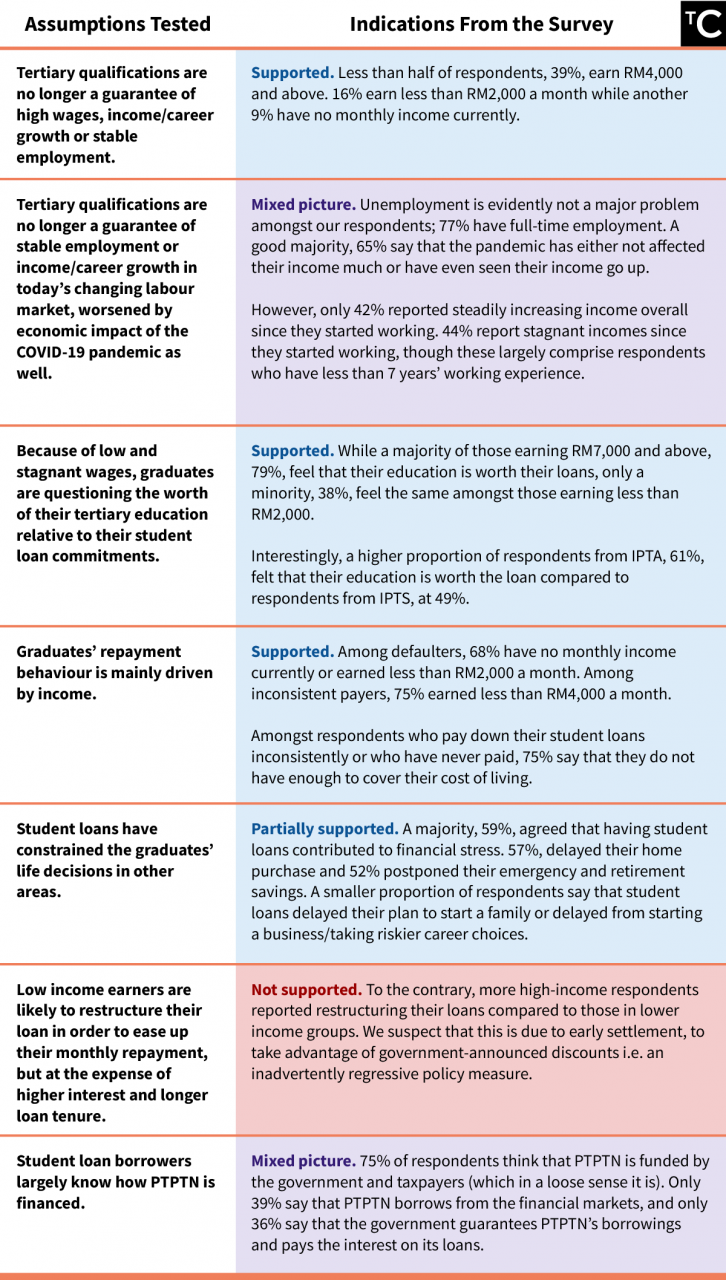
We tested our other assumptions on related facets such as payment behaviour, level of loan restructuring, how student loans affect stress and life plans as well as the extent of knowledge on how PTPTN is financed; these are summarised in Table 1 below. While we were mostly validated regarding the effects of income on some of these hypotheses, some results were less negative/severe than we expected.
Table 1: Assumptions tested and indications from the survey
Apart from the assumptions above, we also tested our policy perspectives against borrowers’ views via the survey (Table 2). Some of our policy recommendations did not find favour. In Part 3, we had advocated to tighten conditions and limit student loans to certain courses or institutions with proven track records, but respondents rejected this proposal by a huge margin. We had also advocated to extend more student loans for technical and vocational (TVET) and microcredit courses but respondents were not enthusiastic about reducing loans for traditional degrees in favour of funding more TVET and microcredit courses.
However, other proposals evidently struck a chord among the respondents. There was strong endorsement to permit borrowers to begin repayment only after they reached an affordable level of income i.e. income-based repayment. Respondents also supported our policy view that lower income households should not have to incur debt to attain higher education, suggesting an appetite for progressive reforms. Our policy recommendations that align with such a vision include providing targeted and partial student loan cancellation for low income borrowers as well as direct subsidies, rather than loans, to low-income students.
Table 2: Support for our loan policy recommendations
In essence, decisions on how to improve today’s educational financing policy ought to be shaped by two key drivers: the real returns of higher education and the sustainability of PTPTN’s funding structure.
Acknowledging and identifying the unevenness of returns from higher education would help to set the path towards policies that (i) really help to level the playing field for low-income households/students, and (ii) puts the right level of funding and quality assurance support in non-traditional forms of higher or continuing education such as TVET and microcredentials.
Acknowledging the (lack of) long-term sustainability of PTPTN’s funding structure would help to set the path towards policies that (iii) moves away from debt towards further supporting/subsidising the behaviour of early saving for every Malaysian’s lifelong education, and (iv) institutionalises greater transparency, accountability and oversight in funding bodies such as PTPTN.
Given the changes occurring in employment and higher education, we believe that the time is ripe for more evidence-based policymaking and research-led inquiry on student loans as a policy instrument, as well as alternative paths forward. With the General Election in Malaysia’s imminent future, we look forward to seeing and contrasting the range of policy proposals from the nation’s major political parties on this highly important topic.
Our Fair Work Act research series started with Part 1, presenting a case for updating Malaysia’s employment classifications to capture the evolving power dynamic between employers* and workers. Part 2 argued for clarifying the meaning of minimum wage in achieving the ideal of ‘fair pay’. Part 3 dissects the broad topic of ‘fair working conditions’ and in Part 4, we examine the idea of ‘fair contracts’.
*Note: The term ‘employer’ is used broadly throughout this piece, representing the party that either employs the worker directly or an intermediary such as gig platforms.
In the fifth and final instalment of this research series, we look at the last two pillars of the Fair Work Act, namely ‘fair management’ and ‘fair representation’. What do they cover and mean for different worker categories prevalent today? We ask this question and more in this article.
What does fair management cover?
According to the Oxford Internet Institute’s Fair Work Initiative, ‘fair management’ encompasses labour practices towards fair hiring, disciplining and firing of workers, irrespective of their employment status.
The essence of fair management is also reflected in the International Labour Organisation (ILO) conventions that focus on discrimination, workplace violence and sexual harassment. The 1958 Discrimination (Employment and Occupation) Convention introduced anti-discrimination labour guidelines to promote equal employment opportunity and labour treatment. The more recent 2019 ILO Convention on Violence and Harassment requires governments to implement measures protecting workers in the formal and informal economy against violence and harassment at work.
Building on the Fair Work Initiative and the ILO conventions, our definition of fair management is two-fold. Firstly, fair management should guard against and eliminate all discriminatory practices in every stage of employment. Secondly, fair management should protect all workers against invasive labour practices, for example, labour monitoring or job allocation practices implemented in the name of efficiency or productivity.
Current laws on fair management
In Malaysia, the principle of fair management is most closely captured in Article 8(2) of the Constitution, which states that “… there shall be no discrimination against citizens on the ground only of religion, race, descent, place of birth or gender, in any law or in the appointment to any office or employment …”.
Current labour laws (see Figure 1) also provide guidelines for payment and deduction of wages, termination of employment and protection for whistleblowing, though provisions cover employees only. For contractors, the Contract Act 195 governing contracts for service between contractors and client-employers does not provide any terms that touch on fair management.
Figure 1: Current Malaysian legislation relating to fair management
In case of dispute, employees can file complaints relating to the monetary aspect of employment at the Labour Court. Contractors can only bring complaints to the civil court where decisions would mostly be made on the terms and conditions written in their service contract.
Current shortfalls relating to fair management
(1) Insufficient protection against discriminatory practices
The problem with today’s labour laws on discrimination is that there is neither an official definition for discrimination nor comprehensive legal protection for workers against discriminatory labour practices. Article 8 of the Federal Constitution has been the main guiding legislation on this score but its provisions are quite high level, making it insufficient as a safeguard in specific cases.
In the Beatrice a/p AT Fernandez court case for example, the Federal Court dismissed a pregnant air stewardess’ claim of being unlawfully terminated by her employer, judging that there is no provision expressly prohibiting firing due to pregnancy, and that the laws only mandate employers to provide maternity allowance to female employees on maternity leave.
Nevertheless, the recently tabled Employment (Amendment) Bill 2021 is a step in the right direction. If passed, the newly added legal provisions will empower the Labour Department-General to investigate disputes on discrimination. Apart from that, the legislation update will also provide maternity protection which prohibits the dismissal of a pregnant employee or an employee suffering from illness arising out of pregnancy. However, the new amendments still do not clarify the definition of discrimination and grounds for discriminatory practices for all workers, including non-employees and migrant workers.
Policy Recommendations
For Malaysia to eliminate all forms of discrimination in every stage of employment, the government should revise existing labour laws by referring to relevant ILO conventions, such as the 1951 Equal Remuneration Convention, the 1958 Discrimination (Employment and Occupation) Convention and the 2019 Violence and Harassment Convention. When updating the labour laws, the government should ensure similar anti-discrimination provisions are spelled out clearly and be made applicable to all workers, including contract workers and migrant workers.
Politically, socially tricky: Defining what is ‘unacceptable’ labour discrimination in Malaysia
The Malaysia NGO CEDAW Alternative Report Group has reported various discriminatory practices against vulnerable groups, such as women, LGBTQ, refugees, migrant workers and more.
While the Constitution is clear that there should be no discrimination on the count of religion, race, descent, place of birth or gender, it is silent on groups such as LGBTQ and non-Malaysians; inclusion of such groups in the definition of labour discrimination would require much dialogue and leadership. By the same token, Article 154 of the Constitution justifies positive discrimination for Bumiputera in certain fields, but it is arguably not meant to be applied without limitation or without qualifying criteria. Defining labour discrimination would require serious discussion on what should be permissible and prohibited in Malaysian society. Elements of an Equal Opportunity Commission, proposed in 2010, could serve as a starting point to this effort.
(2) Lack of legal provisions against invasive labour practices
With the increasing digitalisation of work fueled by the COVID-19 pandemic, there has been a seismic change in labour monitoring. The rise of remote working culture drives many employers to adopt surveillance software for monitoring employees’ work-from-home activities, tracking workers micro-behaviours such as internet activities and keystroke movements. These technologies raise serious concerns about the extent of permissible surveillance, privacy and wellbeing.
To date, the government plans to include clauses on employer responsibility for employees’ safety and wellbeing in remote working settings in the proposed Employment (Amendment) Bill 2021. However, it is as yet unclear whether the undisclosed clauses can truly address the lack of transparency and level of assurance needed to protect workers against any invasive use of surveillance systems at work.
Apart from surveillance software, the use of algorithms particularly on gig platforms is also arising as a potential concern. Algorithmic technologies automate worker job allocation and monitoring via the 6R mechanism, where the algorithms direct workers by restricting and recommending, evaluate by recording and rating, and discipline by replacing and rewarding. Given that there is no law in place for governing the use of algorithms in employment, platform algorithms have the potential to invade workers’ privacy or significantly reduce their wellbeing.
Policy Recommendations
It is high time for the government to take a closer look at technological applications in employment. The government should update existing labour laws or consider new legislation for regulating the use of automated monitoring systems as well as task assignment algorithms.
Such regulations should clarify how employers can ethically access, monitor and control such information. This has become an emerging policy area in recent years. Jurisdictions including China and Europe have introduced regulations to require that workers be informed on the use of algorithms as well as to prevent algorithimic settings from endangering workers’ safety and wellbeing. A recent example is the draft law published by the European Commission which details the parameters and prohibitions for automated monitoring and decision-making systems in use with digital platform workers.
What does fair representation cover?
What about fair representation? As suggested by Fair Work Initiative, the term ‘fair representation’ means giving workers the right to express their voice, organise in collective bodies and negotiate with employers, irrespective of their employment status.
The principles of fair representation are also reflected in several ILO conventions. The 1948 Freedom of Association and Protection of the Right to Organise Convention sets out principles to ensure workers and employers have the right to establish or join a collective body freely without interference. The 1949 Right to Organise and Collective Bargaining Convention provides workers protection against anti-union discrimination and enshrines the right to collective bargaining. The 1971 Workers’ Representatives Convention calls for governments to provide effective protection for workers against any act prejudicial to them due to the workers’ activities as a worker representative or participation in union activities, provided that their acts abide by the laws and by collective agreements.
For the purposes of this piece, our notion of fair representation comprises two pillars, namely the right to express and the right to organise. The right to express covers aspects that allow workers to express their voice and communicate to management without fear of retribution. The right to organise covers aspects that enable workers to form and act as collective bodies that can engage in meaningful collective bargaining with employers.
Current laws on worker representation and its shortfalls
Currently, there are three main labour laws touching on workers’ right to express (only employees however), namely the Employment Act 1955, the Trade Unions Act 1959 and the Industrial Relations Act 1967. Although the laws do not explicitly spell out the right to express, employees are allowed to voice out and file labour complaints. Early this year, the Human Resources Ministry (MOHR) also launched an online grievance channelling platform called Working For Workers (WFW) to enable workers to communicate their labour complaints to the government and seek government assistance in highlighting grievances to employers without exposing the workers’ identities.
The same three laws apply (similarly, employees only) to the right to organise. The Employment Act 1955 grants all employees the right to representation while prohibiting employers from preventing and penalising them from being unionised. The Trade Unions Act 1959 sets guidelines for the registration of unions, memberships and organisation of a worker strike. The Industrial Relations Act 1967 regulates industrial relation matters between employers, workers and unions.
There are two types of labour unions that employees can join: a national union or an in-house union within a specific company. National unions like the Malaysian Trade Union Congress (MTUC) and the Congress of Unions of Employees in the Public and Civil Services (Cuepacs) tend to have larger membership, more funding for union activities and address broader labour issues. In-house unions are organised by relatively smaller groups of workers with a focus on matters concerning a specific company or an occupational group.
On paper, employees appear to have the right to express and to organise. However, there are several shortfalls in current policies that restrict them from voicing out and engaging in collective bargaining with employers without fear of being punished.
Inadequate facilitation of workers’ right to express
Both the Employment Act 1955 and the Industrial Act 1967 focus on enabling employees to voice out and negotiate better working conditions formally as a collective group. There is no law or regulation that expressly requires or encourages employers to establish internal communication channels for workers to express their labour grievances informally.
Proactive employers do hold town hall sessions and other communication platforms to hear labour complaints from employees and contractors. However, these communication channels and employee engagement are done voluntarily.
Besides that, legal protection for the right to express only covers unionised employees who engage in collective bargaining with employers. Workers who express their labour concerns as an individual or non-unionised group are legally open to employer retaliation. And although current laws prohibit employers from discriminating, punishing and dismissing unionised employees for expressing their labour demands, some employers still accuse and punish union workers for tarnishing the company’s reputation and violating disciplinary rules.
Policy recommendations
Irrespective of employment classification, all workers should have access to communication channels to voice out complaints or grievances to management without fear of reprisal. The government should ensure employers provide internal communication channels by issuing guidelines for establishing worker liaison platforms. An example is found in Germany’s Works Council Constitution Act which establishes guidelines for employers to form in-house work councils for communicating and addressing labour complaints. Under the Works Council Constitution Act, workers of each company are free to elect their representatives to discuss labour matters with employers and ensure compliance with the laws, ordinances and collective agreements.
Apart from that, the government should strengthen the legal protection for the right to express by extending the coverage to all workers regardless of their employment status and the level of organisation. Whether it is an individual, a group or a union, all workers should be empowered to raise labour complaints with their employers and the officials without fear of being punished.
Extremely tight controls over union activities
One major issue with workers’ right to organise is the extremely tight controls the government has over union activities. The government essentially wields the power to provide the right to representation for workers by approving the formation of unions and union activities. However, tedious bureaucratic hoops and stringent control over registration requirements and membership eligibility of labour unions are imposed, deterring union formation*.
*Read this four-part article by Aliran on the history and state of Malaysian labour movements.
Currently, the government only permits the formation of a worker union representing employees of a specific company, occupation or industry. To form a new union, workers have to show the Industrial Relations and Trade Unions Director-Generals that they meet the eligibility to represent workers and have the majority support (50% + one worker) of the relevant worker segment. Then only would their union application be submitted to the Human Resources Minister to decide and accord statutory recognition.
Even after a labour union is formed and recognised, strict regulations and complex procedures limit unions from mobilising and organising any labour movement. For unionised workers to conduct a labour strike, the Trade Unions Act 1959 requires them to conduct a secret ballot and gain two-thirds support of union members before seeking the government’s approval to launch a strike. These applications for organising labour movements could also be rejected based on the decision of the Human Resources Minister or if they fail to comply with the standard procedure.Other countries, particularly in Europe such as Denmark, Finland and Sweden have a simpler administrative process by which to allow for and organise labour movements.
Perhaps due to these restrictions, the unionisation rate of Malaysia’s labour force has been decreasing over the years (Figure 2).
Figure 2: Unionised and non-unionised workers, 2012-2019
Policy recommendations
At the time of writing, Malaysia has caught international attention for repeated cases of forced labour prevalent in electronic manufacturing, glove making, and palm oil plantation industries, to name a few. Though the issue is complex, the right to organise plays a significant role in limiting situations of forced labour and should be facilitated.
The government should consider transferring the discretionary power in registering a union to an independent agency with representatives of major worker unions, key employer federations and the government. Having representation from different stakeholders would facilitate more balanced judgements on the formation of unions and rules on union activities. The independent body could function like the Canada Industrial Relations Board and Australia’s Fair Work Commission which manage trade union matters and facilitate trade disputes while ensuring transparency and fairness.
Navigating the path to a Fair Work Act
Many of the policy shortfalls discussed in this and past instalments point to the need to have several legislative amendments in Malaysia’s current laws. Amendments of current laws will only go so far however; we will always be playing catch up with changes in the employment landscape.
As such, it is time for the government to consider a more forward-looking legislative approach to reform our labour laws and social protection in ways that are adaptive to the changing labour market. To achieve this, our five-part Fair Work Act research series calls for three major policy changes in Malaysia.
As suggested by the title of this research series, we propose an omnibus Fair Work Act that, amongst other things, recognises a third employment classification that addresses the employment dynamics of informal gig workers. The omnibus Fair Work Act should also lay out the principles of fair pay, fair working conditions, fair contracts, fair management and fair representation for all workers, including migrant workers.
To realise the fair work provisions for all workers, we suggest establishing an independent statutory body similar to Australia’s Fair Work Commission that enforces the various labour legislation and handles labour disputes. The government can formulate a Malaysian Fair Work Commission represented by all stakeholders with sufficient fundings and regulatory power to ensure compliance with the Fair Work Act and equitable labour outcomes.
Admittedly, the path to a Fair Work Act is not without challenges, as some policy recommendations may have unintended consequences. But we can navigate potential policy pitfalls through a national regulatory sandbox with the participation of all stakeholders for experimenting and fine tuning relevant labour policies. This approach to mitigate implementation risks is currently underway in Denmark, where the world’s first collective agreement was reached between gig platform Hilfr and Danish union 3F after both parties conducted a one-year trial to test out a new classification method for gig workers.
In a world of COVID-19, labour reforms are no longer a choice but a necessity to ensure the promise of the future of work still holds for every worker, regardless of their employment status and demographics. The case for a Fair Work Act is also a case for Malaysia to achieve the 8th United Nations Sustainable Development Goal in promoting inclusive and sustainable economic growth, employment and decent work for all.
Nota: Artikel ini adalah terjemahan bagi artikel kami dalam Bahasa Inggeris yang diterbitkan pada 8 April 2021.
Dalam Bahagian 1 kajian COVID-19 dan kesejahteraan ini, kami telah mendapati bahawa lebih daripada separuh para responden telah melaporkan bahawa mereka mengalami keadaan kesejahteraan mental yang semakin teruk sepanjang tempoh setahun yang lalu, iaitu setelah bermulanya Perintah Kawalan Pergerakan Fasa 2 (PKP 2.0). Golongan wanita dan anak muda di bawah umur 35 tahun adalah yang paling terkesan akibat daripada kesihatan mental yang negatif dalam tempoh masa ini, dan penemuan ini adalah selari dengan pelbagai kajian di peringkat global. Bahagian 1 juga turut menyerlahkan hubung kait yang jelas di antara kesejahteraan fizikal dan juga mental; mereka yang melaporkan kesejahteraan mental yang semakin teruk sepanjang tempoh setahun yang lalu adalah lebih berkemungkinan untuk turut melaporkan kesejahteraan fizikal yang merudum.
Dalam Bahagian 2 bagi siri kajian ini, kami menyelidiki kesan keadaan hidup ‘norma baharu’ terhadap kesihatan mental. Khususnya, kami mendapati bahawa jumlah orang yang menghuni dalam rumah yang sama serta kekerapan bekerja dari rumah memberi kesan yang signifikan terhadap kesihatan mental seseorang.
Nota:Kesihatan atau kesejahteraan mental para responden telah dinilai menerusi jawapan mereka terhadap soal selidik DASS-21. Bagi mendapatkan lebih maklumat tentang bagaimana soal selidik DASS-21 telah digunakan, sila lihat Bahagian 1.
Kehidupan Bersendirian dan Kesejahteraan Mental
Secara keseluruhannya, para responden yang hidup bersendirian mengalami keadaan kesihatan mental yang lebih teruk berbanding mereka yang hidup bersama orang lain dalam rumah yang sama (Rajah 1). Majoriti daripada golongan yang hidup bersendirian, iaitu seramai 78%, telah melaporkan bahawa mereka mengalami kemurungan, berbanding 52% hingga 60% daripada mereka yang hidup bersama orang lain. Dari segi keterukan, 38% daripada mereka yang hidup bersendirian telah melaporkan tahap kemurungan yang teruk atau amat teruk, berbanding tahap yang lebih rendah, iaitu 23% hingga 28%, bagi mereka yang hidup bersama orang lain.
Corak ini turut dapat dilihat di kalangan mereka yang mengalami perasaan tertekan; 60% daripada mereka yang hidup bersendirian telah melaporkan perasaan tertekan, berbanding 32% hingga 46% bagi mereka yang hidup bersama orang lain. Dari segi keterukan, 28% daripada para responden yang hidup bersendirian telah melaporkan perasaan tertekan yang teruk atau amat teruk, berbanding hanya 13% hingga 20% bagi mereka yang hidup dengan orang lain.
Perlu juga dinyatakan bahawa corak ini berbeza sedikit bagi mereka yang melaporkan perasaan gelisah. Dari segi keseluruhan, para responden yang hidup bersendirian didapati tidak menunjukkan tahap kegelisahan yang ketara berbanding dengan responden yang hidup bersama orang lain. Bagaimanapun, dari aspek keterukan, didapati bahawa 44% daripada responden yang hidup bersendirian telah melaporkan tahap kegelisahan yang teruk atau amat teruk, berbanding hanya 24% hingga 33% bagi mereka yang hidup bersama orang lain.
Rajah 1: Jumlah Orang dalam Isi Rumah dan Kesejahteraan Mental
Penemuan ini adalah selari dengan kajian di peringkat global yang mendapati saling hubung kait di antara kehidupan bersendirian dan tekanan psikologikal. Persatuan Psikologi Amerika (APA) menyabitkan hakikat ini kepada fenomena keterasingan sosial, yang didapati dapat mengakibatkan kesan kesihatan yang ketara seperti peningkatan risiko masalah jantung dan tahap kemurungan yang tinggi.
Adalah penting untuk diambil kira bahawa kehidupan bersendirian tidak semestinya bererti bahawa seseorang itu akan mengalami kesunyian atau keterasingan sosial, namun ia mungkin membawa risiko kesihatan mental yang lebih tinggi bagi golongan tertentu. Kajian yang dijalankan oleh pakar sosiologi Eric Klinenberg berkenaan keterasingan sosial dan kesannya terhadap kesihatan awam mendapati bahawa beberapa kumpulan demografi seperti lelaki, golongan tua, dan mereka yang berada dalam kalangan berpendapatan rendah mempunyai risiko yang lebih tinggi untuk mengalami perasaan keterasingan atau kesunyian sekiranya mereka hidup bersendirian.
Kekerapan Bekerja dari Rumah dan Kesejahteraan
Apabila Perintah Kawalan Pergerakan (PKP) mula dilaksanakan pada tahun 2020, kerajaan telah melaporkan bahawa 33.5% daripada rakyat Malaysia telah mula bekerja dari rumah. Perubahan dalam cara bekerja bagi ramai rakyat Malaysia ternyata telah memberi kesan terhadap kesejahteraan mental (Rajah 2). Para responden yang bekerja dari rumah setiap hari telah melaporkan tahap kemurungan dan tekanan yang lebih tinggi berbanding mereka yang bekerja cuma beberapa hari dalam seminggu di rumah, ataupun langsung tidak bekerja dari rumah.
64% daripada para responden yang bekerja dari rumah setiap hari telah melaporkan perasaan murung, berbanding hanya 53% hingga 55% di kalangan mereka yang kurang kerap bekerja dari rumah, ataupun langsung tidak bekerja dari rumah. Dari segi keterukan, 30% daripada responden yang bekerja setiap hari di rumah telah melaporkan tahap kemurungan yang teruk atau amat teruk, berbanding 20% hingga 26% responden yang bekerja di rumah secara kurang kerap, ataupun langsung tidak bekerja dari rumah.
Corak yang sama dapat dilihat bagi fenomena tekanan, di mana 50% daripada mereka yang bekerja dari rumah setiap hari telah mencatatkan perasaan tertekan berbanding cuma 35% hingga 38% daripada para responden yang bekerja dari rumah secara kurang kerap, atau langsung tidak bekerja dari rumah. Walau bagaimanapun, dari segi keterukan, perbezaan di antara keterukan perasaan tertekan di kalangan responden yang bekerja dari rumah setiap hari, berbanding mereka yang bekerja dari rumah secara kurang kerap atau langsung tidak bekerja dari rumah, adalah kurang ketara.
Perbezaan dari segi kegelisahan di antara mereka yang bekerja dari rumah setiap hari, berbanding mereka yang bekerja dari rumah secara kurang kerap atau langsung tidak bekerja dari rumah adalah agak tipis. Sepertimana penemuan dalam hubung kait di antara kehidupan bersendirian dan kegelisahan, perasaan gelisah berkemungkinan lebih didorong oleh faktor-faktor lain berbanding aturan kerja dari rumah.
Rajah 2: Kekerapan Bekerja dari Rumah dan Kesejahteraan Mental
Apakah cabaran bagi mereka yang bekerja dari rumah setiap hari? Pakar psikologi dari Singapura, Jeanette Lim, telah menyatakan bahawa semasa pandemik COVID-19, terdapat trend isu kesihatan mental yang boleh diperhatikan yang berpunca daripada bekerja terlalu kuat dan keterasingan akibat bekerja dari rumah. Sungguhpun aturan bekerja dari rumah mungkin digemari oleh sesetengah pekerja, kesannya terhadap kesihatan mental perlu diambilkira apabila syarikat dan juga kerajaan menimbangkan dasar untuk membenarkan aturan kerja yang lebih fleksibel dalam era pasca-pandemik nanti.
Pertimbangan Dasar
Penemuan di atas menunjukkan kesan keterasingan sosial terhadap kesihatan mental bagi rakyat Malaysia sepanjang tempoh setahun yang lalu, sepertimana yang dapat dilihat dalam laporan kemurungan dan tekanan di kalangan mereka yang hidup bersendirian dan bekerja dari rumah setiap hari. Sungguhpun terdapat faktor lain yang turut menyumbang kepada kesihatan mental seseorang, peri pentingnya pergaulan sosial dalam kehidupan seharian mungkin tidak diberi perhatian sepenuhnya berbanding faktor lain yang lebih tampak, seperti status pekerjaan dan perubahan dalam pendapatan.
Baru-baru ini, kesihatan mental secara amnya telah dibincangkan secara meluas oleh kerajaan, organisasi bukan kerajaan (NGO), dan tokoh umum. Sungguhpun demikian, bagi menangani kesan COVID-19 terhadap kesihatan mental, perlu ada kesedaran yang lebih tinggi di kalangan pembuat dasar dan masyarakat umum berkenaan risiko yang khusus dan tidak terlihat seperti keterasingan sosial. Usaha seperti kempen awam boleh dianjurkan untuk memaklumkan rakyat tentang cara-cara untuk menangani keterasingan sosial, seperti mengingatkan para individu yang hidup bersendirian agar berhubung dengan insan yang tersayang ataupun mencari kesempatan pergaulan sosial dalam komuniti masing-masing, di samping terus patuh kepada tatacara pengendalian piawai (SOP) berkaitan pandemik yang telah ditetapkan.
Kempen kesihatan awam juga harus dilaksanakan ke atas syarikat-syarikat untuk mendidik mereka tentang cabaran bekerja dari rumah secara seharian. Sungguhpun syarikat boleh melaksanakan aturan kerja yang lebih fleksibel, sokongan lanjut juga perlu disediakan, contohnya dengan melaksanakan dasar dan amalan yang boleh menjamin penjagaan berterusan dan pemeliharaan kesejahteraan bagi setiap pekerja.
Di samping meningkatkan kesedaran tentang keterasingan sosial di kalangan masyarakat awam dan juga di peringkat korporat, perlu juga diwujudkan ruang fizikal yang menggalakkan kegiatan riadah luar rumah dan yang membolehkan pergaulan sosial yang selamat. Dalam sebuah editorial yang kami terbitkan pada tahun 2020, kami telah membincangkan tentang bagaimana perekayasaan ruang bandar boleh difikirkan semula untuk menjamin kesejahteraan mental, khususnya melalui ruangan pro-masyarakat seperti gelanggang futsal yang dapat menyokong gaya hidup fizikal dan hubungan sosial dalam komuniti setempat.
Dalam bahagian ketiga kajian ini, kami akan membentangkan penemuan kami berkaitan impak COVID-19 terhadap kesihatan mental akibat daripada keadaan kewangan dan pekerjaan di kalangan rakyat Malaysia.
Sekiranya anda mengalami kesukaran emosi atau mental, sila dapatkan bantuan dan sokongan daripada talian yang berikut: Mercy Malaysia dan talian sokongan psikososial Pusat Kesiapsiagaan dan Tindakan Cepat Krisis di Kementerian Kesihatan iaitu 03-29359935. Talian Kasih yang dikendalikan oleh Kementerian Wanita dan Pembangunan Keluarga juga boleh dihubungi di 15999 atau Whatsapp di 019-2615999.
Recap: our research series proposing a Fair Work Act comprises five pillars of employment, namely fair pay, fair working conditions, fair contracts, fair management and fair representation.
We kicked off this research series in Part 1 by presenting the case for updating Malaysia’s employment categories, in order to capture the evolving employment power dynamic between employers* and workers, particularly gig workers. In Part 2 we tackled the notion of fair pay, in which we argued for clearly defining the basis for the ‘minimum wage’, advocating for setting it based on the local ‘living’ wage accompanied with wage subsidy policies for selected employment categories. Part 3 was a broad overview of the large subject of fair working conditions, where we outlined key on-the-job benefits and off-the-job protections that should be in place.
*Note: The term ‘employer’ is used broadly throughout this piece, representing the party that either employs the worker or is the intermediary for the supply of jobs.
The fourth instalment of the research series will focus on the next pillar of Fair Work, fair contracts. This article attempts to answer two questions: firstly, what do fair contracts mean? And secondly, how would it apply to different employment categories?
What do ‘fair contracts’ cover?
Employment contracts are a fairly recent legal innovation; the first ones were developed around the late 1800s to early 1900s in England, precipitated by the Second Industrial Revolution. The master-servant employment relationships in the booming mining and manufacturing industries had led to various labour abuses, such as termination of work without compensation and unpaid work. To curb such exploitation, the government developed the judicial concept of labour contracts to serve two purposes: to recognise reciprocal obligations between employer and worker and to support delivery of the state welfare system.
Today, many countries including Malaysia have labour laws that make employment contracts mandatory for employees. A labour contract has become the legal agreement for defining the employment status of an employee (if not all workers), as well as the rights, benefits and responsibilities owed to them by employers and vice versa. The purpose of employment contracts is also spelled out in the ILO Convention on Employment Relationship Recommendation, which requires labour contracts to define employment relationships, standardise contractual arrangements for those in the same employment classification, and list out items relating to employment benefits and protection against labour exploitation and discrimination.
But what do fair contracts mean? According to the Fair Work Initiative, a fair employment contract is one that provides clear and transparent terms and conditions, with no unfair contract terms. Building on this broad description as well as the abovementioned ILO Convention, our proposed criteria of ‘fair contracts’ comprises the following three pillars.
Firstly, a fair contract should not contain terms that fall below or violate fair labour standards, which we discussed in Part 1, Part 2 and Part 3 of our research series. Secondly, the terms and conditions in the contract should be verifiably clear, transparent and understandable to workers. Thirdly, a fair employment contract should inform and seek the worker’s consent on the use of technologies and algorithms that impact the worker.
The following sections will cover current laws, current shortfalls and proposed measures to get closer to the ideal of fair contracts.
Current Malaysian laws on labour contracts
In Malaysia, employment contracts are governed differently for employees and contractors. The traditional employer-employee relationship is regulated mainly by the Employment Act 1955, accompanied by other relevant labour laws (see Figure 1). Labour contracts between contractors and their clients or employers are known as service contracts, or contracts for service, which fall under the purview of the Contract Act 1950.
For employees, the Employment Act 1955 obligates all employers and employees to establish a labour contract with terms and conditions that follow the labour standards stipulated in current labour laws*. These labour legislations set the minimum premise of employment contracts and draw legal boundaries with the aim of protecting employees from exploitative labour conditions.
*Note: Read Part 1, Part 2 and Part 3 of our Fair Work Act research series to learn more about minimum labour standards in existing labour laws.
Labour contracts for non-employees, i.e. contractors, are governed by the Contracts Act 1950, which defines the relationship between contractor and client-employer as a promisor-promisee relationship, and not an employer-employee relationship. Contractors are to negotiate the terms of their contract with their client-employers based on a willing seller willing buyer premise.
Key pieces of current legislation related directly to employment contracts are outlined in Figure 1 below.
Figure 1: Current Malaysian legislation relating to employment contracts
*Clauses on the right of representation in the EA 1955 and the Industrial Relations Act 1967 are identical. The EA 1955 directs readers/judges to the Industrial Relations Act 1967 for more detailed provisions relating to workers’ right of representation.
In case of dispute, employers and employees could settle their disagreements either at the Labour Court or the Industrial Court. Although the jurisdiction of the two courts appears to overlap with each other, each covers very different types of labour issues.
The Labour Court functions according to the Employment Act 1955 and addresses disputes relating to the monetary aspects of employment brought by manual workers of selected industries or employees who earn less than RM5,000 a month*. The Industrial Court is under the purview of the Industrial Relations Act 1967 and handles complaints regarding unfair dismissal, trade union matters and trade disputes brought in by any employee. Figure 2 below shows the differences between the Labour Court and the Industrial Court.
*The Employment (Amendment) Bill 2021 will remove the salary requirement of employees who can bring disputes before the Labour Court if passed.
Figure 2: Differences between Malaysia’s Labour Court and Industrial Court
Any contractual disputes involving contractors and their clients or employers need to be brought to the civil courts as contractors do not meet the criteria of ‘employee’ covered by the Labour Court or the Industrial Court. Civil court decisions would be made based on the terms and conditions written in their service contracts. Contractors seeking to bring any complaint to the Labour Court or the Industrial Court would need to get a referral from the Director-General of Labour or the Human Resources Minister respectively.
A former Grab driver attempted to seek the Human Resources Minister’s help to refer her case of alleged unfair dismissal to the Industrial Court but was denied. The terminated Grab driver subsequently took legal action to challenge the minister’s decision, whereupon the High Court ruled to dismiss the application citing that Grab drivers are not employees.
Addressing today’s shortfalls relating to fair contracts
Much like the topic of fair pay and fair working conditions, which we highlighted in previous instalments of this research series, rapid digital transformation and increasing labour informalisation have exposed gaps in the current legal framework with respect to fair employment contracts. We discuss the shortfalls and potential policy solutions below.
(1) A fair contract should not fall short of minimum labour standards
Today, Malaysian laws on labour contracts for employees do stipulate that terms cannot fall short or violate minimum labour standards contained in relevant Acts. As specified in the Employment Act 1955, in every agreement between an employer and employee, “the parties thereto shall be subject to, and shall be entitled to the benefits of, this Act”. The term ‘benefits’ comprise various provisions on termination of employment, payment of wages, maternity-related benefits, social security contributions and more.
The main issue here is whether the minimum labour standards prescribed by Malaysia’s labour laws today can be construed as ‘fair’. As argued in Parts 1, 2 and 3 of our research series, there are several shortcomings concerning pay and working conditions, rendering these labour standards as less than fair in our estimation. Apart from some major issues around threshold setting and exclusions, these shortfalls are also partially driven by a lack of appropriate employment categorisation for certain types of workers in the informal sector, such as full-time gig platform workers.
Compared to employees though, independent contractors have even fewer safeguards in their contracts for service with regard to ensuring minimum labour standards. There is currently no legal provision that stipulates adherence to minimum labour standards in contracts for service. The Contract Act 1950 only states that a contract is a legal proposal made by either of the parties involved to recognise their legal relationship and promises, where acceptance of the legal proposal must be done with sound minds, consideration, certainty and free will.
Policy recommendations
To deliver on fair labour contracts, the minimum labour standards presumed in the contracts also need to be ‘fair’. Our earlier instalments of this research series have covered what fair standards could look like for classification, pay and working conditions. Current labour laws, in particular the Employment Act 1955, would need to be revised to spell out, amongst others, minimum fair pay and minimum fair working conditions for different employment categories.
To ensure fair contracts for independent contractors, the government could consider a supplementary bill to make it mandatory that contracts for service contain or adhere to minimum labour standards for contractors. The Freelance Workers Protection Act in the Philippines is an example, requiring freelancers and their client-employers to establish a written contract detailing itemization of all services provided by freelancers, tenure of work, rate and method of compensation, payment deadline, grounds for termination and other terms and benefits imposed by the government.
(2) A contract should be verifiably clear, transparent and understandable to workers
The signing of an employment contract does not necessarily mean full understanding of the employment contract by the worker. Even for workers with a degree, the legalese language in employment contracts can be difficult to understand. Some employees may be informed about their rights and benefits during onboarding, but not all companies have structured onboarding processes. Even companies with onboarding processes may not fully brief the employee on all terms of the employment contract, nor check for the employee’s full comprehension of the terms.
For non-employees, there is no stipulation mandating them to have a written contract for service with their client-employers. As such, some in the informal sector may only have verbal agreements, and terms can be altered easily and unilaterally by client-employers without consent. Even non-employees with a written contract for service may not fully comprehend all the terms, unless they hire a lawyer to craft, explain and or even negotiate on their behalf.
Policy recommendations
The Employment Act 1955 requires employers and employees to establish a written contract, while non-employees are free to form a written contract under the Contract Act 1950 with their client-employer if they prefer. In principle and in policy, written labour contracts should be made mandatory for most workers, whether employee or contractor.
Some informal jobs are only one-off or comprise piecemeal work, in which having a contract could overcomplicate the employment relationship and incur extra labour costs for contract drafting. To avoid this, the government could set minimum criteria where those earning above a specific income level per job must establish a written labour contract.
In the Philippines, for example, the Freelance Workers Protection Act only requires freelancers to establish a written contract for services that have a minimum value of 10,000PHP. In New York City, only freelancers who provide a service worth USD800 upwards are mandated to form a written contract with their client-employer under the Freelance Isn’t Free Act.
At any rate, there is no requirement in any Malaysian law which stipulate for labour contracts to be written in concise and clear language. Irrespective of employment classification, laws should require that all labour contracts be written in plain language understandable to both workers and employers. Example can be taken from the United States which introduced the Plain Writing Act 2010, propelled by the Plain Language Movement, to ensure writing in all government documents is clear, concise, and well organised for its intended audience. Replacing a contract full of confusing legalese with a plain language contract could ensure fuller understanding of labour contracts, regardless of who the parties’ educational or socioeconomic background.
Plain language contracts are increasingly popular globally, especially in corporate settings. Interestingly, some employers in Australia and South Africa have even adopted comic format contracts to ensure labour contracts are understandable to all workers, especially for those who are illiterate. To facilitate the drafting of plain language contracts, the government could provide contract guidelines as provided by Australia’s Fair Work Ombudsman and Hong Kong’s Labour Department.
The worker’s understanding of the contract terms should also be verifiable, namely, that there are simple ways to check and confirm the worker’s comprehension and acceptance. Be it paper or electronic labour contract, workers could indicate and affirm their understanding of the terms (written in plain language) by, for example, signing each section of the contract. Explanation and clarification of labour contracts should not only be done when onboarding new workers but also when there are any ad-hoc contractual changes which could affect their employment entitlements and work expectations.
(3) A contract should inform and seek worker’s consent on the use of technologies
Given the rapid digitalisation of work and rising remote working culture, the use of staff monitoring software is an increasing norm at work, especially among gig platform workers. The algorithm embedded in these technologies has taken over previously manual roles to allocate tasks, monitor, evaluate and reward work based on data gathered from worker behaviours (i.e. consumer reviews, time efficiency) and broad contextual factors (i.e. weather and seasonal patterns).
To clarify, the application of algorithms or monitoring software is not objectively wrong. But in practice, workers could be in the dark as to how the algorithms impact them, for example in how jobs are allocated or prioritised. With employers protecting algorithm design as trade secrets, workers may be faced with no option but to accept the application of such technologies without full comprehension.
The problem here is the lack of meaningful consent for the use of technologies, especially if it involves data collection and sharing. The worker would neither know nor be given the choice to decide whether they willingly agree to how their data is collected, stored, processed and used.
Policy recommendations
It is high time to rethink the workers’ consent in the use of technologies at work in ways that can be more meaningful than a rubber stamp which they cannot negotiate or opt-out.
Whether the worker is an employee, a dependent contractor or an independent contractor, employers should seek individual-level consent from workers for accessing their digital and data rights. At the minimum, workers should be informed about how technological applications related to labour practices could impact them with clear and understandable terms listed in their labour contracts. Beyond that, the government could consider requiring employers to seek collective consent* from workers to enable them to determine the access, ownership and usage of their data.
*More on this topic in the instalment of our research series on fair management and fair representation.
The world may be moving from a state of pandemic to endemic COVID-19, but remote working is here to stay. With that is rising concern for employee monitoring, including the application of activity monitoring software for productivity tracking and the lack of remote working protocols.
There is a fine line between monitoring and surveillance. Some of the monitoring tools used track workers’ micro-behaviours such as internet activities and keystroke movements. These technologies bring up serious questions on the extent of permissible surveillance, privacy and wellbeing. As yet, workers do not have much say in deciding or consenting to the application of such monitoring technologies.
If passed, the Employment (Amendment) Bill 2021 tabled by the government will include clauses on employer responsibility for the safety and wellbeing of employees in work-from-home settings. While this is a positive step, for better transparency on privacy rights, the information and consent on such technologies should also be incorporated in labour contracts.
Putting fair contracts into practice
It has been more than two centuries since the judicial concept of labour contracts was conceived, and its purposes have remained largely unchanged. But while labour contracts play an important role in recognising employer-worker relationships and supporting the delivery of the state welfare system, the job market has evolved drastically with increasing labour informalisation driven by rapid digitalisation.
In adapting to the changing world of work, we not only need to ensure that fair labour standards are presumed within labour contracts, but that the contracts themselves are presented in an understandable way to all workers, with contract acceptance indicating meaningful and informed consent.
That said, we keep in mind that having a fair contract does not guarantee that terms and conditions would be translated into fair labour practices for all workers. In reality, putting fair contracts into practice would also require fair management practices and fair representation to ensure fair labour practices. We discuss these topics in the next and final instalment of this research series.
Nota: Artikel ini adalah terjemahan bagi artikel kami dalam Bahasa Inggeris yang diterbitkan pada 4 Mac 2021.
Sejak bermulanya pandemik COVID-19, kehidupan ramai rakyat Malaysia telah amat berubah. Ribuan telah merasai kesan langsung akibat jangkitan COVID-19. Jutaan lagi ditimpa masalah kesihatan mental dan fizikal.
Tahun lepas, kami telah menyelidik tentang bagaimana pandemik dan PKP yang pertama telah memberi kesan terhadap kesihatan mental rakyat Malaysia. Kami mendapati bahawa lebih separuh daripada mereka yang ditinjau telah mengalami kesan negatif dari segi kesihatan mental mereka. Apakah keadaan ini telah berubah, hampir setahun sejak tinjauan tersebut? Untuk menjawab persoalan ini, kami telah ulangi kajian tahun lepas dan meluaskan ruang lingkupnya untuk merangkumi soalan berkaitan kesejahteraan fizikal dan kewangan.
Dalam Bahagian 1 bagi siri kajian ini, kami kemukakan dapatan tentang bagaimana pandemik ini telah memberi kesan kepada kesejahteraan mental dan fizikal bagi rakyat Malaysia secara keseluruhan. Bahagian 2 pula akan mengongsikan dapatan berkaitan kesan daripada keadaan hidup serta aturan kerja dari rumah, manakala Bahagian 3 pula akan membincangkan penemuan berkenaan kesejahteraan dari sudut kewangan.
Tentang Kajian Ini
Kajian ini telah dilaksanakan melalui suatu survei dalam talian yang telah diedarkan melalui kaedah pensampelan bola salji (snowball sampling) antara 4 Februari sehingga 14 Februari 2021. Survei tersebut telah diedarkan dalam Bahasa Malaysia, Bahasa Inggeris, dan Bahasa Mandarin.
Memandangkan kaedah pensampelan bola salji telah digunakan, dapatan bagi kajian ini tidaklah mewakili suatu sampel berstrata nasional (nationally stratified sample). Oleh yang demikian, kami menasihatkan para pembaca agar mentafsir hasil kajian ini dengan had yang sewajarnya. Sepertimana kajian tahun lepas, soal selidik DASS-21 telah digunakan bagi mengukur kesejahteraan mental, khususnya berkenaan kehadiran dan keterukan kemurungan, kegelisahan, dan tekanan.
Soal selidik DASS-21 (ringkasan daripada soal selidik asal yang mempunyai 42 soalan) telah dirangka oleh para penyelidik di University of New South Wales di Australia. Soal selidik ini mengukur kesejahteraan mental berdasarkan penilaian kendiri oleh para responden terhadap keadaan mental mereka.
Kemurungan adalah dinilai melalui laporan kendiri terhadap tahap am bagi ketidakpuasan, perasaan tiada harapan, dan kekurangan rasa minat. Kegelisahan pula dipastikan melalui laporan kendiri terhadap tahap reaksi kepada keadaan fizikal dan pengalaman rasa gelisah secara am. Tekanan pula diukur melalui laporan kendiri terhadap tahap kesukaran untuk berehat, rasa gementar, kehilangan rasa sabar, dan tindak balas yang melampau.
Soal selidik DASS-21 tidak bertujuan untuk mendiagnosis kemurungan, kegelisahan atau tekanan sebagai masalah perubatan. Penilaian hasil daripada soal selidik DASS-21 boleh digunakan oleh mereka yang bukan merupakan pakar psikologi bagi kajian yang terhad, namun sebarang keputusan klinikal berdasarkan kepada skor soal selidik ini hanya boleh dibuat oleh pakar yang berpengalaman, besertakan pemeriksaan kesihatan yang sewajarnya.
Skor daripada soal selidik DASS-21 boleh dikelaskan kepada tahap keterukan yang berjulat daripada normal, ringan, sederhana, teruk hinggalah ke tahap amat teruk (lihat Rajah 1 berikut).
936 respons telah dikumpul semasa kajian ini, yang mana 2 telah ditolak akibat respons yang berulang, menjadikan jumlah sampel kajian sebanyak 934 respons.
52% daripada para responden terdiri daripada golongan wanita, yang menunjukkan imbangan jantina yang baik. 50% daripada responden adalah di bawah umur 35 tahun. Dari sudut kaum, sebanyak 76% daripada responden adalah Melayu / Bumiputera. Dari segi geografi, sebanyak 74% daripada responden adalah dari negeri-negeri Tengah Semenanjung, yang mengakibatkan hasil kajian ini sedikit miring ke arah keadaan mereka yang hidup di kawasan bandar.
Rajah 2: Demografi Responden
Kesejahteraan Mental Secara Keseluruhan
NOTA PENTING: Respons terhadap soal selidik DASS-21 mengukur keamatan bagi perasaan murung, gelisah dan tertekan secara am, sebagaimana yang dilaporkan oleh para responden. Kajian ini tidak bertujuan untuk mendapatkan sebarang penemuan atau diagnosis bagi keadaan kesihatan seseorang. Sebarang taksiran klinikal bagi tahap kesihatan mental atau penyakit jiwa haruslah dilakukan oleh seorang profesional yang berkelayakan.
Kajian ini dimulakan dengan tinjauan terhadap keadaan kesejahteraan mental yang dilaporkan secara kendiri oleh para responden melalui soal selidik DASS-21. Sepertimana yang dipaparkan dalam Rajah 3, tahap kemurungan dan kegelisahan adalah jelas lebih tinggi secara keseluruhan berbanding dengan tahap tekanan.
58% daripada para responden melaporkan bahawa mereka mengalami kemurungan, dengan 26% pada tahap teruk dan amat teruk. 56% daripada para responden pula melaporkan kegelisahan, dengan 31% melaporkan tahap kegelisahan yang teruk dan amat teruk, iaitu tahap yang tertinggi di antara tiga emosi yang dikaji. Skor terendah dicatat bagi insiden responden yang mengalami tekanan. 42% mengalami tekanan, dengan 19% melaporkan tahap tekanan yang teruk dan amat teruk.
Rajah 3: Skor Keseluruhan bagi Kemurungan, Kegelisahan dan Tekanan
Perbandingan langsung dengan kajian kami pada tahun lepas menunjukkan bahawa skor bagi tahap kemurungan, kegelisahan dan tekanan telah meningkat pada tahun ini (lihat Rajah 4 di bawah). 58% daripada responden melaporkan rasa kemurungan pada tahun ini, berbanding dengan 48% responden pada tahun lepas. 56% responden pula melaporkan rasa gelisah pada tahun ini, berbanding dengan 45% responden pada tahun lepas. Dalam kategori perasaan tertekan, 42% responden melaporkan berasa sedemikian berbanding 34% pada tahun lepas. Rasa kemurungan, kegelisahan dan tekanan yang ‘teruk’ dan ‘amat teruk’ juga meningkat dengan mendadak berbanding pada tahun lepas.
Rajah 4: Perbandingan Skor DASS-21, 2021 berbanding 2020
Perbandingan di atas perlulah dibaca dengan berhati-hati, memandangkan komposisi sampel bagi kajian tahun ini adalah sedikit berbeza berbanding sampel tahun lepas, sepertimana yang lazim bagi kaedah pensampelan bola salji. Walau bagaimanapun, sungguhpun kajian ini bukanlah suatu kajian membujur (longitudinal study), perbandingan yang telah dibuat menunjukkan bahawa terdapat kemungkinan yang tinggi bahawa kesejahteraan mental secara keseluruhannya telah merosot di kalangan awam sejak tahun lepas.
Nota: Jumlah responden dalam kajian tahun lepas adalah seramai 1,084 orang, berbanding 934 responden pada tahun ini. Sampel bagi kajian ini mempunyai jumlah responden wanita yang sedikit berkurang, iaitu 52% berbanding dengan 66% dalam kajian tahun lepas, dan juga jumlah golongan Melayu / Bumiputera yang juga sedikit rendah, iaitu 76% berbanding dengan 81% pada tahun lepas.
Di samping soal selidik DASS-21, kami juga telah bertanya kepada para responden tentang tanggapan mereka terhadap kesejahteraan mental mereka berbanding tahun lepas. Suatu jumlah yang ketara, iaitu seramai 43%, telah melaporkan tiada perubahan bagi tahap kesejahteraan mental mereka, tetapi pada masa yang sama, suatu jumlah yang agak sama, iaitu 42%, telah merasakan bahawa tahap kesejahteraan mental mereka telah merosot. Hanya 15% yang menjawab bahawa kesejahteraan mental mereka telah bertambah baik berbanding tahun lepas.
Rajah 5: Tanggapan Kendiri Para Responden Terhadap Kesejahteraan Mental Berbanding Pada Tahun Lepas
Kami mendapati bahawa tanggapan kendiri para responden terhadap perubahan dari segi kesihatan mental adalah berkait rapat dengan skor DASS-21 masing-masing. Sepertimana yang ditunjukkan dalam Rajah 6 di bawah, kadar kejadian dan keterukan bagi tahap kemurungan, kegelisahan dan tekanan adalah jauh lebih tinggi bagi golongan responden yang merasakan bahawa tahap kesejahteraan mental mereka telah merosot, berbanding dengan para responden yang merasakan bahawa tahap kesejahteraan mental mereka telah meningkat, ataupun tidak berubah dalam masa setahun yang lalu.
Rajah 6: Kesejahteraan Mental dan Hubungan dengan Skor DASS-21
Suatu perkara yang menarik untuk diperhatikan adalah tahap kemurungan, kegelisahan dan tekanan yang dialami oleh mereka yang melaporkan bahawa kesejahteraan mental mereka ‘meningkat’ atau ‘tidak berubah’ sejak tahun lepas. 39% daripada para responden tersebut melaporkan rasa kemurungan, 39-47% merasakan kegelisahan, dan 22-23% melaporkan perasaan tertekan. Ini menunjukkan bahawa bagi mereka yang merasa bahawa kesejahteraan mental mereka lebih baik bagi tahun lepas, perasaan murung, gelisah dan tertekan masih wujud. Suatu kajian membujur adalah perlu bagi mengkaji sama ada ini merupakan kesan daripada pandemik yang kini melanda dunia, ataupun sekadar suatu tahap yang lazim bagi kesejahteraan mental di kalangan rakyat Malaysia.
Perbezaan Demografi
Perbezaan yang agak ketara dapat dilihat bagi kesihatan mental untuk golongan demografi yang berbeza. Satu perbezaan yang jelas adalah dalam kategori jantina; lebih ramai wanita berbanding lelaki yang melaporkan tahap kesihatan mental yang negatif. Satu lagi perbezaan demografi yang jelas adalah dalam kategori umur. Mereka yang berada dalam golongan muda, iaitu umur di antara 18 hingga 34, telah melaporkan tahap kesejahteraan mental yang lebih teruk berbanding dengan mereka yang lebih berumur.
Jantina
Rajah 7 menunjukkan perbezaan dari segi jantina bagi tahap kemurungan, kegelisahan, dan tekanan. Dalam hal ini, golongan wanita dilihat mengalami tahap kesejahteraan mental yang agak teruk apabila dibandingkan dengan golongan lelaki.
Rajah 7: Perbezaan dalam Kesejahteraan Mental Mengikut Jantina
Lebih ramai wanita, iaitu 64% daripada jumlah responden, yang melaporkan rasa kemurungan berbanding hanya 52% daripada golongan lelaki. Dari segi keterukan, 32% daripada golongan wanita melaporkan rasa murung yang teruk atau amat teruk, berbanding hanya 20% daripada golongan responden lelaki.
Begitu juga bagi aspek kegelisahan, di mana 61% daripada responden wanita telah melaporkan rasa gelisah berbanding hanya 50% daripada golongan lelaki. Dari sudut keterukan, 37% daripada responden wanita telah melaporkan kegelisahan yang teruk atau amat teruk, berbanding 24% daripada golongan lelaki.
Dari segi rasa tertekan, 50% daripada responden wanita telah melaporkan rasa tertekan berbanding 34% daripada responden lelaki. Dari aspek keterukan, 22% daripada golongan wanita telah mencatatkan tahap tekanan yang teruk dan amat teruk, berbanding hanya 15% daripada responden lelaki.
Terdapat juga perbezaan dari sudut jantina dalam laporan kendiri berhubung tahap kesihatan mental bagi tahun ini berbanding tahun lepas. Sepertimana yang dipaparkan dalam Rajah 8 di bawah, 45% daripada responden wanita telah melaporkan perasaan bahawa tahap kesihatan mental mereka telah merosot, berbanding dengan 39% di kalangan lelaki. Bagaimanapun, lebih sedikit golongan wanita yang telah melaporkan tahap kesejahteraan mental yang lebih baik berbanding tahun lepas, sedangkan cuma 13% daripada golongan lelaki yang melaporkan perkara yang sama.
Rajah 8: Perbezaan dalam Tanggapan Kendiri bagi Kesejahteraan Mental Berbanding Tahun Lepas, Mengikut Jantina
Umur
Golongan yang lebih muda telah melaporkan tahap emosi negatif yang lebih tinggi berbanding golongan yang lebih berumur. Sepertimana yang dapat dilihat dalam Rajah 9a, suatu jumlah yang amat tinggi, iaitu 70% hingga 72% daripada responden di bawah umur 35 tahun, telah melaporkan rasa murung, berbanding 28% hingga 49% bagi mereka yang berumur lebih daripada 35 tahun. Dari segi keterukan, mereka yang berada dalam golongan di bawah umur 35 tahun telah melaporkan tahap kemurungan yang teruk atau lebih teruk pada kadar dua hingga tiga kali ganda berbanding mereka yang berumur 35 tahun ke atas. Di sini perbezaan di antara generasi adalah amat ketara: sejumlah 40% daripada para responden dalam kelompok umur 18 hingga 24 tahun telah melaporkan tahap kemurungan yang teruk atau amat teruk, berbanding cuma 9% di kalangan responden yang berumur 55 tahun ke atas.
Rajah 9a: Perbezaan dalam Tahap Kemurungan yang Dilaporkan Mengikut Kelompok Umur
Rajah 9b menunjukkan tahap perbezaan yang serupa bagi kegelisahan, di mana 66% hingga 70% daripada responden yang berumur di bawah 35 tahun telah melaporkan rasa gelisah, berbanding 34% hingga 48% bagi mereka yang lebih berumur. Dari sudut keterukan, responden di bawah umur 35 tahun melaporkan tahap kegelisahan yang membimbangkan, di mana 40% hingga 49% daripada mereka melaporkan rasa gelisah yang teruk atau amat teruk, yang merupakan dua hingga empat kali ganda lebih tinggi berbanding mereka yang berumur 35 tahun ke atas.
Rajah 9b: Perbezaan bagi Tahap Kegelisahan yang Dilaporkan Mengikut Kelompok Umur
Corak ini dapat dilihat sekali lagi dalam kategori tekanan, di mana 56% hingga 61% daripada responden yang berumur di bawah 35 tahun telah melaporkan tahap tekanan yang merupakan dua hingga tiga kali ganda berbanding tahap tekanan bagi mereka yang lebih berumur. Dari segi keterukan, sekali lagi dapat dilihat bahawa 25% hingga 31% daripada para responden yang berada dalam kelompok umur di bawah 35 tahun melaporkan tahap tekanan yang teruk atau amat teruk, berbanding hanya 8% hingga 13% bagi mereka yang berada dalam kelompok umur 35 tahun ke atas.
Rajah 9c: Perbezaan dalam Tahap Tekanan yang Dilaporkan Mengikut Kelompok Umur
Perbezaan dari segi umur ini juga dapat dilihat dalam laporan kendiri bagi keadaan mental bagi para responden untuk tahun ini berbanding tahun lepas. 51% hingga 55% daripada para responden yang berumur di bawah 35 tahun telah melaporkan tahap kesejahteraan mental yang lebih teruk berbanding 22% hingga 37% bagi mereka yang berumur 35 tahun ke atas. Kelompok umur yang lebih tua, khususnya mereka yang berumur 45 tahun ke atas, didapati dapat menyesuaikan diri dengan agak baik, di mana 73% hingga 78% daripada mereka melaporkan tiada perubahan ataupun peningkatan dalam tahap kesihatan mental mereka.
Rajah 10: Perbezaan dalam Tanggapan Diri bagi Kesejahteraan Mental berbanding Tahun Lepas Mengikut Umur
Faktor Penyumbang
Kami telah meminta setiap responden untuk menamakan 3 faktor utama yang telah memberi kesan mutakhir kepada keadaan mental mereka. Kami dapati bahawa satu faktor telah dinamakan dengan lebih kerap, tanpa mengira sama ada tahap kesejahteraan mental mereka telah berubah dalam jangka masa setahun yang lalu: renungan tentang masa hadapan (lihat Rajah 11 di bawah). Malah, ketidaktentuan berkenaan masa hadapan tampak mempunyai kesan yang lebih ke atas mereka yang melaporkan kesejahteraan mental yang lebih teruk dalam tempoh setahun yang lalu, berbanding mereka yang melaporkan tiada perubahan mahupun peningkatan dalam kesihatan mental mereka.
Tidak menghairankan juga apabila didapati bahawa keadaan kewangan merupakan satu lagi faktor yang berada dalam tiga tangga teratas bagi semua responden, tanpa mengira tahap kesejahteraan mental mereka. Yang lebih menarik, halatuju ekonomi dan politik negara turut dinamakan dalam tiga tangga teratas sebagai satu lagi faktor pendorong bagi para responden yang melaporkan tahap kesihatan mental yang semakin teruk atau tidak berubah. Dalam hal ini, bolehlah dirumuskan bahawa ketidakstabilan ekonomi dan politik negara telah memberi kesan kepada tahap kesihatan di peringkat nasional. Namun, kajian yang lebih lanjut adalah diperlukan untuk mendapatkan kesimpulan yang lebih jelas.
Rajah 11: Tiga Faktor Penyumbang Utama bagi Kesejahteraan Mental
Perubahan Tahap Kesihatan Fizikal Sewaktu Pandemik COVID-19
Di samping melihat kepada tahap kesejahteraan mental, kami juga telah mengkaji perubahan terhadap tahap kesihatan fizikal rakyat Malaysia dalam setahun yang lalu. 49% daripada para responden telah melaporkan tiada perubahan, manakala 32% pula telah melaporkan bahawa tahap kesihatan fizikal mereka bertambah teruk dalam tempoh setahun yang lalu. Hanya 19% responden melaporkan peningkatan dalam tahap kesihatan jasmani mereka.
Daripada kelompok 32% responden yang melaporkan penurunan dalam tahap kesihatan fizikal mereka dalam setahun yang lalu, faktor penyumbang yang kerap dipilih dalam tiga tangga tertinggi adalah jumlah pengambilan makanan dan minuman yang kurang sihat (65%). Faktor-faktor lain yang turut tersenarai dalam tiga tangga tertinggi, dari segi urutan menurun, adalah jumlah rokok yang dihisap (55%), jumlah tempoh tidur (54%), kekerapan kegiatan fizikal (52%) dan kualiti tidur (51%).
Rajah 12: Tanggapan Kendiri Para Responden terhadap Kesejahteraan Fizikal berbanding Tahun Lepas
Rajah 13 menunjukkan corak hubungan yang berkadar langsung di antara tahap kesihatan mental dan fizikal bagi para responden. Mereka yang melaporkan tahap kesejahteraan mental yang lebih baik turut melaporkan tahap kesejahteraan fizikal yang lebih baik, dan begitulah sebaliknya – ramai daripada para responden yang melaporkan kesejahteraan mental yang lebih teruk turut juga melaporkan kesejahteraan jasmani yang lebih teruk (59%).
Rajah 13: Corak Hubungan di antara Kesejahteraan Fizikal dan Mental bagi Responden
Untuk memahami dengan lebih mendalam tentang bagaimana kesihatan jasmani di kalangan rakyat Malaysia telah berubah, kami juga telah meminta para responden untuk melaporkan sebarang perubahan dalam gaya hidup mereka. Tempoh serta kualiti tidur dan kekerapan kegiatan fizikal jasmani didapati adalah dua perkara yang mengalami kemerosotan yang paling ketara.
Rajah 14: Perubahan dalam Gaya Hidup dan Kesihatan
Nota: ‘Jumlah rokok yang dihisap’ hanya dinyatakan oleh para responden yang mengaku sebagai perokok. Para responden yang mengaku sebagai perokok hanyalah 13% daripada jumlah sampel.
Gaya hidup juga mempunyai kaitan rapat dengan markah DASS-21 yang dilaporkan oleh responden. Misalnya, bagi kualiti tidur (sepertimana Rajah 15 di bawah), kita dapat lihat bahawa kemurungan, kegelisahan dan tekanan meningkat dengan ketara bagi para responden yang melaporkan kemerosotan dalam mutu masa tidur mereka, berbanding dengan para responden yang melaporkan tiada perubahan atau peningkatan dalam kualiti masa tidur mereka. Corak yang sama dapat diperhatikan dalam markah DASS-21 merentasi semua tingkah laku gaya hidup yang digariskan di atas.
Rajah 15: Hubungkait Antara Kualiti Tidur dan Kesejahteraan Mental
Pertimbangan Dasar
Kajian ini telah menyerlahkan suatu penemuan yang walaupun mudah untuk diduga masih agak membimbangkan, iaitu kesejahteraan rakyat secara keseluruhannya telah merosot sejak setahun dilanda pandemik global. Sungguhpun sampel yang diambil tidaklah mewakili kependudukan negara setepatnya, ia jelas menunjukkan bahawa terdapat kemungkinan yang tinggi bahawa keadaan mental dan jasmani rakyat Malaysia telah merosot secara keseluruhan, dan bahawa ramai di kalangan rakyat yang kini mengalami tahap kemurungan, kegelisahan dan tekanan yang teruk dan amat teruk. Walau bagaimanapun, kesan ini tidaklah dialami secara saksama di kalangan rakyat: golongan wanita dan mereka yang berumur di bawah 35 tahun telah terkesan secara tidak proporsional dan memerlukan sokongan yang khusus.
Ketidaktentuan tentang masa hadapan tampak merupakan faktor penyumbang utama kepada tahap kesejahteraan mental, dan walaupun keadaan mungkin akan bertambah baik bagi segolongan rakyat pada bulan-bulan yang bakal mendatang, sesetengah kelompok demografi mungkin mengalami tahap ketidaktentuan yang lebih tinggi dari yang lain, misalnya mereka yang baharu sahaja menamatkan pengajian di peringkat sekolah menengah atau universiti, ataupun mereka yang kehilangan kerja akibat proses pendigitalan yang semakin dipacu oleh keadaan pandemik semasa.
Hubungkait di antara kesihatan mental dan kesihatan fizikal juga jelas kelihatan, dan ini perlu diiktiraf dan diberi perhatian sewajarnya dari segi dasar. Suatu corak yang tekal dapat dilihat di antara markah DASS-21 dan maklumat berkaitan tingkah laku gaya hidup: corak yang negatif dalam kualiti tidur, kegiatan fizikal jasmani dan kualiti pemakanan mempunyai kesan yang besar ke atas keadaan mental bagi para responden (dan kemungkinan juga sebaliknya).
Pada waktu ini, perbincangan yang berkaitan dengan pandemik sering berlegar di sekitar program pemvaksinan yang baharu sahaja dilancarkan, dan juga usaha untuk memulihkan ekonomi negara. Bagaimanakah caranya untuk kita menyokong mereka yang telah – dan mungkin sekali akan berterusan – mengalami kesan mental dan jasmani akibat pandemik ini?
Capaian yang lebih bersasar bagi sokongan dan kemudahan kesihatan mental adalah mustahak, terutamanya bagi golongan yang sudah dikenalpasti sebagai kelompok yang lebih terdedah, contohnya mereka yang lebih muda, serta golongan wanita. Gerakan akar umbi untuk meningkatkan kesedaran dan menggalakkan mereka yang terkesan untuk mendapatkan pertolongan seharusnya diberi dorongan, dan sumbangan dana sekiranya perlu.
Program jangkauan (outreach) juga sepatutnya digalakkan bagi meningkatkan tingkah laku kesihatan yang bersifat mencegah, dengan cara menampakkan kaitan di antara kesihatan mental dan fizikal. Ini bolehlah merangkumi usaha untuk mendidik masyarakat tentang kepentingan tidur, pemakanan yang sihat, dan kegiatan fizikal, serta cara-cara untuk meningkatkan faktor-faktor tersebut. Di samping itu, adalah penting juga agar sumber sokongan kesihatan mental dapat disampaikan kepada mereka yang kini terbeban dengan rasa ketidaktentuan tentang masa hadapan mereka.
Dalam Bahagian 2 bagi kajian ini, kami memberikan tumpuan kepada kesan keadaan penghidupan dan aturan kerja-daripada-rumah (“work-from-home”) sewaktu pandemik, manakala Bahagian 3 pula akan memaparkan penemuan kami tentang bagaimana pandemik COVID-19 telah memberi kesan kepada keadaan kewangan dan pekerjaan bagi ramai rakyat Malaysia.
Sekiranya anda mengalami kesukaran emosi atau mental, sila dapatkan bantuan dan sokongan daripada talian yang berikut: Mercy Malaysia dan talian sokongan psikososial Pusat Kesiapsiagaan dan Tindakan Cepat Krisis di Kementerian Kesihatan iaitu 03-29359935. Talian Kasih yang dikendalikan oleh Kementerian Wanita dan Pembangunan Keluarga juga boleh dihubungi di 15999 atau Whatsapp di 019-2615999.
The death penalty came under the spotlight again very recently with the viral video of Hairun Jalmani. The 55-year-old single mother of nine was sentenced to death under Section 39(B) of the Dangerous Drugs Act last week, following her conviction in 2018. Hairun, who has maintained her innocence, was found by the police in the same room as 113.9g of methamphetamine — an amount equivalent to just under half a cup.
The widely shared footage of Hairun’s cries on receiving her sentence have sparked renewed calls to abolish the death penalty in Malaysia. But cases like Hairun’s are sadly nothing new. More than 1,300 people are on death row in Malaysia as of September 2021. About 75% of them were convicted under Section 39(b) of the Dangerous Drugs Act for drug trafficking, many of them addicts, drug mules or small-time operators rather than drug kingpins.
For perspective, it takes as little as possessing or being near 50g of methamphetamine, better known as syabu, to be tried as a serious drug trafficker and liable to the death penalty.
Much has been written on the questionable effectiveness of Malaysia’s heavy drug laws and its disproportionate effect on vulnerable people. Therefore, the calls for the abolishment of the death penalty is understandable. But it is also polarising. Following Hairun’s sentencing, calls for death penalty abolishment by prominent figures such as Prof Datuk Dr Adeeba Kamarulzaman and Muar MP Syed Saddiq Syed Abdul Rahman was met with vocal opposition from various segments, from netizens to leaders.
The divide over death penalty abolishment is not surprising. Past online media polls show relatively high support for retaining the death penalty; even our organisation’s 2019 representative sample study (Peninsular) found that a small majority of Malaysians, 60%, felt the death penalty is necessary, mostly believing that it has a deterrent effect.
That same study, however, also showed that appetite or support for the death penalty drops sharply depending on the type of offence as well as the presence of mitigating factors. For a low-level drug trafficking offence, defined as local small-scale distribution, only 38% of our representative respondent pool supported the death penalty.
Support for the death penalty drops even more, to only 15% of respondents, when there is lack of intent or knowledge by the perpetrator. Support for the death penalty is similarly low when there are mitigating circumstances, such as age or gender – only 14% of our study respondents supported the death penalty for the case of a teenager found with 600g of cannabis.
Bottomline, total abolition of the death penalty is a tough proposition. It is highly polarising, as evidenced each time the issue surfaces. However, our study of Malaysian attitudes towards the death penalty tells us that sentencing reform would yield greater impact. There is appetite, at least, for abolishing the mandatory death penalty among Malaysians: in fact, of the 60% of our respondents who think the death penalty is necessary in society, only 1% supported the mandatory death penalty for all specific case scenarios that were posed to them.
Even if there’s sentencing reform though, there will still be issues. For one, there is still a lack of limitations on using the death penalty in Malaysia on vulnerable groups. As it stands, only offenders who are (i) under the age of 18, (ii) pregnant, or (iii) have young children are excluded from the application of the death penalty. There has yet to be any explicit prohibition on meting out the death penalty against those who either suffer from mental health issues or are elderly in Malaysia — contrary to recommendations by the UN.
Malaysia’s strict drug laws also lack consideration for mitigating factors such as knowledge of the crime and socioeconomic realities of accused persons. Despite a 2017 amendment to the Dangerous Drugs Act that provides for judicial discretion for the death penalty (under certain conditions), unknowing carriers and vulnerable persons are likely held to the same level of accountability as those who sell drugs with criminal intent. A study by Monash University and the Anti-Death Penalty Asia Network (ADPAN) earlier this year showed that only 4 out of 38 people convicted of drug trafficking in Malaysia between March 2018 and October 2020 were not sentenced to death due to application of this amendment.
Meanwhile, the focus on ‘small fish’ continues. Bukit Aman’s Narcotics Crime Investigation Department (NCID) recently proposed to lower the weight threshold for the drug trafficking offence. The proposal has received support from Alliance for Safe Community chairman Tan Sri Lee Lam Thye, who called for it to be tabled in the Dewan Rakyat as soon as possible. If passed, the move could allow the death penalty to be applied more widely than before, unless there is sentencing reform.
Nevertheless, both Pakatan Harapan and Perikatan Nasional administrations have expressed intentions to replace the death penalty with minimum jail terms for drug trafficking cases in Malaysia. Home Minister Dato’ Seri Hamzah Zainudin also recently announced that the government is looking into the legalisation of medical marijuana, possibly driven by public outcry from the ‘Dr Ganja’ case and others like it.
Despite conflicting messages, on the whole it feels like the ground amongst lawmakers is ready for reform. But the question is, how many more like Hairun will have to wait until these long overdue changes are carried out?