Malaysia’s Migrant Worker Recruitment Process

Since 2005, many Malaysian companies do not directly hire migrant workers. Instead, migrant workers are employed by recruitment agencies, which in turn outsource them to the companies.

This outsourcing practice was institutionalised through a 2012 amendment of the Employment Act 1955. Under this system, work permits are attached to the recruitment agents, or “contractors for labour”, instead of the companies which the migrant workers are outsourced to. Companies prefer this arrangement as workers who are not direct employees would not be subject to collective bargaining agreements and can be hired for specific periods of time and be sent back to the recruitment agencies once their services are no longer needed. The system has also distanced the companies from any liability towards the workers.

Critics have highlighted how the system has brought back labour practices that are reminiscent of those from the British colonial era, which deprived workers of their basic rights. Many of the workers have found themselves in debt bondage from having paid high recruitment fees to the agencies. They have also been subjected to numerous forms of mistreatments, including the withholding of passports by employers, and exposure to poor working conditions.

Who and what is involved in the recruitment process?
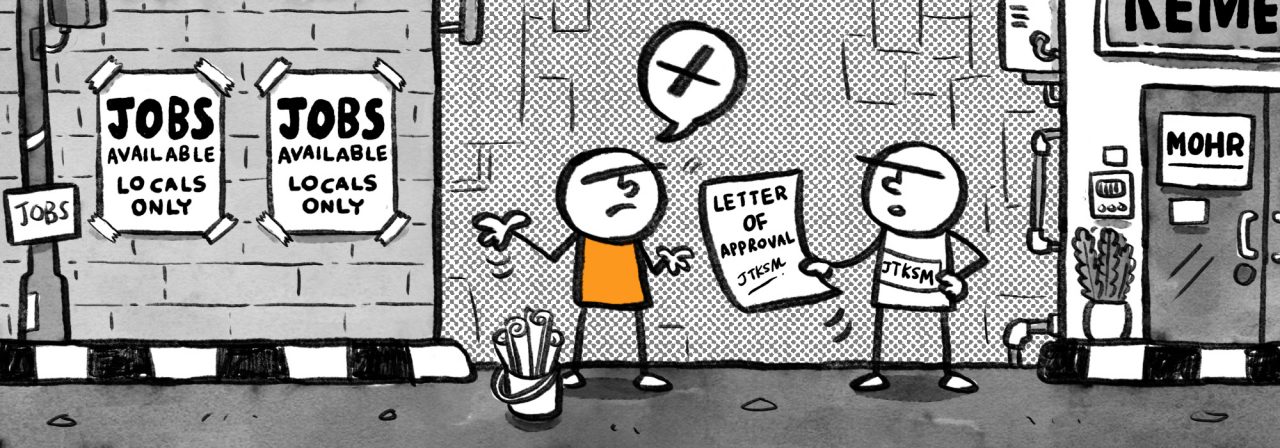
To hire foreign workers, the company first needs to obtain a letter from the Ministry of Human Resources’ (MOHR) Jabatan Tenaga Kerja Semenanjung Malaysia (JTKSM) confirming that they are not able to hire Malaysian workers.*

Part of the process involves putting up a job posting on the JobsMalaysia online portal (replaced by MYFutureJobs on 1 November 2020) to advertise available vacancies to local workers. For several years there was no fixed time period for advertising on JobsMalaysia in order to determine that no Malaysians can fill the vacancies. Companies treated the requirement as a formality and would proceed to apply for foreign workers via MOHR’s Sistem Permohonan Pekerja Asing (or ePPAx) right after posting the vacancies on JobsMalaysia. In June 2020, however, a 30-day mandatory posting period was added through a cabinet decision.

* The approver for Sabah is the Sabah State Labour Department and the Committee for Foreign Workers in Sabah and Labuan, and for Sarawak is the Sarawak State Labour Department.

With the letter from JTKSM, the company can apply for a foreign worker quota from MOHR. The Ministry will approve the application if the company meets the relevant criteria.

This quota is a company-specific quota for a certain position that was posted on  JobsMalaysia which Malaysians could not fill. The job posting allows the company to apply for a certain number of foreign workers for the position. This is the first among two quotas that the company needs to apply for, the second being the one issued by the Ministry of Home Affairs (MOHA). The quotas can also be applied for through a recruitment agency, who may act on behalf of the company throughout the recruitment process.

Once the company has obtained the approval from MOHR, it can apply to MOHA for the Ministry’s foreign worker quota. This is typically an online process via the Foreign Workers Centralized Management System (FWCMS). Once the quota is approved, the company needs to pay the workers’ levy*, the relevant insurance policies, and a security bond.

Quota allocation is determined by MOHA based on a list of approved “source countries” and specific industries in which workers from those countries are allowed to work. Quotas are determined by arbitrary guesstimates based on different industry guidelines. For example, for the plantation sector, guidelines from the Ministry of Plantation Industries and Commodities may indicate 1 foreign worker for every 8 hectares of palm oil plantation, while for the construction sector, guidelines from the Construction Industry Development Board indicate 1 foreign worker for every 3 Malaysians. Meanwhile, in the services sector, 5-star hotels are allowed to hire 1 foreign worker per 12 rooms, while 1-star hotels can hire 1 foreign worker per 30 rooms.

* Introduced in 1992 with multiple increases since, levies were originally imposed on migrant workers in order to cover their use of public services and infrastructures. The levies yielded approximately RM1.75bn to RM2.75bn to the government annually between 2005 to 2014.

Once the relevant quotas have been approved, the company can begin recruiting. However, this is not an easy process. For companies that require the services of a large number of workers, it is logistically challenging and uneconomical for them to internalise the recruitment process. They will instead enter into a contractual agreement with the recruitment outsourcing agency, which will not only help find the migrant worker candidates from the source country, but which will also become the workers’ direct employers. 

To find the worker candidates, the outsourcing agencies typically engage the services of agents that are based in the targeted countries. Upon receiving a request from the destination country, the agents, however, may find it difficult to locate prospective migrants from remote areas and villages; they also charge an upfront recruitment fee and will need to find people who would be willing to pay the fee in order to get hired. To facilitate the process, the agents rely on informal sub-agents to act as intermediaries between them and the prospective workers.

The informal sub-agents assist in the process by vouching for the recruiters and convincing the prospective migrants to migrate. They also assist in the paperwork, passport application, bank account opening, medical check-up, and transportation to the airport for the would-be migrant workers. In some cases they even act as guarantors for the workers who require credit. Many intermediaries are in fact returnee migrants or relatives of prospective migrants who are familiar with the procedures and challenges of migration. This stage of the recruitment process can prove to be costly for the worker, as we will discuss further below. 

Once the services of the workers are secured, the outsourcing agency applies for a Visa With Reference (VDR) at the Malaysian Embassy in the source country so the workers can travel to Malaysia. Upon arrival in Malaysia, the workers have 30 days to undergo a medical checkup by the Foreign Workers’ Medical Examination Monitoring Agency (FOMEMA) Sdn Bhd. 

The medical checkup is usually arranged by the employer. Once the workers have obtained the medical clearance, the employer can then apply for an employment pass called the Visitor Pass (Temporary Employment), or VP(TE). After receiving the VP(TE) the workers can begin their employment in Malaysia. 

Despite this being the formal process, employers can also bypass it through Special Approvals (Kelulusan Khas) from the Ministry of Home Affairs through ministerial approval and ‘intermediaries’. Between 2016 and 2018, a quota totalling 512,315 was approved by MOHA or through special committees, instead of going through JobsMalaysia, which approved 416,510 foreign workers over the same period. Through Special Approvals, 22,901 foreign workers were allowed to work in Malaysian-only sectors and of the 7,784 employers granted Special Approvals, only 1,036 advertised the jobs on JobsMalaysia. 

The employer is also legally liable if the migrant workers abscond and become illegal. Abscondment is reported as the second largest challenge that employers face in dealing with migrant workers, after communication problems. In the event of abscondment, in order to cancel the VP(TE), the employer will need to submit documentation to the Malaysian Immigration Department which includes the foreign workers’ passports

In order to mitigate the risk of abscondment, the passports (and the VP(TE) inside) are often held by the recruitment agency or company, even if the government has made it clear that this an offence under the Passport Act 1966. There have also been reports of employers attempting to compromise by storing passports on premise with the workers keeping the key, in response to pressures from multinational companies. 

The status of recruitment agencies through the years

The legality of recruitment agencies in Malaysia has been subject to numerous policy U-turns. They were first legalised in 1981 through the Private Employment Agencies Act. Due to exploitation, indenture, corruption and fraud, they were subsequently banned in 1995 and were replaced by a Special Task Force on Foreign Labour under the Ministry of Home Affairs as the sole agency responsible for foreign labour recruitment. This signalled a shift to the implementation of a Government to Government (G2G) model*, which centralised foreign worker recruitment in Malaysia. 

Recruitment agencies were re-legalised in 2005 through an amendment to the Private Employment Agencies Act, as lawmakers found that the ban did not solve the problem as foreign workers and employers continued to use the agencies. Moreover, the ban also made it difficult to control unregulated private agencies. This move also enabled outsourcing to be practiced in the recruitment process. From 2010 onwards, however, the government phased out outsourcing firms and reverted to the G2G model. This policy shifted again in 2012 as a result of the amendment of the Employment Act 1955, through which the concept of “contractor for labour” was invented. 

During its tenure, the Pakatan Harapan government announced that outsourcing agencies would be abolished by March 2019 and companies would need to absorb the workers who they employed via the agencies. Whether or not the policy is still in place, however, is not clear. At present, due to the ongoing COVID-19 pandemic, the Perikatan Nasional government has introduced a freeze on the hiring of foreign workers.

* G2G agreements and MOUs between Malaysia and the source country are usually signed in order to cut out the exorbitant fees charged by recruitment agents from the hiring process.

The cost of working abroad for a migrant worker in Malaysia

For a migrant worker to come and work in Malaysia, a hefty amount needs to be paid. Recruitment agencies and sub-agents may charge each worker an upfront recruitment fee  that can be multiples of the actual cost of the expenses it is meant to cover. A large proportion of the workers end up having to sell land or property or take on debt to finance the migration at usurious rates.

Alternatively, recruitment agencies may bear the cost of recruitment, but often recoup the outlay through salary deductions once the workers have been outsourced to other companies. These fees are only meant to be paid once; however, researchers have found that some agents in the source countries double-dip, claiming the same expenses from both the worker and the employer in Malaysia. 

Many migrant workers become indentured as a result of this. If a worker comes to Malaysia to work for an average salary of RM1,000 a month, the indenture would be worth 20 months wages in the case of a Bangladeshi, 5-6 months for a Nepali, and 2-3 months for an Indonesian. For Nepalis and Indonesians, there is some semblance of financial viability with extreme scrimping. However, the reality is that Indonesian maids have reported needing to pay 6-10 months of their wages to recruitment agencies. For Bangladeshis, the payback is gravely uncertain because the VP(TE) is only issued for 12 months with a possibility of additional 12-month extensions for up to 10 years, which are not guaranteed. Taking into account living costs, interest on the loan, potential employer salary deductions and a reasonable profit, there is a built-in assumption that Bangladeshi migrant workers will need to work in Malaysia continuously for several years, whether legally or otherwise, before seeing any semblance of a financial return. 

The Case For A Fair Work Act, Part 2

Rapid digital transformation has changed the power relationship between employers* and workers, creating new employment categories in its wake and eroding the relevance of current labour laws. Building on the Oxford Internet Institute’s Fair Work Initiative as well as global research efforts to classify today’s workers, Part 1 of our research series argued for updating Malaysia’s employment categories in order to reflect today’s inherent power relationships, and to outline what is owed to workers of each category.

*Note: The term ‘employer’ is used broadly throughout this piece, representing the party that either employs the worker or is the intermediary for the supply of jobs.

In this Part 2 of the research series, we focus on a major pillar of Fair Work as per the Oxford Internet Institute, namely fair pay. What does fair pay mean in the context of a law describing Fair Work in Malaysia? And how would it apply to the different power relationships between employers and workers that we see today?


Economic fairness vs. moral fairness?

In 1965, shortly before the United States government adopted the first federal definition of the poverty line, one of its policy drafters Mollie Orshansky wrote: “There is not, and indeed in a rapidly changing pluralistic society there cannot be, one standard universally accepted and uniformly applicable by which it can be decided who is poor. … If it is not possible to state unequivocally ‘how much is enough,’ it should be possible to assert with confidence how much, on an average, is too little.”

The term ‘fair pay’ usually suggests an equitable level of compensation for a specific job. Going by this framing, the basis of fair pay becomes founded on the idea of that job’s value contribution to a good or service. This primarily economic idea of fairness leads to policies emphasising the linkage of wages to productivity, which assumes that low wages can be increased or avoided if the job’s productivity is calculated and if the job is made more value-adding. 

While the concept of productivity-linked wages appears principled, in reality, it is tested by the challenge of measurement. An assembly line worker’s output can be measured by units assembled per hour but how much is the productivity and value contribution of a cleaner and what is the commensurate level of compensation for that job? What about for a security guard?

The question of fair pay by occupation, sector, paper qualification or productivity calculation has its place in policy discussions and in union negotiations, but we argue that it is not the core problem in question for this piece. 

Instead, the idea of fair pay in the context of fair work legislation is primarily one of moral judgement. Going back to Mollie Orshansky above, it is about asserting with confidence how much is too little, i.e. how much is a societally acceptable level of compensation for working a customary number of hours a month, regardless of the job performed? How much is the amount, where coming below the said figure would be considered humanly exploitative and warranting of legal penalties? Going by this framing of the issue, the basis of fair pay becomes founded on the idea of a minimum living wage and non-wage benefits – i.e. how much is the minimum needed to live on.

As will be argued, the gap between this idea and what is currently practised underpins the need for a revised conception and administration of fair pay in Malaysia.


Of formulas and consultations

Historically, governments have established a minimum income floor by enacting minimum wage laws. Along with the statutory wage laws, each country has a regulatory infrastructure or process by which to revise the minimum wage periodically. Figure 1 below shows a brief cross-country comparison of minimum wage regimes.

Figure 1: Selected Cross-Country Comparison of Minimum Wage Regime

Sources:
Malaysia – Minimum Wages Order 2020; National Wages Consultative Act 2011
China – Employment Law Overview China 2019 – 2020 by L&E Global
United Kingdom – UK’s National Minimum Wage Act 1998
Australia – Australia’s Fair Work Act 2009

As stated in Figure 1, countries’ minimum wage regimes differ in several key respects such as coverage. The minimum wage may not cover all workers and can exclude or be silent on coverage for informal or self-employed workers. Many governments set minimum wages federally or nationally, though countries like China favour local government setting of minimum wages. In many countries, final authority to decide on the minimum wage resides within the responsible ministry or government department, whereas some like Australia have established a commission by law to set the minimum wage. Revisions to the minimum wage level appear based on a combination of formula, research and stakeholder consultation, though the level of transparency on each of these varies from country to country.

In Malaysia, the advent of the minimum wage is a fairly recent phenomenon – the first minimum wage was enforced in 2012. Before that, wage levels were regulated by the Industrial Relations Act 1967 and the Wages Councils Act 1947, where wage rates were determined through collective bargaining for unionised workers and work councils for non-unionised workers.

When a key 2009 study found that over one-third of private sector workers earned less than the national poverty line, the government resolved to set up the National Wages Consultative Council (NWCC) via the National Wages Consultative Council Act 2011 to develop and advise on the national minimum wage. One year after the founding of NWCC, the government implemented the first minimum wage via the Minimum Wages Order 2012 with the announced aim of helping to eradicate poverty and ensure workers can meet the rising costs of living.

The National Wages Consultative Council (NWCC) is a tripartite working group set up to study all matters concerning minimum wages and to give recommendations to the government for making or revising the Minimum Wages Orders according to the sector, type of employment and regional area.

According to the NWCC Act 2011, the council shall consist of the following members who shall be appointed by the Minister of Human Resources:

1. A Chairman
2. A Deputy Chairman
3. A Secretary
4. At least 5 public officers from the Ministry of Finance, the Public Service Department, the Ministry of International Trade and Industry and the Economic Planning Unit
5. At least 5 members representing employees
6. At least 5 members representing employers
7. At least 5 members representing independent members

Source: International Labour Organisation (2018)

The first minimum wage level was set at RM900 a month for West Malaysia and RM800 a month for East Malaysia. Any employer who fails to comply with the minimum wage law can be punished by paying the worker the sum owed as well as a potential fine of not more than RM500 per offence. Editor’s note: A low amount on the surface, in comparison to other fines in Malaysia’s statutes.

Since 2012, the government has increased the minimum wage level to RM1,200 a month for 56 cities and municipal council areas and RM1,100 a month for other areas. Despite these revisions, experts and worker unions still think the current amount is too low to live on adequately. In partial response, the former Human Resources Minister had said in 2019 that the government was considering a sectoral-based minimum wage, which is where the question of minimum wage setting still stands today, after the change in government and the onset of the COVID-19 pandemic in early 2020.

Non-wage financial benefits* in Malaysia are covered by social security acts mandating employers to protect their employees against future financial risks, the key ones being employer monetary contributions to employees’ retirement savings and unemployment insurance. Today, the Employee Provident Fund (EPF) Act 1991 requires all employers to contribute 11-12% of their employees’ base salaries for retirement savings while the Employment Insurance System (EIS) Act 2017 requires employers to contribute a set amount into a national unemployment insurance program for full-time employees. Although informal workers are not eligible for any employer contributions for EPF or EIS, they are allowed to contribute into the self-employed versions of these schemes voluntarily, and on their own initiative.

*Note: Social protection schemes relating to workplace safety and accidents like SOCSO, and reskilling like HRDF, will be discussed in our next article on ‘fair conditions’.

To date, there is no law in Malaysia mandating employers to contribute to workers’ healthcare insurance; provision of private healthcare insurance by companies is mostly due to market norms. To a large extent, the mandating of healthcare insurance by law is driven by the characteristics of a country’s healthcare system. Countries such as Singapore, Thailand and China mandate eligible employers to contribute into a national healthcare insurance scheme for every eligible worker (much like our EPF scheme) while countries like the USA mandate eligible employers to provide company-sponsored health insurance or subsidise their employees’ private health insurance premiums.


What are the current gaps?

Although Malaysia has a legal framework to govern workers’ wages and benefits, there are key gaps in definition and administration that put us some way from achieving the notion of ‘fair pay’. Given the significant role of the minimum wage laws in achieving ‘fair pay’ in Malaysia, this piece focuses on the limitations of the current wage framework and reserves discussion on non-wage compensation such as retirement contributions in future related pieces.


Vague rationale for minimum wage

Currently, Malaysia’s minimum wage levels are determined through a combination of formula application and stakeholder consultation. The NWCC’s website states that the setting of the minimum wage rates are based on factors affecting workers’ ability to make ends meet, such as the national poverty line, the median income, productivity growth, inflation and the unemployment rate. A technical committee under the NWCC conducts calculations, industry sensitivity tests and consultations with stakeholders, after which proposed options for the minimum wage are debated amongst members of the NWCC. The agreed upon minimum wage range is then proposed to the Minister of Human Resources and the Cabinet for the government’s decision. 

It is unclear whether the core basis of the minimum wage is driven by the question of the minimum needed to live in today’s society, or by the question of what industry can or is prepared to bear. The NWCC website states two potentially competing aims of ensuring employees are able to meet basic needs as well as providing a conducive environment for industrial production. 

The current formula suggests that Malaysia’s minimum wage setting takes into consideration the national poverty line, median income, inflation rate, unemployment rate and productivity growth. However, as mentioned above, experts and worker unions still think the current minimum wage is too low to live on adequately. The significant difference between the current minimum wage (RM1,200 for Kuala Lumpur & major cities) and estimates for the real living wage (BNM’s RM2,700 for Kuala Lumpur & major cities and SWRC’s reference budget of RM1,870 for an unmarried public transport user in Klang Valley) implies that either the formula needs improvement or that employer readiness plays a more significant role in deciding Malaysia’s national income floor.

Read our past primer on minimum wage vs. living wage.


Opaque review and decision-making process

While there are broad guidelines under the current framework, there is a lack of transparency in how the review of the minimum wage level is conducted and what factors drive decision-making. The recommendations of the NWCC, including its supporting calculations and information sources are not published for public comment or information. The deliberations on these recommendations and the rationale for the government’s final decision are also not published.


Increasingly outdated policy paradigm

As outlined in Part 1, the emerging trend of labour informalisation makes policy frameworks that revolve around formal full-time employment increasingly obsolete, including minimum wage laws. Even if the official minimum wage were to be sufficient to cover local costs of living, its enforcement would still be limited to full-time or part-time formal employees only – a declining employment category in an era of digitalisation and contract or ‘gig’ employment. To ensure that all workers who work a stipulated number of full-time or part-time hours receive the fair minimum pay, new employment categories would need to be established (such as dependent contractors) and would need to be thoughtfully integrated into current minimum wage laws.

Finally, the acute hardships caused by the COVID-19 pandemic on low-waged income earners have shown how policy frameworks that focus on employer affordability are increasingly insufficient and siloed. Minimum wage policy needs to be compatible and consistent with a national policy on social safety nets. In this past year of COVID-19 we have seen the government implement both ad hoc measures such as wage subsidies as well as more established Bantuan Sara Hidup household cash transfers (or its pandemic-times name, Bantuan Prihatin Rakyat) to supplement low or interrupted incomes. This same approach should be a cornerstone of a long-term social safety net policy post-COVID, where minimum wages and non-wage financial contributions by employers plays the role it is intended to accomplish, in tandem with wage support, household income support and reskilling schemes by the government.


A clear, viable policy for fair pay

To reiterate, the core policy question on fair pay in the context of this piece is about determining the minimum amount owed to a worker for a specified (and conventional) number of hours worked. To close the gaps in doing so, we propose the following:


A societally acceptable level for the minimum wage

What is the purpose of a national minimum wage? If it is to ensure that workers can meet a minimum reasonable cost of living – which we argue is the foremost purpose – the minimum wage should be researched, calculated and set at the level of a minimum living wage for the locality. 

There will surely be debates around what is a societally acceptable definition of a minimum living wage and minimum living conditions but at the very least, Malaysians would be clear that the minimum wage, in principle and in law, is set at a level that does not come below the poverty threshold or other benchmarks of misery or exploitation. Future revisions of the minimum wage would be mostly reflective of changes in the consumption basket, inflation, and the level of local economic development.


A transparent review and decision-making process

Setting the minimum wage, even to the level of a living wage, will likely continue to be a negotiation between application of a formula as well as appeals from stakeholders. While we aspire to the level of independence in Australia’s minimum wage set-up, particularly in the autonomy of the Fair Work Commission, as a medium-term measure we advocate emulating the transparency of that same commission.

The details of the annual minimum wage review process and data sources should be made public including the formula or calculation for the minimum wage, any research papers commissioned to amend or update the formula, counter-proposals from stakeholders, proceedings from stakeholder engagement sessions, to name a few. Instead of closed-door discussions, we strongly advocate for these key information to be published and for the government to explain discrepancies between NWCC’s minimum wage proposals and the government’s final decision on the minimum wage. These pieces of information can then be constructively debated in Parliament by elected representatives (when Parliament reconvenes).


An updated policy paradigm of wages and social safety nets

With new forms of employment mushrooming in the fast-changing labour market, the eligibility criteria for earning a fair minimum wage and benefits should not only be limited to those in formal employment. As argued above, the minimum wage should apply to all worker categories, unless there are sectoral or practical obstacles barring its implementation (in which cases wage or income support kicks in).

In Part 1, we argued for the establishment of 3 major employment categories to reflect 3 major underlying power relationships: employees, dependent contractors and independent contractors. As per current laws, all formal employees who contribute full-time hours should earn a minimum living wage and have non-wage financial benefits such as employer contributions to EPF and EIS. 

For dependent contractors, we propose that those who work the equivalent of full-time hours should also earn incomes not less than the minimum living wage. Independent contractors meanwhile have the highest degree of job autonomy and control; workers in this category should have sufficient means and capacity to negotiate for rates and fees above the minimum living wage but for additional information and know-how support, should also be supported by collectives supporting independent contractors and solopreneurs.

Some countries have created a tiered minimum wage system to account for younger workers, apprenticeships, hours worked and other material circumstances.

In the United Kingdom, workers younger than 23 years old and workers in apprenticeship have separate minimum wage levels. Australia adopts a different approach by offering special provisions known as modern awards in addition to the statutory wage law to set sectoral/occupation-based minimum wage and employment conditions. To accommodate flexible working hours, some state governments in the United States have enabled those working full-time hours or more in a week to earn a premium payment on top of their minimum wage.


Anticipated Issues

At the time of writing, the debate* about raising the minimum wage to the living wage level is increasing across the world in the United States, Indonesia, and more. In Malaysia, the COVID-19 pandemic has highlighted the struggles of many low-income Malaysians to make ends meet, exposing the inadequacy of our current minimum wage, both in amount and in coverage. While the government promises a review of the minimum wage, we argue that its definition, administration and policy paradigm needs to undergo a significant change.

*Note: Debate amongst economists on the effects of raising the minimum wage have come a long way from mostly negative to mixed, based on empirical evidence showing little impact to employment upon modest increases (paywall).

Implementing a local living wage as the minimum wage in one stroke will very likely not be possible or even advisable. The difference between the current minimum wage and the revised poverty line (not to mention various proposals of local living wage figures) is very large, and there will be serious and legitimate concerns regarding companies’ ability to pay, especially SMEs. Raising the minimum wage has to be done in stages. To further support the transition to a minimum living wage regime, the government may also institute sectoral exemptions to reflect the cost of living in specific working environments such as oil palm plantations, as well as targeted, temporary wage subsidies for qualifying companies with clear criteria.

Extending minimum wage coverage to all workers will also not be straightforward. One challenge is in determining numbers of hours worked for certain types of dependent contractors, for example gig platform workers. Should hours spent on the platform app be equated to hours worked or would this result in ‘gaming the system’? There is as yet no answer to this question, and many other practical nuts-and-bolts questions of implementation. But if ensuring fair pay for all workers, including informal workers, is something we consider not only societally acceptable but also societally important, we should ensure that the principle is agreed upon, and that time and effort are invested towards resolving the practical issues.

Beyond earning a living wage, what other factors constitute Fair Work? We take up fair working conditions and fair contracts in the next instalment of this research series.

Email us your views or suggestions at editorial@centre.my

A Year of Living Under COVID-19

In February this year, we began a study to assess the effects of the then year-long pandemic on Malaysians’ mental health. At the time, a second nation-wide lockdown had just been declared. Data for this mental health study was collected via online survey which reached nearly 1,000 respondents from across the country*.

*Respondents’ mental health was measured by their responses to the DASS-21 questionnaire. For more details on how the DASS-21 questionnaire was applied, respondent demographics and the study’s overall methodology, please refer to Part 1. Please note that this is not a nationally representative stratified sample.

A descriptive analysis of the data was published in three parts, each tackling a different aspect of the general deterioration experienced over the past year. Part 1 showed that over half of surveyed respondents experienced worsened mental health over the past year. Women and youths self-reported lower mental health levels compared to other demographic groups. There was also a clear relationship between physical and mental well-being; those who reported worsened physical health over the past year also experienced worsened mental health.

Part 2 explored the impact of living arrangements and social connection on mental well-being. Social isolation appeared to be a factor; respondents who live alone self-reported worse mental well-being compared to those who live with others. Additionally, respondents who work from home every day also appeared to have worse mental health levels compared to those who worked from home less often.

Part 3 looked at the impact of changes to employment and income on mental well-being. The unemployed appeared most vulnerable mental health-wise, and similarly for part-time employees. Respondents earning less than RM 5,000 also appeared to experience worse mental well-being relative to other income groups.

In this fourth and final instalment of the research series, we sought to understand which of the variables included in our study were the most statistically significant in driving high scores in depression, anxiety and stress levels. We conducted a multiple variable analysis on the data set, using multiple linear regression.

Regression analysis is a statistical method used to determine the strength of the relationship between a dependent variable (in this study, self-reported mental health scores) and one or more independent or predictor variables (for example, age, gender etc.) in a regression model. Multiple regression analysis allows us to determine the relative contribution of each of the predictor variables to the model, in order to identify the most significant predictors.

Results of the Multiple Variable Analysis

The multiple variable analysis on our data set found age and gender as highly significant predictors of depression, anxiety and stress while marital status is a highly significant predictor of depression and anxiety (Table 1). Other significant predictors are change in income and level of household income. Comparatively, other variables such as living alone (i.e. household occupancy) and working from home frequency were not as significant as suggested by the descriptive analysis.

Table 1: Predictors of mental well-being

With respect to age, there is a very significant likelihood that people aged 35 years and younger are experiencing worse mental health in terms of depression, anxiety and stress levels compared to older age groups. Uncertainty over future prospects, financial distress, social isolation and lack of quality sleep have been attributed as the likely causes by a global cross-sectional COVID-19 and well-being study published this year.

As for gender, there is a very significant likelihood that women have worse depression, anxiety and stress levels compared to men. A study published last year exploring the impact of the pandemic on women shows that gender-related challenges such as parenting challenges, uneven distribution of domestic care and the increased risk of domestic violence are some of the key contributors to women’s mental health difficulties.

Marital status is a very significant predictor of negative mental health as well; there is a very significant likelihood that people who are single during the pandemic have worse depression and anxiety levels compared to those who are married. A relationship quality and COVID-19 study published last year showed that single individuals had poorer mental health compared to those who were in relationships of good quality. This is supported by a social relationships and health study that showed how social support systems and a sense of meaning found in relationships led to better mental health and health behaviours overall.

Change in income is a significant predictor for depression, anxiety and stress. Based on our data set, there is a significant likelihood that a fall in income over the past year is accompanied by higher levels of depression, anxiety and stress compared to an increase or no change in income levels.

The absolute level of household income is a significant predictor for anxiety; there is a significant likelihood that individuals with household incomes less than RM5,000 experience higher anxiety levels compared to those with higher household incomes.

In Part 2, we discussed the impact of social isolation on self-reported mental health scores, particularly in those living alone and those who work from home (WFH) daily. Although the descriptive analysis showed a somewhat clear pattern in negative mental health scores, the variables of household occupancy and WFH frequency were only weakly significant as predictors of negative mental health.

Employment status (e.g. whether full-time, part-time or unemployed), number of financial dependents and availability of personal space were not included in the regression model as these variables were highly correlated with some of the above-mentioned variables and were very weakly significant in explaining the patterns observed in negative mental health scores.

Conclusion

At the time of this writing, a full national lockdown had just been declared as it became clear that the third Movement Control Order then underway was not enough to bring down the rate of virus transmission. With case numbers breaching 9,000 a day, it is hard to visualise better days. But if we look to the history of past global pandemics and if the necessary precautions are taken, we can reasonably hope that the current worrying situation will gradually abate over the next one to two years.

However, we remain concerned about the long-term implications of the pandemic, beyond the immediate crisis. COVID-19 and successive lockdowns have amplified and exacerbated problems latent in Malaysian society, including widespread mental health challenges

Our study found that young people, women, unmarried Malaysians and those with reduced incomes are the ones most likely to have negative mental health after the year-long pandemic (and counting). These findings are generally consistent with other mental well-being studies, both local and worldwide.

These are groups that require particular mental health outreach and support, now and after the pandemic, alongside the various measures of economic support that have been announced. It is crucial that these groups are intentionally targeted for mental health support services by the government and civil society.

In addition, it is also necessary to have institutional reform. We have to rethink how existing ministries and agencies are involved in mental health support. Although the Ministry of Health leads public mental health, mental health support and services are fragmented across different ministries, such as the Ministry of Women, Family and Community Development and the Ministry of Education. There is a need to rebalance assistance budgets in relevant ministries to ensure greater recognition for and a higher level of support for mental health modules within various existing socioeconomic assistance and relief programmes.

There is also an argument for decentralising service provision and resources, and empowering regional and local authorities to address healthcare issues based on detailed local knowledge and contexts, particularly amongst vulnerable populations.

The fallout of the COVID-19 pandemic will be felt for many years, or even decades, to come. We need to address these very real social challenges now, if we are serious about helping Malaysians navigate their way safely into the post-pandemic future.

Academics and researchers interested in the data and further details of this research project may contact the principal researcher at aziff@centre.my.

Generasi Berhutang

Bagaimanakah rakyat Malaysia membiayai pendidikan tinggi mereka? Bagi sebahagian besar generasi muda sekarang, jawapannya adalah melalui pinjaman pendidikan.

Hutang pendidikan merupakan sesuatu kebiasaan dan keunikan dalam kalangan generasi yang belajar di Institusi Pengajian Tinggi (IPT) dalam alaf baru ini. Ianya menjadi suatu kebiasaan disebabkan pengambilan pinjaman pendidikan secara meluas yang dikeluarkan  oleh Perbadanan Tabung Pendidikan Tinggi Nasional (PTPTN), badan berkanun yang telah diwujudkan untuk menawarkan pembiayaan pendidikan tinggi dengan kos faedah rendah. Menurut sebuah laporan Agensi Kaunseling dan Pengurusan Kredit (AKPK) pada 2018, hutang pendidikan adalah hutang kedua yang paling biasa diambil dalam kalangan belia berusia 20-29 tahun.

Pada masa yang sama, hutang pendidikan juga unik bagi segenerasi rakyat Malaysia masa kini. Tidak seperti generasi terdahulu, golongan belia masa kini memikul beban hutang yang berat sebelum memasuki alam pekerjaan. Kami menganggarkan bahawa secara purata, pelajar yang mendaftar di universiti awam tempatan atau universiti swasta tempatan hari ini akan mengumpul hutang pendidikan masing-masing sebanyak RM26,600 dan RM56,120 untuk pengajian ijazah yang memakan masa empat tahun.1

Antara sebab yang telah meloncatkan populariti pinjaman pendidikan termasuklah pengembangan rangkuman pembiayaan jenis dan tempoh kursus dan pertambahan kelayakan jumlah institusi pendidikan tinggi swasta. Walau bagaimanapun, peningkatan beban hutang pendidikan juga telah didorong oleh pengurangan pulangan dari pendidikan tinggi. Menurut sebuah laporan terbaru dari Jabatan Perangkaan Malaysia, “graduan baru telah mencatatkan penurunan pendapatan bulanan di mana majoriti daripada mereka memperoleh antara RM1,001 hingga RM1,500 pada tahun 2020 berbanding RM2,001-RM2,500 pada tahun 2019.”

COVID-19 juga sememangnya memainkan peranan utama dalam perkara ini, tetapi sebelum penularan wabak ini, graduan baru telah pun menghadapi prospek pekerjaan yang tidak menentu, pasaran pekerjaan yang tidak sepadan dengan bidang pengajian, dan genangan gaji. Pada masa ini, impian untuk menikmati mobiliti sosial melalui pendidikan tinggi semakin kurang terjamin berbanding beberapa dekad yang lalu bila jumlah graduan dalam pasaran pekerjaan jauh lebih berkurangan.

Hampir dua tahun lalu kami telah menerbitkan primer tentang topik kos pendidikan tinggi di Malaysia yang telah memberikan gambaran umum mengenai yuran pendidikan dan kaedah pembiayaan. Kali ini, kami mengkaji strategi utama dasar nasional Malaysia dalam pembiayaan pendidikan tinggi, iaitu pinjaman pendidikan, untuk menjawab persoalan mengenai kelestarian dan kerelevanan jangka panjang dasar ini. Sebagai permulaan, kami meneliti sejarah pengasasan dasar ini.

1Mengikut jadual pinjaman PTPTN, jumlah tersebut diperolehi dengan mengira jumlah pinjaman penuh untuk kursus ijazah pertama selama empat tahun berdasarkan pengagihan (disbursement) tahunan yang berkelayakan bagi setiap pelajar IPTA / IPTS.

Pendidikan tinggi (dan pinjaman pendidikan) untuk semua

Pada awal tahun 1980-an, dua pertiga pelajar yang mendaftar di universiti awam Malaysia (terdapat hanya 5 universiti awam di Malaysia pada ketika itu) dibiayai oleh biasiswa kerajaan yang dianugerahkan oleh Jabatan Perkhidmatan Awam (JPA) atau oleh badan berkanun yang lain.2 Sebilangan kecil pinjaman pendidikan ditawarkan oleh agensi kerajaan seperti JPA dan Majlis Amanah Rakyat (MARA).3

Peralihan kepada pinjaman pendidikan sebagai kaedah utama untuk membiayai pendidikan tinggi bermula pada tahun 1990-an, didorong oleh tujuan untuk meningkatkan enrolmen di peringkat pendidikan tinggi dengan cepat dan menghasilkan tenaga kerja yang berpendidikan. Dasar ini lahir dari Dasar Persyarikatan Malaysia (atau Malaysia Incorporated) yang dimulakan oleh Perdana Menteri ketika itu, Tun Dr. Mahathir Mohamad. Tujuannya adalah untuk mengurangkan pergantungan pada sumber kerajaan, dan meningkatkan peranan syarikat swasta sambil mempromosikan kemajuan ekonomi Bumiputera.4

Umumnya, dua perubahan yang berkaitan berlaku pada masa itu – pengkorporatan universiti awam5 dan perkembangan institusi pengajian tinggi swasta yang pesat.6 Perubahan ini mewujudkan lebih banyak tempat pengajian di institusi pendidikan tinggi. Akan tetapi, ia juga telah meningkatkan kos pengajian. Hal ini juga telah menjadi isu politik yang hangat, terutamanya berkenaan keupayaan terhad pelajar Bumiputera untuk membayar yuran pengajian yang tinggi.7

Dengan demikian, idea pinjaman pendidikan sebagai dasar penyelesaian telah diperkenalkan, yang membawa kepada pembentukan badan berkanun PTPTN pada tahun 1997. Pada awalnya, PTPTN memberikan pinjaman pendidikan kepada 11 universiti awam (IPTA) dan beberapa universiti swasta (IPTS) yang dimiliki oleh beberapa syarikat berkaitan kerajaan (GLC).8 Permintaan untuk pinjaman pendidikan PTPTN juga telah meningkat, disebabkan kelulusan pinjaman yang mudah dan kadar faedah yang rendah.

Pada awal 2000-an, kelayakan pinjaman diperluaskan kepada pelajar dari institusi pendidikan tinggi swasta, termasuk kampus cawangan tempatan universiti luar negara. Selain memberikan pinjaman kepada pelajar dari lebih banyak institusi, PTPTN juga telah mula memberikan pinjaman bagi pengajian peringkat diploma dan sarjana.

Rajah 1 menunjukkan lonjakan jumlah bilangan pinjaman PTPTN yang diluluskan setiap tahun sementara Rajah 2 menunjukkan kenaikan jumlah amaun pinjaman PTPTN yang diluluskan setiap tahun. Lebih ketara lagi,  amaun pinjaman PTPTN yang diluluskan untuk pengajian di institusi swasta melebihi amaun yang diluluskan untuk pengajian di institusi awam sejak 2007 (lihat Rajah 2), walaupun jumlah pinjaman yang diluluskan, atau jumlah peminjam, untuk institusi awam tetap lebih tinggi daripada institusi swasta (lihat Rajah 1).

Rajah 1: Bilangan Pinjaman PTPTN yang Diluluskan, 2000-2018

Rajah 2: Jumlah Amaun Pinjaman PTPTN yang Diluluskan, 2000-2018

Sumber: Laporan tahunan PTPTN, buklet Info PTPTN, dan laporan “Kelestarian Skim Pinjaman PTPTN” oleh Penang Institute.

2 Mehmet, O., Hoong, Y.Y. “An empirical evaluation of government scholarship policy in Malaysia,” Higher Education 14, 197–210, 1985.
3 JPA telah menamatkan penawaran pinjaman pendidikan beberapa tahun selepas PTPTN ditubuhkan untuk mengelakkan pertindihan fungsi. Peruntukan JPA telah dipindahkan ke PTPTN, yang mengambil alih peranan sebagai penyedia pinjaman pendidikan yang utama.
4 Lihat “Introduction” in the Privatization Master Plan 1991. Lihat juga Khoo Boo Teik, Beyond Mahathir: Malaysian Politics and its Discontents. Zed Books, 2003.
5 Universiti-universiti yang dikorporatkan dijangka dapat menambah dan mempelbagaikan sumber pendanaan mereka melalui pelbagai kegiatan yang dapat menjana pendapatan seperti perniagaan, menawarkan lebih banyak program yang dapat dikomersialkan, dan meningkatkan yuran pengajian untuk mengurangkan pergantungan pada peruntukan kerajaan. Untuk perincian, lihat: Molly Lee (1998), “Corporatization and privatization of Malaysian higher education.” International Higher Education, 10.
6 Penubuhan universiti swasta, penaiktarafan kolej swasta menjadi kolej universiti dan universiti, dan jemputan kepada universiti negara asing untuk mendirikan kampus cawangan di Malaysia telah dibolehkan melalui undang-undang, polisi-polisi dan badan-badan baharu yang dibuat untuk memfasilitasi perkembangan industri pendidikan tinggi pada tahun 1990-an.
7 Dalam beberapa Perhimpunan Agung UMNO pada pertengahan 1990-an, para perwakilan telah membawa isu enrolmen pelajar Bumiputera yang rendah di IPTS. Di samping itu, mereka memberi amaran bahawa sekiranya universiti awam dikorporatkan, pelajar Bumiputera akan terkesan akibat kenaikan yuran pembelajaran.
8 Oleh kerana enrolmen pelajar Bumiputera di IPTS sangat rendah, pinjaman PTPTN untuk IPTS hanya diberikan kepada pelajar Bumiputera dalam beberapa tahun pertama operasi badan tersebut.

Impak dan beban yang tidak dijangka

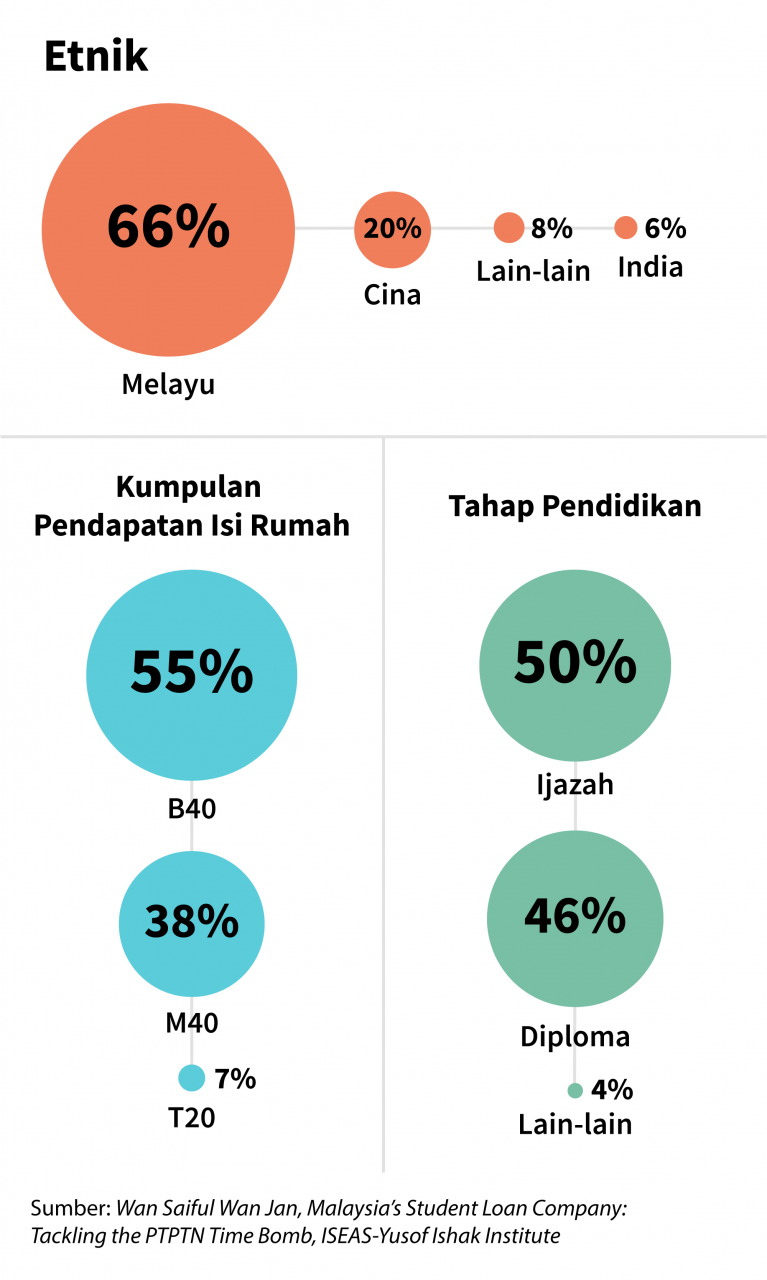
PTPTN ditubuhkan untuk meluaskan akses ke pendidikan tinggi, terutamanya untuk belia dari isi rumah berpendapatan rendah hingga pertengahan. Dari segi pinjaman yang telah diagih, PTPTN telah pun hampir mencapai misi ini. Rekod PTPTN antara tahun 2014-2018 menunjukkan bahawa 66% daripada semua peminjam adalah golongan Bumiputera dan 55% dari semua peminjam tergolong dalam isi rumah B40 (lihat Rajah 3). Taburan jumlah pinjaman hampir sama rata antara mereka yang meminjam untuk membiayai program ijazah dan program diploma.

Rajah 3: Demografi peminjam PTPTN, 2014-2018

Walau bagaimanapun, dua isu yang besar dan tidak dijangka telah menjadi semakin ketara sejak penubuhan PTPTN. Isu yang pertama ialah jangkaan peningkatan mobiliti sosial yang tidak menjadi kenyataan.

(i) Pulangan dari pendidikan tinggi

Premis asas pemberian pinjaman pendidikan adalah kemampuan peminjam untuk membayar balik berkat potensi pendapatan yang lebih tinggi yang datang daripada pencapaian tahap kelayakan pendidikan tinggi. Pada tahap makro, anggapan ini seolah-olah benar; pendidikan tinggi masih mendatangkan gaji median yang lebih tinggi secara keseluruhan berbanding dengan pendidikan menengah dan rendah, seperti yang ditunjukkan dalam Rajah 4.

Rajah 4: Gaji Median Mengikut Tahap Pendidikan

Sumber: Laporan Survei Gaji & Upah, 2014-2019, Jabatan Perangkaan Malaysia.

Tetapi, jika kita meninjau secara mendalam di sebalik angka-angka aras tinggi ini, kita boleh menyimpulkan bahawa pulangan dari pendidikan tinggi tidak diagihkan secara sama rata. Ketidaksepadanan tenaga kerja dan genangan gaji dapat dilihat dari data pendapatan dan pengangguran peminjam PTPTN.

Kajian Pengesanan Graduan Malaysia (SKPG) 2018 menunjukkan bahawa hampir 60% graduan menganggur atau kekal menganggur setahun selepas tamat pengajian mereka. Daripada bilangan siswazah yang menganggur ini, separuh mempunyai pinjaman pendidikan untuk dibayar balik.9 Dalam kalangan  mereka yang bekerja, tinjauan tahun 2019 mengenai peminjam yang disurvei oleh PTPTN mendapati bahawa lebih daripada satu pertiga  responden mereka berpendapatan di bawah RM2,000 sebulan.10

Pilihan kursus atau program pengajian nampaknya tidak menjelaskan mengapa sebilangan peminjam menghadapi nasib yang lebih teruk daripada yang lain. Tinjauan yang dilakukan oleh Parti Keadilan Rakyat (PKR) pada tahun 2013 mendapati bahawa lebih sedikit daripada separuh dari 1,053 responden dari pelbagai bidang pengajian dan jurusan berpendapatan di bawah RM2,000.11 Walaupun kerajaan menggalakkan kursus sains dan teknologi berbanding kursus kemanusiaan12, tinjauan itu mendapati bahawa majoriti merasa dibebani oleh hutang pendidikan mereka tanpa mengira bidang pengajian.

Lebih serius lagi, kombinasi isu jangkaan pendapatan lebih tinggi yang tidak direalisasi dan beban hutang pendidikan paling menjejaskan peminjam dari golongan B40. Kajian PTPTN sendiri menunjukkan bahawa 97% penghutang lalai yang ditinjau berasal dari kumpulan pendapatan B40.13 Menurut golongan penghutang lalai ini, komitmen hutang yang tinggi dan pendapatan rendah adalah sebab-sebab utama mereka tidak membayar balik pinjaman; kurang daripada 10% mengaitkan kekurangan pembayaran mereka dengan tindakan protes atau kelemahan kaedah pungutan hutang oleh PTPTN. Jelaslah di sini bahawa mobiliti sosial untuk peminjam B40 tidak terjamin melalui pencapaian kelayakan pengajian tinggi.

Selain daripada mobiliti sosial, timbul juga persoalan berkenaan kesaksamaan. Lazimnya peminjam dijangka habis membayar balik pinjaman dalam masa 20 tahun atau kurang, tetapi PTPTN membenarkan mereka untuk merundingkan penstrukturan semula pinjaman dan memanjangkan tempoh bayaran balik sehingga mereka mencecah umur 60 tahun.

Jika peminjam menangguhkan bayaran balik atau menstruktur semula pinjaman mereka (contohnya dengan membayar ansuran bulanan yang lebih rendah untuk tempoh yang lebih lama), akhirnya mereka akan membayar lebih banyak faedah berbanding dengan peminjam yang berpendapatan tinggi dan berupaya untuk membayar balik pinjaman dengan lebih cepat. Tempoh bayaran balik yang berpanjangan bermakna peminjam yang berpendapatan rendah bukan hanya membayar faedah yang lebih tinggi, tetapi sebahagian besar daripada kehidupan dewasa mereka ditempuhi dalam keadaan berhutang.

Memandangkan pulangan daripada pendidikan tinggi kurang terjamin pada masa ini dan telah menjejaskan golongan B40 secara tidak seimbang, adalah wajar untuk menilai semula pendekatan  PTPTN sebagai instrumen dasar pembiayaan pendidikan tinggi.

9 Laporan Kajian Pengesanan Graduan 2018, Kementerian Pendidikan Tinggi Malaysia. Untuk suku pertama 2021, PTPTN membenarkan peminjam yang menghadapi masalah kewangan kerana pandemik Covid-19 untuk memohon penangguhan bayaran balik pinjaman.
10 Wan Saiful Wan Jan, “Malaysia’s Student Loan Company: Tackling the PTPTN Time Bomb,” ISEAS-Yusof Ishak Institute, April 2020.
11 Tinjauan ini adalah sebahagian daripada inisiatif dan kempen untuk menuntut pendidikan percuma di universiti awam. Dengan demikian, kaedah persampelan mungkin mencerminkan pengalaman pelajar dan lulusan universiti awam secara tidak proporsional.
12 Dorongan kerajaan terhadap kursus-kursus sains & teknologi tercermin dalam dasar: dalam kalangan kumpulan pertama peminjam PTPTN, mereka yang mengambil kursus sains dan teknologi dikenakan kadar faedah 2% manakala mereka yang mengikuti kursus sastera dan kemanusiaan dikenakan kadar faedah 4% .
13 Wan Saiful Wan Jan, Malaysia’s Student Loan Company: Tackling the PTPTN Time Bomb, ISEAS-Yusof Ishak Institute, April 2020.

(ii) Kemampanan kewangan PTPTN

Perkara yang sering dibangkitkan mengenai kelestarian kewangan PTPTN adalah cabaran memungut balik pinjaman dari penghutang. Jumlah pungutan sememangnya adalah lebih rendah daripada yang diunjurkan. Sosok si penghutang lalai yang ‘tidak bermoral’ sering dikaitkan dengan situasi ini, tetapi dakwaan ini hanya separuh sahih sahaja.

Melainkan terdapat pengecualian, kebanyakan peminjam PTPTN diminta untuk mula membayar balik pinjaman pendidikan mereka 12 bulan setelah graduasi dari program pengajian mereka. Daripada 3 juta peminjam, 1.9 juta sepatutnya sedang membayar atau telah melunaskan pinjaman mereka pada masa ini.

Rajah 5 menunjukkan jumlah bayaran balik pinjaman dan kurangan yang dihadapi oleh PTPTN. Dari segi jumlah peminjam, 81% daripada 1.9 juta peminjam yang sepatutnya mula membayar balik pinjaman mereka telah sama ada menyelesaikan pembayaran mereka, pernah/sedang membayar secara konsisten, atau pernah/sedang membayar secara tidak konsisten. Keseluruhan pinjaman yang dipungut dari 1.9 juta peminjam ini berjumlah RM14.3 bilion.14 Sekumpulan minoriti yang agak besar, 19% peminjam, gagal membuat pembayaran sama sekali dengan jumlah keseluruhan sebanyak RM2.8 billion.

Rajah 5: Pungutan dan Kurangan Pinjaman PTPTN, mulai 2018

Sumber: Laporan tahunan PTPTN 2018.

Seperti yang telah dinyatakan sebelum ini, tinjauan PTPTN sendiri menunjukkan bahawa hampir semua peminjam lalai berasal dari isi rumah B40 yang berhadapan dengan masalah kewangan.15 Tinjauan yang sama mendapati bahawa 74% peminjam tidak mempunyai pendapatan tetap atau berpendapatan di bawah RM2,000 setelah tamat pengajian berbanding dengan 52% peminjam. 16 Oleh itu, naratif dan retorik yang menggambarkan peminjam yang mempunyai tunggakan sebagai individu “tidak tahu malu” atau “tidak bertanggungjawab” adalah kurang tepat. Naratif pungutan hutang yang lemah juga kurang berasas – bayaran balik sukar dikuatkuasakan sekiranya peminjam tiada lebihan pendapatan

Bayaran balik hutang sememangnya sesuatu yang penting, namun isu yang lebih serius berkaitan kelestarian keadaan kewangan PTPTN (dan kurang dibincangkan) ialah struktur kewangan badan ini. Dalam lima tahun pertama operasi PTPTN, ia telah menerima geran langsung kerajaan untuk memberi pinjaman kepada pelajar. Selepas tempoh lima tahun ini, PTPTN telah bergantung kepada pinjaman dari pasaran kewangan, melalui pinjaman dan juga penerbitan sukuk, untuk membiayai operasi pemberian pinjamannya (lihat Rajah 6).17 Pada akhir tahun 2018, PTPTN mempunyai pinjaman yang dijamin oleh kerajaan yang berjumlah hampir RM40 bilion yang diramalkan akan meningkat kepada RM76 bilion dalam masa dua puluh tahun akan datang.

Rajah 6: Hutang Terkumpul PTPTN, pada akhir 201818

Jurang kadar faedah yang ketara antara pinjaman yang diambil oleh PTPTN (daripada institusi kewangan) dan pinjaman yang diberikan kepada pelajar menunjukkan suatu model yang jelas tidak mampan. PTPTN secara terbuka mengakui fakta ini apabila Pengerusinya menyatakan bahawa “PTPTN meminjam dari pasaran kewangan pada purata kadar faedah antara 4% hingga 5%, dan pada masa yang sama hanya caj 1% kepada peminjam. Perbezaan ini hanya memburukkan keadaan setiap tahun dan telah menyumbang kepada beban hutang PTPTN.” 19

Pinjaman yang diambil oleh PTPTN daripada institusi kewangan adalah dijamin oleh kerajaan dan melihat kepada saiz hutang yang belum dijelaskan,  terdapat kemungkinan kerajaan dan pembayar cukai perlu menampung hutang dan pembayaran faedahnya selama beberapa dekad yang akan datang.

Pada tahun 2018 sahaja, PTPTN telah menerima RM 1.94 bilion dari kerajaan, di mana sejumlah besar daripada itu, iaitu RM1.74 bilion, digunakan untuk membayar  kos faedah kepada institusi kewangan. Badan berkanun ini menganggarkan bahawa ia kini bertanggungjawab untuk hutang yang berjumlah hampir RM40 bilion dan faedah sebanyak RM13 bilion. Rajah 7 memberi gambaran pembayaran faedah PTPTN kepada institusi kewangan dari tahun 2011 hingga 2018, yang puratanya mencapai 73% dari perbelanjaan tahunannya.

Rajah 7: Pembayaran Faedah PTPTN lwn Jumlah Perbelanjaan, 2011 – 2018

Sumber: Laporan tahunan PTPTN dan Laporan “The Sustainability of the PTPTN Loan Scheme” oleh Penang Institute.

Memandangkan jumlah hutang yang banyak dan yang terus bertambah dari tahun ke tahun, adalah wajar untuk bertanya sama ada suntikan dana untuk melunaskan pinjaman institusi ini benar-benar membantu merealisasikan tujuan asal PTPTN, atau sama ada ia merupakan jalan yang berbelit untuk membiayai pendidikan tinggi melalui sistem percukaian negara.

14 Pembayar yang tidak konsisten adalah mereka yang membuat bayaran dan kemudian berhenti sebelum menyelesaikan hutang, atau mereka yang membayar secara konsisten tetapi pada kadar yang lebih rendah dari jumlah yang ditetapkan
15 Wan Saiful Wan Jan, Malaysia’s Student Loan Company: Tackling the PTPTN Time Bomb, ISEAS-Yusof Ishak Institute, April 2020.
16 Ibid
17 Ibid
18 Walaupun mereka mempunyai tempoh pematangan yang berbeza, kami mengumpulkan jumlah pelbagai sukuk yang dibeli oleh setiap institusi kewangan untuk tujuan ilustrasi di atas. Sukuk PTPTN dijamin tanpa syarat oleh Kerajaan Malaysia yang melindungi daripada kehilangan modal.
19 Wan Saiful Wan Jan, Malaysia’s Student Loan Company: Tackling the PTPTN Time Bomb, ISEAS-Yusof Ishak Institute, April 2020.

Impak meluas hutang pendidikan sebagai instrumen dasar kerajaan

Keperluan untuk mereformasi pembiayaan pendidikan tinggi telah diakui oleh penggubal dasar dan juga PTPTN melalui pelbagai cara. Seorang pegawai kanan PTPTN telah memberitahu penyelidik bahawa mereka mengambil berat isu pengangguran siswazah dan juga kemungkinan golongan belia menjadi muflis. “Kami bukan hanya bimbang tentang pungutan hutang, tetapi juga graduan yang tidak mempunyai pekerjaan tetapi mempunyai banyak hutang. Sebagai contoh, jika seseorang mengambil ijazah di IPTS, dia akan berhutang kira-kira RM 60,000. Cuba bayangkan jika anda mengambil kursus yang tiada permintaan di pasaran pekerja. Tiba-tiba anda mempunyai hutang sebanyak RM60,000. PTPTN juga mempunyai kuasa untuk membankrapkan orang. Jadi kami tidak mahu orang mempunyai hutang yang tidak mampu dibayar, terutamanya golongan muda.”20

“Kita sebenarnya…bukan worry pada duit (hutang) yang banyak sahaja, tapi juga graduate yang grad tapi tak ada pekerjaan dan ada hutang yang banyak. Just imagine, contoh kalau diorang ambil [degree] dekat IPTS so dia ada akan berhutang dengan kita dalam 60k..sekejap, degree IPTS 13-14k setahun, 4 tahun = RM 56,000. Just imagine kalau you ambil kursus yang belum tentu ada kerja. So RM56,000 tiba2 you ada hutang. And even…PTPTN boleh memufliskan orang. So kita tak nak..orang ada hutang yang salah, especially orang yang muda.

Sejak tahun 2004, PTPTN telah mempromosikan skim simpanan SSPN dengan sokongan daripada kerajaan. Penabung dalam skim ini layak mendapat pelepasan cukai sehingga RM8,000. Penabung berpendapatan rendah juga layak mendapat sumbangan yang sepadan hingga maksimum RM10,000.

Lebih banyak perubahan mungkin berlaku pada masa akan datang. PTPTN baru-baru ini telah menyatakan bahawa satu rancangan strategi baru akan dilancarkan pada bulan Jun 2021 untuk menambah baik fungsi badan berkanun tersebut. Meskipun  kami menantikan pengumuman ini, kami juga berpendapat bahawa masalah yang kita hadapi melangkaui isu daya maju PTPTN itu sendiri, dan ia merangkumi soal peranan pendidikan tinggi kepada negara dan penilaian semula model pembiayaannya.

Enrolmen pendidikan tinggi sering dipuji sebagai salah satu kisah kejayaan Malaysia. Tahun lalu, Jabatan Perangkaan melaporkan bahawa terdapat sebanyak kira-kira 5.3 juta graduan.21 Enrolmen pelajar di institusi pengajian tinggi awam dan swasta pada tahun 2010 adalah enam kali ganda dari tahun 1990.22

Namun, seperti yang dinyatakan di atas, pulangan dari pendidikan tinggi tidak terjamin, terutamanya bagi penghutang pinjaman pendidikan dari golongan B40. Massifikasi pendidikan tinggi – baik dari segi enrolmen pelajar atau jumlah institusi pendidikan tinggi di negara ini – adalah sebahagian daripada masalah ini.

Sejak akhir 1990-an, PTPTN telah berfungsi sebagai penghubung ekosistem pendidikan tinggi di Malaysia dengan pemberian pinjaman pada kadar faedah yang rendah dan mudah diperoleh. Kolej-kolej swasta khususnya sangat bergantung pada pinjaman pendidikan, dan kolej-kolej dengan kualiti yang berbeza-beza telah berkembang pesat kerana kemudahan kelulusan pinjaman pendidikan yang ditawarkan melalui PTPTN dan kurangnya peraturan kualiti.21 Peraturan-peraturan yang lebih baik diharapkan boleh mengurangkan jumlah kolej yang tidak berkualiti tetapi Malaysia masih perlu bergelut dengan soalan-soalan teras seperti yang berikut: pertama, apakah pulangan sebenar daripada pelbagai jenis pengajian yang ditawarkan dan kedua, bagaimanakah pendidikan tinggi atau pendidikan berterusan dapat dibiayai secara berkesan, adil dan saksama.

Dalam Bahagian 2 siri penyelidikan ini, kami akan mengutarakan kebaikan dan kelemahan pelbagai cadangan dasar untuk mereformasi hutang pendidikan dan pembiayaan pendidikan tinggi di Malaysia. Nantikan.

20  Temu ramah penulis dengan pegawai kanan PTPTN, 17 Februari 2020.
21 “Graduates Statistics 2019,” Jabatan Statistik Malaysia. diterbitkan pada 16 July 2020.
22 Malaysia Education Blueprint 2015-2025 (Higher Education). Kementerian Pendidikan Malaysia.
23 Kementerian Pengajian Tinggi telah berusaha untuk menguatkuasakan standard. Agensi Kelayakan Malaysia (MQA) ditubuhkan pada tahun 2007 dan pihak kementerian merancang untuk mewajibkan semua IPTS untuk dinilai melalui Sistem penilaian Kualiti Malaysia untuk Kolej Swasta (MyQuest) dan sistem penilaian Sistem Pendidikan untuk Pendidikan Malaysia (SETARA).

Beyond Boom And Bust, Part 3

Malaysia has long been dependent on a migrant labour force. The sustained growth of Malaysia’s economy – even Malaya’s economy – would not have been possible without migrant labour to plug the gaps in the country’s manpower needs.

Although it has become widely accepted that migrant workers help to do dirty, difficult and dangerous work (3D), migrant workers are also plentifully employed in less-than-3D jobs in the services and manufacturing sectors. This dependence on migrant workers has clearly become a complex structural issue that cannot be truly addressed without a policy reset.

Many Malaysian companies’ operations are either partially or very much dependent on the employment of migrant workers. Many of these companies’ profit margins are dependent on keeping wages low through heavy, and heavy-handed, use of foreign labour. The risks this poses to business and country reputation are becoming ever sharper, as shown by the case of Malaysian glove-making companies which had its exports to the US blocked due to allegations of forced labour.

While the government continues to encourage companies to invest in new machinery and increase automation, the uptake is slow due to the upfront costs involved. In some sectors, such as retail and F&B, the capacity for labour-saving automation is limited though there have been efforts such as robot waiters and robot cleaners in larger establishments. It is high time that we accept that in parallel with continuing efforts to pursue 4IR and greater labour productivity, we must also make room for a different migrant labour policy approach – one that truly anticipates sectoral labour needs, is sustainable and is humane.

A Different Way

Earlier installments of this research series, published in June and August 2021, highlighted the pitfalls of Malaysia’s current migrant worker policy as well as analysed potential solutions and the trade-offs involved. Our primer also provided an overview of the current migrant worker recruitment process.

In this article, we put forth our recommendations for a centrist, progressive approach toward migrant worker policy reform. While we generally agree with policymakers’ stated aims to move towards a high-income, high-productivity economy, we maintain that this needs to be accompanied with a labour policy based on (amongst other things) realistic and periodic long-term assessments on migrant labour needs for relevant economic sectors, while continuing to improve efforts to prioritise Malaysian workers. There also needs to be a clear shift in policy mindset, one that repudiates the current mode of mercenary migrant worker ‘supply’ which often leads to exploitation and oppression, towards a more just approach that sees foreign labour as valued economic contributors.

With these guiding principles in mind, we propose that a comprehensive migrant worker policy reform should comprise the following pillars:

  • An anticipatory and long-term-oriented policy towards issuing new foreign worker visas, driven by a National Labour Policy Commission that oversees all aspects of labour economics and planning in Malaysia, including setting foreign worker visa numbers and minimum wage levels;
  • A zero-indenture and zero-wage deduction policy regime as part of a larger system that regulates and enforces against forced labour.

Anticipatory Labour Planning

As outlined in Part 1 of this research series, the current policy approach towards migrant workers has led us into a “Groundhog Day” trap of boom-and-bust cycles and repeated waves of fresh recruitment followed by mass round-ups and  expulsion of foreign workers. 

We believe that this is driven by a reactive approach towards labour forecasting and management, where visa issuance is driven more by short-term employer quota requests rather than being anchored on long-term economic and sectoral labour planning, including estimates of industry shortages on skilled as well as unskilled labour against the supply of local labour by skill set, forecasts of automation and productivity improvements, amongst many other factors.

In response, we advocate for the establishment of a National Labour Policy Commission that will oversee all aspects of labour economics in Malaysia. The Commission would be empowered to use macro measures such as the setting of foreign worker visa quotas, as well as the regular revisions of minimum wage levels, as means to regulate the workings of a healthy and competitive Malaysian workforce. 

Much like how the Monetary Policy Committee (“MPC”) at Bank Negara Malaysia monitors the broader Malaysian economy and sets interest rate policy to regulate monetary stability in Malaysia, the National Labour Policy Commission* will have the responsibility of overseeing the Malaysian labour market, and will have the sole power for setting the number of migrant worker visas. This will ensure that the management of foreign worker visas is closely anchored to the long-term needs of the Malaysian labour market.

This will also ensure that visa quotas, by sector, are set by an economic planning entity with a macro view of labour market dynamics, including any potential impact on Malaysians’ employment and wage growth. The interplay between the level of wages and the intake of foreign workers would also need to be part of the equation; raising the minimum wage, for example, to be above the revised poverty line will need to be part of the policy discussion in order to reduce labour market distortions created by low-waged foreign labour.

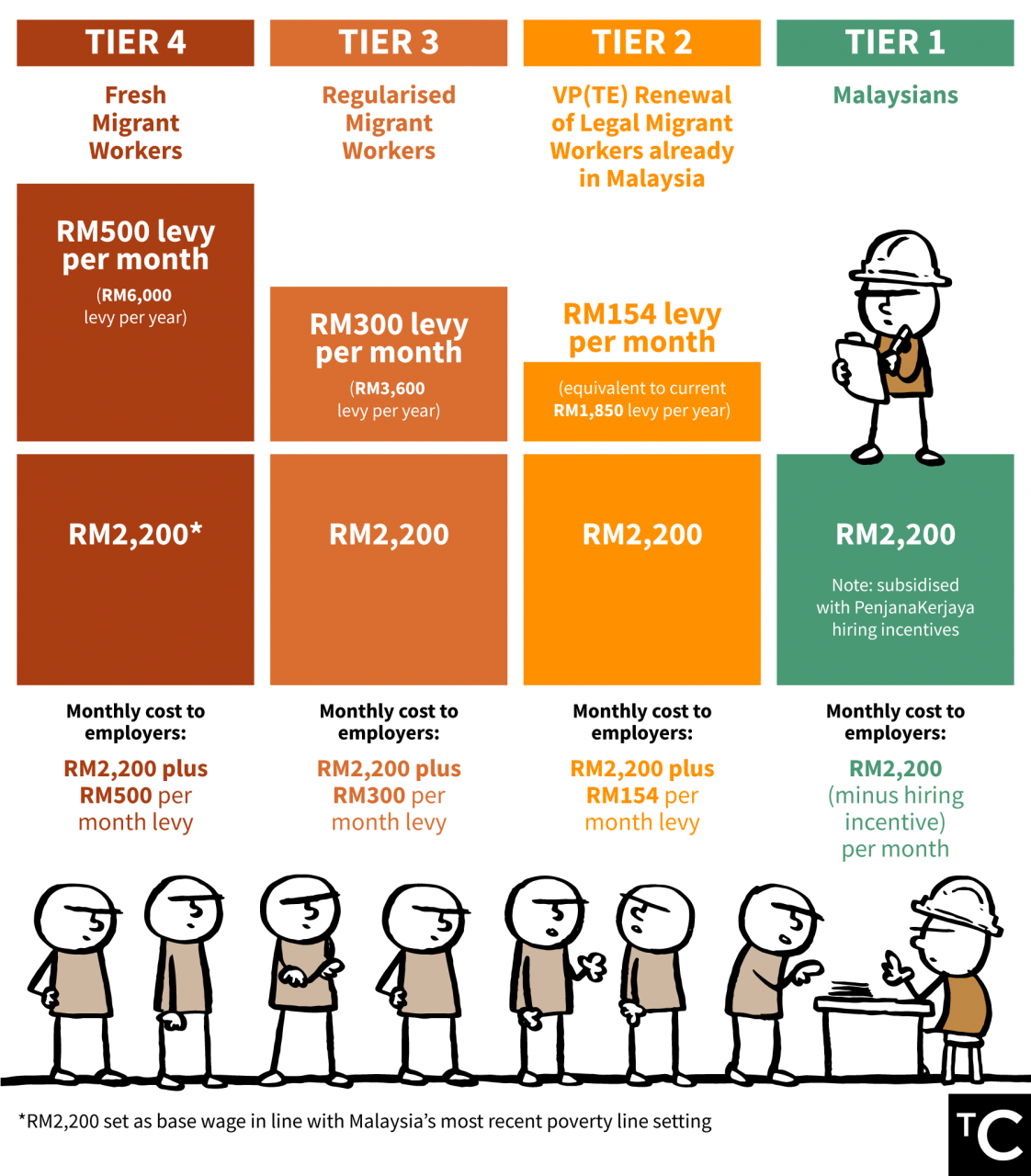
Sectoral dependence on large numbers of low-waged foreign labour will also need to be addressed here, via, for example, instituting a Singapore-style tiered levy system on companies that employ large proportions of foreign labour.

Note: Such a National Labour Policy Commission will certainly require leadership from policymakers and regulators such as the Economic Planning Unit, the Treasury, Bank Negara Malaysia, Ministry of Human Resources, and representatives from other relevant Ministries such as the Ministry of International Trade and Industry, the Ministry of Plantation Industries and Commodities, the Ministry of Works, and the Ministry of Foreign Affairs. Industry and worker representatives should also have a seat at the table, so that decisions would be made taking into account all relevant views. Current entities with similar membership such as the National Employment Council or the National Wages Council could be expanded to take on the functions of the proposed National Labour Policy Commission.

More importantly, an anticipatory labour planning approach towards migrant worker supply would also encourage a more intentful approach for the government to work more closely with Malaysian companies, not only to understand and moderate sectoral demand for migrant labour, but also to minimise companies’ reliance on special leeways. The Parliamentary Public Accounts Committee Report revealed that of almost one million foreign workers who were approved to work in Malaysia between 2016 and 2018, 55% came to Malaysia through a Special Approvals process. A more long-term and planned approach towards visa quotas, with authority assigned to an economic forecasting function, would eliminate such “workaround” processes that only exacerbate boom-bust recruitment cycles.

In order to be able to incorporate economic forecasts in a meaningful way, obtaining and maintaining accurate data on the migrant worker population is crucial; current estimates from various parties show too wide a range. Collecting accurate data requires a multi-pronged strategy. Requiring employers to pay migrant worker salaries into Malaysian bank accounts is one such measure. Another measure is to regularise all foreign workers currently in the country. This will involve a period of amnesty and trust-building however, such that foreign workers would present themselves for registration. Identities should be verified via biometrics with the inclusion of facial recognition technology to complement fingerprinting and curtail identity switching.

Additional migrant worker data can also provide other insights to aid economic planning and decision making. For example, existing Bank Negara remittance data can be used to build a behavioural profile of an average migrant worker based on their nationality, gender, age, remittance frequency, quantum, and destination country. While not directly used for recruitment, data like this can help identify trends and movements to be mapped against economic cycles.

Anticipatory labour planning and avoiding boom-bust cycles in migrant labour hiring also requires a serious relook at measures to hire Malaysians first.  Currently, in order to hire foreign workers, employers are required to post vacancies on Malaysian job sites for a period of time first. There are also several incentives being offered to encourage recruitment of Malaysian workers, such as  the Jaminkerja wage subsidy initiative.

The effectiveness of these efforts is questionable. Based on income bands, the Malaysians that would most likely be competing for migrant worker jobs would be the B1 category, a subcategory within the B40 group who have a median and mean household income of RM1,929 and RM1,849 respectively. This group would likely overlap heavily with the 9.9% of Malaysians who lack internet access and the 5.2% of adults who are illiterate. Therefore, there is a strong possibility that potential B1 applicants would neither have access to or be able to read job-posting websites. In fact, it was recently revealed that the majority of the 300,000 Malaysian users registered on JobsMalaysia are skilled or semi-skilled graduates

SOCSO’s weekly local job fairs would be a much better mechanism to establish whether Malaysians are interested in the jobs on offer. In addition to SOCSO’s initiatives, incentives can be put in place to make it worthwhile for local and regional recruitment firms to match employee and employer, emulating the offline, in-person, boots-on-the-ground methods employed by recruiters in migrant worker source countries. Prihatin cash assistance data can also be used to match Malaysians with jobs. 

Furthermore, with large firms such as Top Glove having to compensate 10,000 Nepali and Bangladeshi foreign workers RM166 million or RM16,600 each to compensate them for recruitment costs, it would arguably be more economical for employers to devote resources to employ private recruitment firms to search for Malaysian interstate workers from Sabah and Kelantan. In essence, efforts to recruit Malaysian workers should go further, with communications and outreach programs that specifically target low income communities or communities without reliable internet access.

The remaining labour gap, if it is to be filled by migrant workers, should prioritise renewals of current VP(TE) passes, followed by those who have been regularised. Fresh intakes of migrant workers should be absolutely last on the list of policy options. 

The migrant worker levy system should be structured such that, in addition to being based on the percentage of total employees as mentioned above, increasingly higher levies can be imposed on workers with shorter working tenures in Malaysia. As highlighted previously, monthly levies in Singapore (in contrast to annual levies in Malaysia) significantly increase the cost of migrant labour to the point where there is an immaterial difference between a Singaporean labourer compared to a foreign worker, ensuring that migrant labour is a necessity rather than a convenience. The proceeds from the increased levy would not only cover the initial intention of covering the migrant worker’s usage of public goods, but expanded to also ensure that employers internalise the cost of externalities, fund immigration infrastructure upgrades, and help employers fund a shift towards high-productivity automation.

Zero Indenture And Zero Wage Deduction

The issue of forced labour in Malaysia has been in the forefront in the last two years, driven by import bans imposed by US Customs and Border Protection on products by high-profile glove-producing companies as well as oil palm producers. Major clients of Malaysian manufacturers are also taking a closer look, with the latest case being Dyson cutting ties with Malaysian company ATA IMS Berhad over labour concerns.

One of the definitions of forced labour as it pertains to migrant workers is the phenomenon of indentured labour, where the migrant worker essentially works to pay off the high costs of getting themselves recruited into the host country. To pay their recruitment related costs, many workers sell family assets, borrow money at high rates from lenders or go into debt with their employers. In the latter case, the migrant worker could face extremely high wage deductions from their employer towards paying down their debt. These high debts, incurred to pay the costs of migration itself (including passage home), render the migrant worker vulnerable to exploitative conditions.

Improving the migrant worker experience starts with ensuring that they are recruited the right way. Malaysia needs to ensure that migrant workers coming to Malaysia do not have to “purchase” the job on offer. All recruitment costs should be borne by the employer – the case of Top Glove’s repayments is an object lesson in showing that this is indeed possible.

We essentially need laws in place and thorough enforcement to ensure that migrant workers in Malaysia cannot be indentured, which will hopefully see further developments with Malaysia’s signing of ILO Protocol 29 on the Forced Labour Convention as well as the National Action Plan on Forced Labour (NAPFL) 2021-2025. The onus needs to be on the regulator and on companies that employ migrant workers to negotiate migration costs and expenses down, as they are in a far better position to do so collectively compared to any individual migrant worker.

A more flexible worker visa would also support a zero indenture principle. The current arrangement whereby temporary employment visas are tied to the employer, and valid for a renewable period of 12 months, leads to a situation where foreign workers are excessively beholden to their employers and vulnerable to exploitative practices. Under a more flexible visa regime, workers could shift to work for other employers within the same sector, or even to take up jobs in a different sector that might have a rising need for migrant labour. A more flexible visa, which allows the worker to look for a new job and employer within a grace period, would reduce the forces that today make migrant workers illegal upon termination or that drives workers to abscond.

As a supportive policy measure, all migrant workers should get a digital identity upon arrival in Malaysia, which is cross registered between the Malaysian government and their embassy. This digital identity will speed up the passport or temporary travel document replacement process in the event of improper retention or loss and allow the migrant worker to return home. This also removes the retention of passports as a method to control migrant workers using fear.

To ensure thorough observation of the zero indenture policy principle, a zero wage deductions policy also needs to be in force except for statutory deductions. Migrant workers must also be briefed about their right to all promised compensation, and net amount of compensation, before signing any agreements, pre-departure, in their own native language. The worker needs to be clear on the mathematical prospect of profit or savings from the duration provided for by the visa.

Once migrant workers have arrived in Malaysia, it is crucial that they have the right to humane standards and quality of life. As seen as recently as this year, the derelict and substandard nature of migrant worker housing is prevalent, and crowding in these areas made it a potent ground for Covid-19 transmission.

Very detailed requirements relating to worker welfare are contained in the Workers’ Minimum Standards of Housing and Amenities Act 1990. Sections exist for water, electricity, nurseries, recreation facilities, rent free use, dependents, estate hospitals, transportation of sick workers, reporting of infectious diseases and weekly inspections. These provisions are poorly respected by irresponsible employers and do not cover illegal migrants. Enforcement of these provisions by the Director General of Labour should match the zeal in which the Director General of Immigration enforces immigration laws.

Finally, the current outsourcing system whereby a recruitment firm is the company that a migrant worker has his or her Visitor Pass (Temporary Employment) attached to, while they are outsourced to another company where they spend the vast majority of their working hours, serves only to deflect responsibility. While recruitment firms can play a big role in sourcing migrant workers on behalf of end-employers, end-employers must take charge of the migrant worker’s welfare and be the firm that the migrant worker’s Visitor Pass (Temporary Employment) be attached to.

The company named in the VP(TE), its directors and significant shareholders will be responsible for the migrant workers’ welfare and maintenance of legal status. Violations – including delays or shortfalls in paying wages – should result in progressively larger fines, increased levies, to complete bans on hiring migrant workers. For larger institutional shareholders, this would add a corporate governance overlay onto migrant labour dependent firms and push towards a Malaysian B10 first hiring policy and automation drive. 

Difficult Choices

Our problem with migrant labour is an important piece of the puzzle of Malaysia’s ongoing entrapment in middle-income status. The problem has been diagnosed multiple times in recent years, and the solution is also quite clear: in every five-year Malaysia Plan since 2006, if not earlier, there has been clear articulation of the need for Malaysia to move away from labour-intensive industries, and the need for greater productivity through investments in digitalisation, automation, and other technologies that reduce the need for low-skilled labour.

And yet, the recent 12th Malaysia Plan reiterates the same set of familiar issues and challenges that have plagued our economy for many years: low productivity, low quality of investments, slow structural transitions, limited gains from global value chain participation. Reluctance in mechanising or using labour more productively – for example in the palm oil industry and the construction industry – have led to a low-skills equilibrium which will be painful and difficult to break.

Hence, a comprehensive migrant worker policy reform must not only involve ‘sticks’ or penalising continued reliance on low-skilled migrant labour, but also  effective incentivisation of automation and higher productivity. For example, as proposed by BNM, additional levies on hiring foreign workers can be channelled into funding applied research for specific industries, to fund start-ups that develop solutions for improving productivity in targeted sectors or to compensate for increased tax incentives targeting companies that invest in customised mechanisation and automation solutions.

Nevertheless, change will be hard. An entire ecosystem involving a diverse range of stakeholders has been built that thrives on, and profits from, reliance on migrant labour. Difficult choices lie ahead, if we intend to finally wean Malaysia off the cheap drug of foreign labour: companies and consumers alike will complain of rising costs, policymakers may be tempted to postpone tough changes particularly if there is a risk of operations moving out of Malaysia, civil servants may balk at the challenge of implementing stringent regulations and closing off loopholes – in short, it won’t be easy.

Decisionmakers will need to stand firm and build the necessary coalitions to push through policy changes. Otherwise, we will continue to lament the same issues for decades to come, while other developing countries increasingly surpass us in productivity, innovation, and human rights reputation.

Indebted Generation, Part 3

In Part 1 of this research series, we outlined the quandary of student debt in Malaysia. As public universities were being corporatised and private universities expanding, student loans were introduced to finance higher education costs thereby rapidly increasing the number of graduates. Since the establishment of Malaysia’s primary student loan institution PTPTN in 1997, RM62.5 billion in student loans have been issued to 3.5 million borrowers. These quantums would be tolerable if it was accompanied by broadly positive returns to higher education; however, upward social mobility has not been evenly realised.

In Part 2, we advocated three bold policies to address issues related to current outstanding student debt: targeted partial debt cancellation, income-based repayment, and greater oversight on the workings and financing of PTPTN. Segmenting existing borrowers by their capacity to repay is a key pillar of these recommendations.

In this third instalment, we propose  ideas for reforming the way Malaysians finance their higher education. A crucial part of this discussion is to recognise the changing face of higher education itself which is diversifying from traditional degrees. Another key part of reform is the required changes in institutional structures, or how to organise education financing anew. The final part of our reform ideas is providing fairer education financing measures for households in need rather than broadly relying on student loans.

In previous articles, we noted media reports of young Malaysians getting stuck in low-waged jobs after having accumulated significant student debt to fund their higher education. This is consistent with a survey we conducted from August to September 2021. A third of respondents said their education was not worth the student debt incurred. 59% said student loans contributed to financial stress while 57% said the loans contributed to a delay in purchasing a home. 77% of respondents either somewhat agree or strongly agree that youth should not need to get into debt to attain higher education, and an even bigger majority, 82%, said the poor should not have to do so.

The burden of student loans received some attention in Budget 2022 where discounts for student loan repayments were announced. While it is a positive sign that the government is paying attention to student loan issues, the discounts offered are mainly for borrowers with the means to make large loan settlements or for borrowers that can afford scheduled deductions – in short, benefiting higher income borrowers rather than the less privileged. The discounts – which is a repeat of a past Budget announcement – are a reflection of longstanding policy thinking on student loans and higher education that is ripe for real change.

From traditional degrees to TVET and microcredentials

A key consideration in our recommendations is the increasing shift away from degree programs. In America and the UK, students and parents are now questioning the traditional college or university education and whether the cost of attending is worth it anymore. The COVID-19 pandemic may have only accelerated this trend, leading to a dramatic decline in enrolment recently.

Malaysia will gradually reach the same conclusion. COVID-19 aggravated, but did not cause, the long-running trend of graduate unemployment and graduate low pay. Graduate unemployment rose 22.5% last year to 202,400 in 2020 from 165,200 in 2019 and appears to be on an upward trend in at least the last four years; graduate unemployment stood at 162,000 in 2018, up from 154,900 in 2017. It also affects Bumiputera graduates who face a high rate of unemployment.

On top of the graduate unemployment rate, fresh graduates are earning wages as low as RM1,000-1,500 a month. Compare these outcomes to the time and financial commitments of a degree program which typically takes at least four years to complete. A diploma program is not much shorter, taking about 24-36 months to complete and longer still if done on a part-time basis.

Given these trade-offs, policymakers should reconsider Malaysia’s decades-old narrative favouring traditional academic degrees. The pursuit of knowledge via a degree is a commendable goal in itself, but are traditional degrees the right choice for all school leavers? As developed countries have learned or are learning, the answer is no. Many school leavers could be better off – and save substantially – by enrolling in technical training, ‘learning on the job’ apprenticeships, lifelong short-term courses or some combination of all these.

Apart from financial considerations, the shift away from degrees is also driven by the changing face of work. School leavers today can opt to build up their portfolio for freelance work rather than enrol in college to burnish their resumes for full-time jobs.

Malaysian educational policy observers have long envied the importance of Technical and Vocational Education & Training (TVET) in countries like Sweden and Germany, where the TVET system trains for a wide range of occupational fields and livelihoods. The employment rate for those with vocational degrees in these countries are nearly as high as bachelor’s degree holders.

Employability for TVET graduates is also high in Malaysia, reaching 98% employability in the past few years, which is a clearly better performance than their degree-holding counterparts. Last year, TVET Division director Azman Adnan of the Ministry of Higher Education said that vocational colleges are the country’s largest provider of skilled workers and that TVET is a solution to the skills mismatch and unemployment issues.

TVET is cheaper, shorter, and closer to industry needs. And yet, the policy focus and resource allocation on TVET has yet to catch up to levels received by the traditional degree system.

There is some improvement. In the 12th Malaysia Plan, the government plans to strengthen TVET by upgrading the industry ecosystem, improving accreditation, creating a TVET institution rating system, and promoting a centralised platform showing data on job offerings. Under the 2021 Budget, the government had allocated RM60million for the Sistem Latihan Dual Nasional (SLDN), a competency-based, industry-oriented training scheme. The SLDN allowance was also increased from RM600 to RM1,000 to encourage more participants from B40 households to enroll. Reflecting the government’s growing priority, overall allocation for TVET has also grown from RM6 billion in the 2021 Budget to RM6.6 billion in the 2022 Budget.

But much more needs to be done. The 2019 Auditor General’s report found that government-funded TVET programs as a whole fell short of 11th Malaysia Plan targets, producing only half the number of projected graduates. Enrolment has been on a downward trend from 2016 to 2020, though COVID-19 was definitely a contributing factor since many TVET programs require face-to-face training.

The fragmentation of government-funded TVET across six ministries has been well documented and the need for better coordination has been acknowledged by both Pakatan Harapan and Perikatan Nasional governments. Beyond ‘coordination’ though, a major overhaul in governance, policy planning and quality assurance has yet to be implemented though the need for it has been raised multiple times, including by MP Nurul Izzah Anwar who served as chairperson of the TVET Empowerment Committee.

To accord as much importance to TVET as to traditional academic education requires a structural overhaul. In Singapore and Vietnam, a single entity oversees the respective countries’ TVET system. In the case of Vietnam, there is even a law specifically on vocational education, enabling the Vietnamese government to invest substantially on TVET as well as promoting private sector participation through incentives on land, taxation, credit, and training of educators.

Despite having a much smaller population and only eight TVET institutions, Singapore has over 113,000 TVET student enrollment, a figure comparable to the total enrolment in Malaysia’s polytechnics and community colleges. This is consistent with a survey by KRI which found that less than 10% of youth in post-secondary education are enrolled in TVET polytechnics (excluding skills training centers).

Apart from TVET, we should also give more emphasis and resources to short-term reskilling and upskilling courses including so-called microcredentials. Compared to traditional degrees and TVET certificates, microcredentials are shorter, more flexible with respect to attendance, and tend to be more narrowly focused on specific skills or topics. They can be offered online, in the classroom, or via a hybrid of both.

In Malaysia, the policy narrative around skills development and microcredentials has been mainly targeted towards working adults and funding is tied to the promoting agency such as the Human Resources Development Fund (HRDF), the Employment Insurance Scheme under SOCSO, and the Malaysian Digital Economy Corporation (MDEC) amongst others. But as with TVET, the policy narrative for skills development and microcredentials should also extend to school leavers.

Not every school leaver is certain in what they want to study or what career they’d like to pursue. Microcredentials offer an opportunity to test things out before large time and financial commitments for further studies are made, if at all. And here, support means not only access to courses. Singapore’s SGUnited Skills program, for example, not only offers access to a wide range of subsidised short training courses for in-demand and emerging skills, it also offers career advisory support and monthly training allowance of SGD1,200 over the course duration to help cover basic living expenses.

In this section, we have argued for a policy shift away from favouring academic degree programs to more support and promotion of TVET and short skill development courses or microcredentials amongst school leavers. We maintain that student loan indebtedness amongst young people was driven in part by the decades-long assumption of status and positive returns from having a degree. This assumption needs to be re-examined, not only by policymakers but also by employers. Young jobseekers today are confronted with degree inflation, or the demand for bachelor’s degrees in jobs that don’t truly require one. A policy shift towards TVET and skills development would also need to be accompanied by efforts to update and re-educate employers on setting more relevant qualifying criteria.

From loans to direct subsidies for B40 students

Increasingly, the government is shifting from student loans towards encouraging early savings as a means to fund one’s higher education, which is a good step. However, the policy incentives to encourage savings will likely be taken up more by middle-to-higher income families who can set aside money for this purpose. What about households who can’t?

We need to move away from asking B40 families to rely on student loans and consider direct educational subsidies. Firstly, the burden of student debt appears to impact B40 borrowers disproportionately. PTPTN chairman, using PTPTN’s own records, wrote that 55% of all borrowers come from B40 households but that 97% of loan defaulters are from the B40 income group.

Secondly, as we outlined in Part 1, the government and taxpayers are already paying for a significant proportion of PTPTN borrowers’ education by paying the interest rate gap between PTPTN’s subsidised rate to their borrowers and the market rate PTPTN is charged by institutional lenders. It makes more sense to do away with this rather roundabout approach of subsidising a person’s education – replacing interest subsidies paid to financial institutions in favour of an outright tuition subsidy and cost of living stipend for B40 school leavers. It would also be beneficial for the loan administrator (i.e. PTPTN) as it provides some relief from managing a chunk of borrowers most likely to default on repayments.

How much will this cost? Our rough estimate puts the direct subsidy cost at 1.3-2 times more than the current regime of subsidising student loans and covering default rates, conservatively assuming that all the courses financed are for degree programs and with a relatively high ratio of IPTS students. The cost multiple for direct subsidies could be lower with a scheme that supports primarily IPTA students as well as a shift away from traditional degrees in favour of diplomas, TVET and microcredentials.

Gratuidad is an income-targeted free tuition program implemented in Chile. This policy was enacted after years of student protests against escalating fees and student debt. Gratuidad provides free tuition to students from the bottom 60% of households. The tuition subsidy is determined by a formula that divides institutions into categories according to the length of their accreditation term (a proxy for quality) and then sets the regulated tuition for each group and each study program.

Tuition fee subsidies and living cost stipends for B40 students need not come only from the government and taxpayers; corporations, private foundations and high net worth individuals could also be incentivised to contribute and supplement these direct subsidies. In the next section, we propose the final component of our education financing reform proposal to make education contributions simpler and part of the Malaysian social fabric.

From disconnected schemes to individual lifelong education accounts

Today, one could save for their education via SSPN-i; apply for a loan from PTPTN or PTPK; contribute to HRDF, EPF (Account 2), or EIS;  or track down different agencies’ offerings and take subsidised courses from for example MDEC, MARA, TEKUN and many others.

What if there was a better way to fund one’s post secondary education all the way to old age? One that accommodates early savings by parents as well as direct subsidies by the government and contributions or scholarships from future employers or benefactors? One that ties the funds to each Malaysian individually rather than with training agencies?

Tying together the two proposals above, we propose lifelong education accounts (LEA) for each Malaysian that are managed as an investment fund similar to the EPF. The accounts are only to be used for educational purposes, including cost of living stipends. The funds are automatically set up at birth, and each Malaysia-born child will receive RM100 credited to their LEA upon birth registration. Children born in B40 households could be credited with higher amounts depending on the level of household income.

This account will be the primary vehicle for voluntary savings schemes incentivised by the government for the child’s future educational expenses, combining features of ADAM50 and SSPN today. This account will also be the primary deposit vehicle for any future direct subsidies by the government to incentivise working age reskilling, much like Singapore’s SkillsFuture program. The account may also accept transfers from EPF Account 2 as well as deposits by government agencies, private foundations, benefactors, or future employers to support post-secondary education, be it loans or scholarships for degrees, diplomas, TVET, microcredentials, apprenticeships and other forms of learning or upskilling in future.

PTPTN could be best positioned to administer this fund given that they are already managing SSPN and are the entity in charge of promoting education savings. However, PTPTN has to be re-structured to improve its governance and expand its mandate. Appointment into PTPTN’s board should be as stringent as appointment into EPF’s board to ensure a qualified, competent and autonomous board. For greater streamlining, the Skills Development Fund Corporation (Perbadanan Tabung Pembangunan Kemahiran, or PTPK) and the Human Resources Development Fund (HRDF) could eventually be merged with PTPTN to create a focused superfund managing finances for lifelong education.

Thus far, the Malaysian government has introduced tax relief for employers (until 31 December 2021) who help pay off their employees’ student loans. If Malaysians had individual lifelong education accounts, such incentives could also be offered to individuals and companies that contribute into the account.

Conclusion

Paying for higher education is a substantial financial decision. To reduce inequalities, we first need to acknowledge that this decision is riskier for less privileged segments of the population. Our three-part series have demonstrated the mixed consequences of the current policy of relying on student loans to pay for higher education. While loans do increase access, it traps many graduates in debt – particularly those from the B40 households – with uncertain prospects of high wages.

With this backdrop in mind, we advocate for direct tuition subsidies and living cost stipends for B40 school leavers. We should also recognise that traditional degree programs, which tend to be lengthy and expensive, are not a surefire path to social mobility. An under-emphasised alternative is TVET, which should receive greater focus, support and promotion. Short skill development courses or microcredentials should also be encouraged, not only amongst working adults but also amongst school leavers.

To reduce dependency on student loans and to habituate Malaysians en masse towards educational savings and contributions, we also propose lifelong education accounts (LEA) automatically set up at birth for each Malaysian. This automatic enrolment account (opt-out rather than opt-in) will be the primary vehicle for voluntary savings schemes incentivised by the government, as well as any cash or voucher incentives for educational purposes.

To be clear, we are not questioning the worth of higher education. But we must reconsider how we define higher education and how we fund that learning. Moving forward, we ought to design policies to increase access to quality education (knowledge, skills, and technical training), especially those who have the least, without nudging them to incur burdensome debts.

The policy designs described here are by no means exhaustive, but they offer an example of how access to higher education can be made more future-oriented, far-sighted and less expensive. As Covid-19 disruptions bring a sense of urgency to address inequities, there appears to be a real policy window to advocate for better education policies, especially for those in low-income families. In our view, this is best served by rethinking the entire edifice of student loans and the narrative of the traditional university degree. We envision a future of diverse (and cheaper) educational pursuits, a culture of investing in continual learning, with greater assistance to those who need it most.

Email us your views or suggestions at editorial@centre.my.

The Affordable Housing Issue in Malaysia

For most young Malaysians, buying or renting their own home is an important rite of passage, marking the beginning of “adulting” which includes taking on probably the most significant financial transaction of their lives thus far. This rite of passage is, however, no longer assured or certain for many young Malaysians, as the gap between incomes and housing affordability continue to worsen.

The Affordability Gap

Figure 1 indicates the extent of the problem: from 2002 to 2019, the disparity between median house prices and annual median household income has nearly tripled.

Figure 1: Median House Price vs. Annual Median Household Income, 2002-2019

A widely used housing affordability indicator is provided by the multiple median approach which divides the median house price by median annual household income. House prices that are more than three times annual household incomes are considered to be unaffordable*. As Figure 2 shows, the housing affordability ratio for Malaysia has been consistently above three times in recent decades. As a comparison, Malaysia’s housing affordability ratio sits between the United Kingdom (4.5) and Canada (3.6).

*Note: This ratio can still be an underestimate as it does not take into account financing costs.

Figure 2: Housing Affordability Ratio, 2002-2019

Therefore, many young Malaysians face a hard choice – pay the price of unaffordable homes (for those who manage to qualify for a loan) and struggle to survive within a tight budget, or buy slightly more affordable homes in far-flung locations and live with a lengthy commute to work (though WFH policies post-pandemic could help make this more bearable). For Malaysians who do own a home, monthly housing expenditure take up a large portion of household income. A 2017 Bank Negara report indicated that housing loans comprise 52% of household debt, far beyond the recommended 28%.

Before unpacking the key drivers of this affordability gap, it is useful to know the range of housing measures to date.

Today’s Affordable Housing Measures

Housing has always been an important aspect of national development. The Ministry of Local Government and Housing was established in 1964 as a means of concentrating efforts to ensure adequate affordable housing to the growing population of a young nation. The Perumahan Awam Kos Rendah (“PAKR”) programme was launched in 1976, which later evolved into the Projek Perumahan Rakyat (“PPR”) which is currently the mainstay of government initiative for providing affordable housing for the poor.

Today, policies for affordable housing in Malaysia are mainly focused on direct provision of social housing (where the government takes on the role of building and/or owning the bulk of housing units), subsidised housing (such as PR1MA) and subsidised financing schemes. There are also supportive regulatory measures such as inclusionary zoning, where local authorities issue development approvals conditional on having a segment of the proposed development be set aside for the building of affordable homes).

As introduced in the 11th Malaysia Plan, It is useful to categorise affordable housing measures by their intended target market i.e. measures for households in the bottom 40% by income or the B40 and measures for the middle 40% of households by income or the M40.

Housing measures for the B40

In terms of relative need, B40 households are especially vulnerable to the challenge of affording a roof over their heads and many schemes are geared more towards rental rather, though purchase schemes are also selectively offered. Table 1 contains a non-exhaustive list of housing measures for  the B40.

Table 1: Affordable Housing Programs for the B40

Housing measures for the M40

In the 11th Malaysian Plan, the federal government expanded their focus towards the Malaysian middle-class. Despite being in a higher income bracket, households in the M40 class are also often unable to afford housing commensurate with their income and expectations. The M40 group has a wider range of schemes and programs catered for their financial capabilities compared to the B40 group, a non-exhaustive list is outlined in Table 2 below.

Table 2: Affordable Housing Programs for the M40

Drivers of Housing Affordability

Despite the plethora of measures that have been introduced over the years, affordability is still a challenge as indicated by the housing affordability ratio shown above. A number of persistent factors continue to define the problem.

Mismatch between housing demand and supply

A frequently cited factor is the mismatch between housing demand and supply. A 2015 report by Bank Negara shows that the proportion of property launches in the under RM250,000 range have been steadily decreasing (see Figure 3). In 2014, only 21% of new housing was priced below RM250,000, at a time when RM165,060 was the threshold of affordability for the median Malaysian household.

Figure 3: Distribution of New Residential Property Launches by Price Range, 2008-2014

The report also showed an oversupply of properties priced at over RM500,000, resulting in a property overhang where completed properties at the high end of the price spectrum remain unsold for months after completion. The National Property Information Centre (NAPIC) indicated that at the end of 2020, 170,699 residential units remained unsold, which is twice the number of unsold units from 2004 to 2015 (see Figure 4). 75% of these unsold units were priced above RM300,000.

Figure 4: Overhang Units in Malaysian Residential Market, 2003-2020

There are several perspectives on why the demand and supply gap persists. Critics argue that property developers choose to focus on satisfying demand for high-end developments in order to maximise profit margins, but there are perspectives, such as from think tank IDEAS and others arguing that the low-priced housing segment is made unprofitable by regulations that lead to supply-side bottlenecks. On the other hand, Khazanah Research Institute, points to the inelasticity of housing supply, driven to some extent by the lack of integrated data on housing supply and demand, among others.

Slow income growth

On the other side of the coin, housing affordability is also negatively affected by the anaemic rate of income growth in the Malaysia economy. In 2019, a World Bank report stated that income growth rates for low-income and younger earners have slowed down in recent years, growing at an annual rate of 2.4% compared to their older, better-educated counterparts at 3.9%. In fact, the starting monthly salaries for fresh graduates in Malaysia have actually declined since 2010, after adjusting for inflation. 

As housing prices continue to rise at a much faster rate than income growth, more young Malaysians are shut out from home ownership. In 2019, real estate industry leaders indicated that more Malaysians are opting to rent as housing prices became increasingly unaffordable. A 2019 study among Malaysian young professionals showed a willingness to embrace renting as existing housing costs — both purchasing and maintaining one — become increasingly out of reach. 

Potential Paths Forward

Setting aside the much bigger challenge of slow income growth, the key problem of affordable housing lies in raising the supply of housing in the price range below RM250,000, which is the affordable range for households earning median income and below in Malaysia. To effect this, the supply of housing in this price range either needs to be commercially viable for the private sector, or needs to be provided more efficiently and sustainably by the government.

There are a number of areas which should be further investigated in order to contribute to the policy discussion on this issue.

Understanding today’s housing demand

In order to increase marketable supply of lower cost housing units, there is a need to update our understanding of today’s demand. What are the preferences of young Malaysians today in terms of the trade-offs and choices they would make between buying vs. renting, space, layout, commute times, security, leisure and social amenities and other factors? How do housing requirements and preferences change amongst young Malaysians from different income classes, from B10 and B20 households to the upper end of the B40 or M10 income range? Knowing these preferences could change the size, design and location of low-cost housing developments, potentially enabling commercial provision of lower cost housing.

Efforts at updating information on demand could also be part of a national data repository on housing demand and supply, as proposed by parties like the Khazanah Research Institute.

Public-Private Partnership

As a matter of necessity, the government customarily steps in to fill the supply gap for affordable housing, especially for the lowest end of the price spectrum. As seen in many countries around the world, the need for affordable housing can often outstrip the government’s ability to fund or build the supply efficiently. Supporting the government in providing housing supply more efficiently could require new forms of public-private partnership.

The right incentives will be needed in order to catalyse private sector involvement. This could involve subsidies, or funding measures such as the issuance of public bonds to facilitate the financing for affordable housing. 

Reforms to planning processes and approvals at the local authority level can also have a significant impact in facilitating more private sector involvement in providing affordable housing. For example, a number of cities have applied inclusionary zoning laws that mandates residential developments to set aside a share of the development to include affordable homes particularly around public transit hubs. The quid pro quo of inclusionary zoning laws is that developers are offered cost-saving incentives, whether it is low-cost land, tax breaks, or low-interest financing. In this way, inclusionary zoning allows the government to facilitate the increased provision of low-cost housing through the private market.

Creative experimentation

One interesting solution, which could be particularly appropriate in a post-pandemic environment, is the conversion of vacant properties into social housing. In Hong Kong, for example, underused hotels and guesthouses are offered to low-income earners, with the rent capped at 25% of the tenants’ income. Similarly, the Irish government has a Buy and Renew Scheme (BRS) that allows local authorities to purchase and renew dilapidated housing units, and convert them into social housing. Indeed, we have seen this take place in Malaysia: an abandoned hotel in Kuala Lumpur was converted into “Rumah Prihatin” to provide for the homeless and indigent during the Covid crisis. This experiment, if successful, can open the doors for more of such repurposed housing in the future. 

Yet another example is rent control, which is especially interesting as this was once implemented in Malaysia, before its repeal in 1997 (see Note 2). Rent control is a legal measure enforced by the government to put a ceiling price on rent prices. In San Francisco, beneficiaries of rent control policies were less likely to migrate, decreasing tenancy turnovers and allowing households to stay longer in their neighbourhoods. The experience of repealing rent control in 1997 suggests that there is room for improvement, were rent control to be reintroduced in Malaysia. 

Another form of intervention related to making rental rates more affordable, would be rent subsidies. In Canada, for example, emergency rent subsidy was introduced as one of the measures to alleviate the negative impact of the Covid-19 pandemic. There is room to experiment with the implementation of rent subsidy, either as direct cash vouchers to qualified households, or as tax credits to rental housing owners

Malaysia’s Control of Rent Act 1966
Malaysia once had a rent control law, the Control of Rent Act 1966, that was repealed in 1997. The repeal was intended to reactivate flows of land capital and liberalise the Malaysian economy, in response to the Asian Financial Crisis and the ensuing need to recharge economic recovery. This repeal, however, led to short-term overnight rent hikes, rampant eviction of tenants, and increased shortages in affordable housing.

While rental levels increased exponentially by 400% post-repeal (though from a relatively low base), it was also found that the repeal of the act also helped to regenerate urban development, as buildings which were previously under rent control can now earn adequate rental income at market rates to facilitate much-needed renovations.

Beyond Boom And Bust, Part 2

In Part 1 of this research series (accompanied by a primer on the migrant worker registration process) we broadly highlighted the main issues surrounding migrant workers in Malaysia. The current situation – significant gaps between official and unofficial numbers, unrealised aims of reducing reliance on unskilled labour and deplorable accounts of inhumane treatment – is in our view a result of short-termist policies driven by boom-and-bust cycles.

A longer term stance requires us to have policies that clearly reduce over-reliance, waves of hiring followed by deportation, as well as decent recruitment practices and working conditions. But these come with costs and repercussions that we must recognise. In Part 2 of this research series, we unpack the trade-offs involved.

I. Proposals to Reduce Over-Reliance

Can we do without migrant workers? The answer, at least in the medium term, is likely no. A better question is whether we can avoid utilising migrant workers as a go to for any and all labour shortages.

Malaysia has long depended on migrant workers to support its economy but the intention, at least as of the mid-1990s, was to keep the importation of low-skilled migrant labour temporary. The 1995/96 Budget announced “the import of foreign labour as an interim solution to meet excess demand for low-skilled labour, while it pursued a longer-term strategy to increase productivity and expand the supply of skilled labour”. A quarter of a century later, this transition has not fully materialised, if at all.

It does not help that the jury is still out on whether we should reduce migrant labour. On the one hand, the World Bank argues that migrant labour enables economic activity which  increases employment for Malaysians, generating 5.2 additional Malaysians employed for every 10 migrant workers. They also argue that migrant labour enables Malaysians to specialise and increase their wage premiums, a position somewhat supported by the Khazanah Research Institute which found limited impact on Malaysian employment from migrant workers.

Bank Negara on the other hand takes a more conservative stance, arguing that migrant workers distort the labour market, disincentivises investment in productivity-enhancing automation, and suppresses wage growth for Malaysians. Adding further nuance, A UKM study has shown a significant positive impact on output growth from employing skilled and semi-skilled migrant workers, but a negative impact on output growth from employing unskilled foreign labour.

Despite their differing conclusions, these findings may both hold true. The hiring of migrant workers in skilled, semi-skilled and unskilled jobs may benefit Malaysians’ wages, productivity and overall growth but only up to a point. Beyond that point, the structure of the job and the sector becomes frozen and heavily dependent on having a segment of workers willing to work at a particular price point, number of daily working hours and certain living conditions.

Hire Malaysians first?

One long-standing proposal towards reducing reliance on migrant workers, particularly in low- and semi-skilled jobs, is to mandate or compel employers to increase the hiring of Malaysians. And one widespread counter-argument to this proposal is that Malaysians will not take up 3D jobs – dangerous, dirty and demeaning – due to the nature of the job as well as the associated social stigma. The palm oil sector is a case in point: with borders shut due to the pandemic, the Malaysian Palm Oil Association say companies have been desperately trying to hire locals. Malaysian candidates, however, evidently prefer jobs as drivers or mechanics rather than as harvesters.

There is enough evidence though to indicate that the real issue here is low wages. A large proportion of labourers who work on Australia’s fruit picking farms are ironically exploited Malaysians working illegally who can earn multiples over Malaysia’s minimum wage.  40% of the approximately 200,000 Malaysians who commute between Johor and Singapore for work daily are in low- to mid-skilled jobs.

Figure 1: Wage range of ‘3D’ job, Malaysia vs. Singapore

Source: News; online job searches

Figure 1 illustrates the wage differential for a Malaysian in a 3D job in Malaysia vs. Singapore. A Malaysian stands to earn from RM900 to RM2,000 a month working as a palm oil harvester in Malaysia, for example, compared  to SGD1,000 per month in Singapore (equivalent to nearly RM3,100 at the time of writing) working a comparable 3D job. Malaysians are willing to work 3D jobs if the price is right. 

Mandating the hiring of more Malaysians would not achieve much unless it is accompanied by higher wages. If the returns to labour remain the same however, it is not likely that Malaysian companies could afford and be willing to pay wages at the levels required for Malaysians to take up 3D jobs. Even when confronted with the prospect of losing 25% of their crop due to labour shortages from the ongoing pandemic, the Malaysian Palm Oil Association was only willing to pay Malaysians workers RM2,000 per month with the caveat that they are ‘hardworking and productive’. The government would need to provide sufficient wage subsidies to incentivise the hiring of Malaysian workers (as attempted by the Hire Malaysia program) or the nature and productivity of these jobs would need to change.

Make migrant workers more expensive?

Another proposal to reduce reliance and appetite for migrant workers is to make them cost more than hiring a Malaysian, primarily by increasing the foreign worker levy. Singapore demonstrated this policy direction recently with some very decisive levy hikes:  in 2020, the levy for foreign workers in the construction sector was increased from SGD300 to SGD950 per month, the levy for foreign workers in manufacturing was increased from SGD250 to SGD 650 per month and the levy for foreign workers in services was increased from SGD300 to SGD800 per month. In comparison, Malaysia’s foreign worker levy is RM640 for the plantation sector and RM1,850 for other sectors annually.

Former Federation of Malaysian Manufacturers (FMM) President Tan Sri Yong Poh Kon recently proposed raising Malaysia’s foreign worker levy every year and, like Singapore, tiering the rate even higher on companies where foreign workers comprise large proportions of the workforce. He also suggested that the levy be reclaimable by employers, like the HRDF scheme, but for investment in initiatives that can boost productivity, like automation, or encourage the hiring of locals, such as building childcare centres at the workplace.

“Until we take this sort of drastic measure, we will not be able to address this foreign worker issue,” said Tan Sri Yong. He is right on one key point: raising the foreign worker levy would be a very potent measure in reducing reliance on migrant workers by hitting the policy target exactly where it hurts, namely employers’ pockets.

As evident in the response to this proposal though, it will have painful repercussions and meet much resistance. Production costs will increase in the short-term, leading to inflation. Malaysia’s position as a medium-cost manufacturing hub may erode in the near term until production processes change. There is also political and economic reality; given the economic fallout from COVID-19 pandemic, the likelihood of instituting a foreign worker levy hike will be extremely low for some time. 

Mitigating short-term pain for the achievement of long-term policy goals needs to be done however, and a clear policy statement indicating the future direction of foreign worker levies will be needed. With a clear policy on levies, planning and phasing can be carefully negotiated with industry stakeholders as businesses get back on their feet. Otherwise, there will be very little impetus to change.

Bring in the robots?

Will automation solve our migrant worker conundrum? From various speeches and pronouncements, many policymakers and industry observers appear to think so, though the World Bank has argued that the relationship between low-skilled migrant labour and technology adoption is limited and inconclusive.

On the face of it, there is great scope for increasing automation. Malaysia’s robot density is relatively low at 34 per 10,000 employees, compared to others such as Singapore (918), Korea (855), the Asian average (118) and the world average (133). And conceptually, the idea of replacing 20 migrant plantation workers with agrobots supervised by a single highly skilled Malaysian technician seems like a major step forward. Automation is inevitable, but it is not an immediate event – time is needed to apply the technologies and to train the accompanying talent needed.

We also need to bear in mind that a push towards automation will not only affect migrant workers but also local workers. According to the Khazanah Research Institute, 70% semi-skilled and 80% low-skilled jobs across multiple sectors can potentially be automated, leading to potentially heavy job losses for Malaysians. As with the foreign worker levy, any policy measures aimed at increasing automation needs to be phased in order to prepare local stakeholders for the effects.

II. Proposal to Improve Migrant Worker Welfare

From highly tied to a free worker model?

Poor working conditions and welfare is sadly synonymous with the migrant worker experience in Malaysia. Workers can get trapped in bad situations as their work visas are tied to the employer or the recruitment agency. Should they try to leave a poor workplace, their work visa or VP(TE) would be void and they would cease to have legal status in the country. Still, many do.

On top of that, the worker’s passport (and the VP(TE) inside) is often physically held by the recruitment agency or employer, even when this is clearly an offence under the Passport Act 1966 which provides for a maximum fine of RM10,000 and 10 years imprisonment. This practice is not unique to Malaysia, with similar cases in Japan, the UAE and Singapore to mention a few. From the employer’s perspective, holding passports is a way to reduce the risk of the migrant worker absconding thereby losing their upfront costs and investment but, as made clear from many reports, this practice of preventing passport access is very problematic. In response to charges of inhuman treatment, some employers have attempted to compromise by storing passports on the premises with the worker keeping the key, though it is unclear if this is a good solution.

One proposal is to move towards a free labourer model where the migrant worker is free to switch between employers on the same work visa. This was recently done as part of Qatari and Saudi Arabian labour reforms. If emulated in Malaysia, it could potentially reduce the incidents of abuse. It may also work as an additional incentive for employers to improve working conditions.

A switch to a free labourer model is a significant event in Malaysia’s pre-Independence history. In the early 1900s, the Tamil Immigration Fund Ordinance was passed which established a funding pool contributed by employers, the Federated Malay States government and the Johor government to convert indentured Tamil labourers  to ‘free’ labourers who could change employers after giving notice. The aim was to address the problem of labour shortages while reducing incidences of abscondment (‘crimping’). The joint fund financed the workers’ sea passage, quarantine, recruitment interviews, among others.

Nevertheless, in attempting to reduce the issues that come with indentured or tied labour, history shows that a free labourer model could cause serious issues if implemented without sufficient economic forecasting or a quick enough (and humane) repatriation system. As occurred in the 1930s, there is a risk of a labour glut, depressed wages and social issues if the influx quota is overly generous or if economic conditions turn sour, or both.

There are many more proposals to reduce reliance on migrant workers and to address deficiencies in migrant worker welfare but for the purpose of this piece, we have focused on aspects that, in our view, have a fundamental role in driving the development of migrant worker policies overall. As we have attempted to show in this piece, every proposal has significant trade-offs and downsides. Malaysia faces hard choices, but these choices must be made. In our third and final instalment, we propose a way forward for policymakers.

Indebted Generation, Part 2

In Part 1 of this research series, we outlined the quandary of student debt in Malaysia. By all measures, student debt has increased exponentially in Malaysia. Since the establishment of Malaysia’s primary student loan institution PTPTN in 1997, the number of borrowers has increased, average loan amounts have risen, and the amount required to fund these loans has ballooned. Each year, approximately 200,000 new borrowers are created as they seek access to higher education via student loans. 

A major problem highlighted in our previous article is the unrealised assumption of upward social mobility. The basic premise of student loans is borrowers’ ability to repay, thanks to higher earning potential from obtaining tertiary qualifications. However, multiple indicators show that many graduates do not have gainful employment, even before the onslaught of the COVID-19 pandemic.

The 2018 Malaysia’s Graduate Tracer Study (SKPG) showed that almost 60% of graduates were or remained unemployed a year after graduation. PTPTN also found that more than one-third of their surveyed respondents earn below RM2,000 a month. More seriously still, the combination of unmet higher earnings potential and the burden of student debt seems to impact B40 borrowers disproportionately as about 97% of the loan defaulters surveyed by PTPTN were from the B40 income group.

Who and how much to forgive?

If the policy preoccupation of the early 2000s is deliberate loan delinquency, recent years have seen concerns shifting towards involuntary loan delinquency due to unmet job prospects. This affects a segment of underprivileged and overburdened borrowers who are in a potent triple bind: disadvantaged by their household’s socioeconomic background, saddled with student debt and still facing low income mobility due to unmarketable qualifications.

Student debt forgiveness or cancellation, either fully or partially, is the leading policy proposal towards providing relief from repaying one’s student loans. In the United States, where astronomical student loans are a massive economic and political issue, student debt cancellation was a key plank in several presidential candidates’ 2020 election campaigns including Bernie Sanders, Elizabeth Warren, and incumbent President Joe Biden – the main difference across the candidates lay in proposed criteria and amount.

In Malaysia, then opposition coalition Pakatan Rakyat had campaigned for student debt cancellation in 2012-2013 following student protests led by Solidariti Mahasiswa Malaysia (SMM) and Gerakan Menuntut Pendidikan Percuma (GMPP). More recently, Lim Lip Eng, the Kepong Member of Parliament, recommended writing off PTPTN loans for B40 borrowers to release struggling families from their debts. Geoffrey Williams, an economist at the Malaysia University of Science and Technology had also called upon the government to recognise and write off PTPTN’s bad debts through debt cancellation.

Malaysia can and has implemented student debt cancellation to achieve assorted policy aims. To incentivise high levels of academic achievement, full loan cancellations have been offered since 2003 for PTPTN borrowers who complete their Bachelors’ degree with first class honours. As of 31st December 2018, 57,236 borrowers have been exempted from paying back their student loan under this scheme1.   

To incentivise quicker loan repayments, partial loan cancellations have been offered since 2013 for PTPTN borrowers who can settle their loans in one lump sum or who repay their loans consistently2. There was even partial student loan cancellation offered for lower income borrowers aged 60 and over in the 2019 Budget speech3.

As pointed out in a 2016 research piece by Penang Institute, some of these partial loan cancellation policies are regressive in nature. Students who graduate with first-class honours tend to secure more job interviews and better paying jobs compared to their peers. More affluent borrowers are better positioned to settle their loans in one lump sum compared to lower income families. 

Ultimately, student debt cancellation is not an untried measure in Malaysia when there is political will to enact. In view of this, rather than granting cancellation to those with better prospects to repay, we advocate targeted and partial student loan cancellation to the segment of borrowers identified as the most structurally underprivileged and overburdened.

A categorisation exercise on current borrowers is needed in order to determine who qualifies to be in this segment. Some factors that should be considered include their family’s socioeconomic background, the borrower’s past and recent years’ wages, the quality of qualifications received e.g. their field of study, level of their certification, and the status of the granting institution. 

The partial loan cancellation for this borrower segment should be an impactful or significant amount of their remaining loan, e.g. RM20,000 or 50-80% of their remaining loan. In addition, those in this identified borrower segment who have been paying their loans for over 15 years should have their full remaining debt cancelled, in order to graduate these borrowers out of student debt. Currently, there is no ‘graduating out of debt’ timeline, no matter the circumstance.

Critics may say, what about extending the loan tenure? In our view, targeted partial debt cancellation is a morally stronger policy option for such structurally overburdened borrowers than extending the loan tenure. Loan tenure extensions result in such borrowers paying more interest and trapping them in debt for even longer. 

Some state actors may be increasingly recognising the importance of relieving student loan burden. Early this year, the Sarawak state government through Yayasan Sarawak signed a Memorandum of Understanding with PTPTN to pay 30% of Sarawakian borrowers’ student loans once the borrowers pay 30% of their debt. Up to 9,000 borrowers from that state effectively had 30% of their debt ‘cancelled’ by this stroke of policy. 

Of course, it would have been a much more progressive policy if the minimum threshold were waived and greater settlement amounts granted to qualifying lower income borrowers. Nevertheless, despite the missed policy opportunity here, tracking this move would still be invaluable to see the impact on borrower welfare and other outcomes. Supporting research in the United States suggests that student debt cancellations can improve both family stability and upward mobility, increase borrowers’ likelihood to start a business, accumulate a down payment on a home, have a child, save more for emergencies, return to school, and boost the economy

On a separate note and in addition, the government should establish a grievance mechanism to investigate and potentially cancel debt for borrowers who have been misled by higher education institutions, or when a program is terminated or unaccredited, or when an institution is shut down, before the borrowers complete their studies4. At the time of writing, more than 500 students in Limkokwing University of Creative Technology (LUCT) were left with worthless degrees after provisional course accreditations were revoked by the Malaysian Qualifications Agency (MQA), with some students having paid up to RM72,000 in fees. Similar protection exists in Australia, to support student borrowers in the event that their education provider ceases in delivering their course or closes entirely.

Partial debt cancellation to encourage public service? As of the time of writing, the Canadian government offers to cancel $8,000 of student debt annually to doctors and $4,000 annually to nurses and nurse practitioners, as long as they work at least 400 hours in a remote or rural community. The benefit can be claimed for five years, which adds up to a significant amount of debt cancellation.

1 The cost of this loan cancellation was initially covered by PTPTN but shifted to the government since 2015. This group of borrowers represent 1.6% of the 3.5 million PTPTN borrowers as of 2018 and have had RM1.75 billion cancelled. Source: PTPTN Annual Report 2018.
2 Such discount incentives were introduced in Budget 2012 including a 20% discount for borrowers to settle their debt in one lump sum payment and a 10% discount for those who pay consistently for one year. These offers were discontinued/expired in December 2018.
3 Qualifying criteria was RM4,000 monthly income and below. The scheme was said to have benefited 350 borrowers with a cost of RM4.2 million.
4 The current policy to help affected students is by arranging credit transfers to another college. But we argue that students should be given the choice between transferring to a different college and continuing with their loan, or ceasing their studies and having their student loan cancelled.

Who should pay, when and how much?

Apart from the issue of structurally overburdened borrowers, two other questions pertaining to current outstanding student loans need to be resolved: when is it appropriate for borrowers to begin paying off their debts (threshold), and how much should they be paying (tiering)?

The default policy for PTPTN today is a time-based repayment scheme, where all borrowers are expected to commence paying their loan instalments 12 months after their graduation regardless of income level5. The current scheme does not differentiate borrowers’ varying levels of financial capability to repay their debts, which penalises those unable to pay as well as under-capitalises those who can.

The leading policy proposal to address this issue is the idea of income-based repayment where borrowers only begin to pay back their student loans after reaching an affordable level of income and where the repayment rate increases with rising income. The policy was first implemented in Australia. According to Bruce Chapman, professor at the Crawford School of Public Policy at the Australian National University6, Australia’s income-contingent loan system has inspired similar policies in New Zealand, South Africa, England, Hungary, Thailand, South Korea, and the Netherlands. Income-based repayment is considered fairer because repayments would be made only by those with feasible earnings while minimising hardship and default risk for borrowers earning less.

This policy was almost rolled out in Malaysia. Following the 2019 Budget speech by then Finance Minister Lim Guan Eng, PTPTN chairman Wan Saiful Wan Jan floated a plan called Scheduled Salary Deductions which sought to impose a progressive loan repayment schedule ranging from 2 to 15 percent of income depending on the borrowers’ monthly income7.

The plan was ultimately shelved due to fierce public backlash. One major source of backlash appears to be setting the monthly income threshold for loan repayment at RM2,000 (originally set at RM1,000, an astonishing figure considering that it is lower than the minimum wage) which many considered to be too low. Many borrowers were also upset that their monthly payments were scheduled for drastic progressive increases, from a typical RM150-RM 300 a month to up to RM1,200. Adding gasoline to the fire was the decision to make the changes mandatory and immediate.

In principle, we support income-based repayment as a way to facilitate higher and quicker repayments amongst borrowers with the capacity to repay. But a viable income-contingent loan policy needs to have a very good understanding of existing borrowers’ constraints and psychology.

Firstly, an income-contingent loan policy on existing borrowers should be implemented on an opt-in basis. Forcibly altering current repayment amounts without room for choice and flexibility, even amongst borrowers with relatively high incomes, will likely ignite anger and resentment as evidenced by the reception to the 2019 proposal. To motivate take-up of the opt-in scheme, one could take a leaf from the marketing of home mortgages, which shows a borrower how much more they stand to save or how much quicker they can get out of debt by increasing their monthly repayments.

Secondly, the threshold of repayment should be both economically and politically acceptable in order to avoid wholesale rejection of the policy. Setting an income threshold that is too low not only invites public uproar, it also sets up conditions for loan distress or default amongst low-income borrowers. In order to maximise policy acceptance and effectiveness, we propose that the threshold to repay is set at a level that allows for a minimum reasonable standard of living, either on par with the national median wage8 or a consumption-based figure such as the Belanjawanku by the Social Wellbeing Research Centre, which importantly also incorporates household size. As a benchmark, the Australian median personal income is $49,805 and their student loan repayment income threshold is currently set at $46,6209.

Thirdly, the tiering of loan repayments also needs to be acceptable to borrowers’ sense of personal affordability and choice. The tiering proposed by PTPTN in late 2018 was arguably too drastic. The tiering in Australia’s income-based repayment system, is much more gradual in its rate increases, had finer income bands and did not require payment exceeding 10% of their borrowers’ income. We compare the two tiering schedules in Figure 1 below.

Figure 1: Malaysia’s Proposed PTPTN Repayment Tiering 2018 vs. Australia

5 However, PTPTN does allow negotiations to restructure repayment on a case-to-case basis. Following the third round of ‘total lockdown’ imposed in June, the Minister of Higher Education announced that borrowers may apply for a three-month deferment to repay their loans.
6 And advisor to at least one major study on higher education financing commissioned by the Malaysian government.
7 To determine borrowers’ income levels, the government had worked out an inter-agency cooperation involving the Employers Provident Fund (EPF), Inland Revenue Board of Malaysia(LHDN), Retirement Fund Inc (KWAP), Accountant-General’s Department, Armed Forces Payroll Directorate and Public Service Department (JPA). PTPTN itself does not have automatic access to nor up-to-date records of its borrowers’ income.
8 Which has the additional benefit of moving in line with economic growth or contraction. The median wage figure is updated every year in the Salaries & Wages Survey Report; the latest available report (2019) has the median wage at RM2,442.
9 Up until four years ago, the threshold used to be around $56,000 but the Australian government gradually lowered the threshold to its current level.
10 Based on the latest B40-M40-T20 classification by the Department of Statistics.
11 Based on household percentile and annual income in a study by ACOSS/University of NSW.

But repayments will not be enough

The buzz around reducing borrower delinquency in past years may give one the impression that collecting repayments is the answer to PTPTN’s sustainability. However, the bitter truth is that even if all currently due outstanding loans were successfully repaid (which is highly unlikely), it would still not be sufficient to pay off PTPTN’s debts to financial institutions and to cover the cost of operations.

The gap between the interest rates charged by PTPTN to borrowers vs. the interest rates PTPTN must pay for its own borrowings is too large, as outlined in Part 1 of this research series. To illustrate the scale of the gap, in 2018 PTPTN collected RM400 million in interest repayment from borrowers but needed to pay RM1.7 billion in interest payments for its own borrowings12.

There is no option but to supplement PTPTN’s loan collections service these institutional borrowings with periodic government injections (as is the current practice) or outright takeover of the borrowings13. Either action must be funded by government revenues and taxpayers. Thus, the policy ‘solution’ in question here is less about how to close the financing gap (though, see ex-MP Rafizi Ramli’s suggestion to earmark oil revenues, amongst others14) and, in our minds, more about increasing the accountability and transparency in how PTPTN’s loans are funded. Given the current amounts involved, greater debate, analysis and oversight needs to happen. 

In the current governance structure, it is unclear how lawmakers can play a meaningful role in overseeing PTPTN, or who gets to decide on major reforms in PTPTN. There are many stakeholders involved including the Minister of Higher Education, the Minister of Finance, and even the Prime Minister whose support is necessary to enact (or veto) proposals to reform PTPTN. To increase accountability and oversight, it may be more effective to place the purview of PTPTN under a single ministry and to empower legislators in monitoring the body. 

What else would increasing accountability and transparency entail? Firstly, all studies commissioned by PTPTN and data collected should be made publicly accessible, and debated in parliament and/or select committees. Secondly, there should be formed – and empowered – both a parliamentary select committee and a parliamentary caucus on PTPTN and higher education financing so that elected representatives may provide increased debate, analysis and oversight. For instance, the Australian parliament has a Senate Standing Committee on Education and Employment, which allows lawmakers to deliberate on such matters and uphold public interest.

12 Loan interest revenue is the result of administrative costs 3% and ujrah 1% on student loans charged to the borrower.
13 Past examples include the bailout of FELDA and the gradual sukuk redemption in the restructuring of Tabung Haji.
14 In addition to proposing an Act to earmark a percentage of oil revenue into an education investment fund, Rafizi also proposed the issuance of new government bonds to cover PTPTN’s debts as an alternative.

Conclusion

This instalment of our research series on student loans in Malaysia advocates three bold policies to address issues related to current outstanding student debt: targeted partial debt cancellation, income-based repayment, and greater oversight on the workings and financing of PTPTN. In supporting these policies however, we reiterate the call for publishing all commissioned studies and data connected to PTPTN and higher education financing. Having more robust and in-depth policy research on student loans and higher education financing requires the public availability of micro-data as well as the contribution of all interested researchers, legislators and policymakers – not just a chosen few. Impact estimates of the above policy measures, such as this one by the Levy Institute for the United States, cannot be done for Malaysia with publicly available data. 

A Select List of Studies on Student Debt in Malaysia

Chapman, Bruce and Michelle Tan. “The Australian University Student Financing System: The Rationale for, and Experience with, Income-contingent Loans”, in Student Loan Schemes. Experiences of New Zealand, Australia, India and Thailand and Way Forward for Malaysia, USM Press. 2009. 38-63.

Hock-Eam, Lim, Russayani Ismail, and Yusnidah Ibrahim. “The implications of graduate labor market performance in designing a student loan scheme for Malaysia.” In Income Contingent Loans. Palgrave Macmillan, London, 2014. 83-97.

Ismail, Russayani. “Equality of opportunity and student support schemes” In: The 5th ASEAN Symposium on Educational Management and Leadership (ASEMAL 5), 18-19 August 2007, Legend Hotel, Kuala Lumpur. 2007 (Unpublished).

Ismail, Russayani. “A Review, Investigation and Recommendation for National Higher Education Funding (Kajian Menyemak, Mengkaji dan Mencadangkan Transformasi Pembiayaan Pengajian Tinggi Negara”. Ministry of Education and PTPTN. 2012.

Ong Kian-Ming, Jonathan Yong, Chew Khai-Yen and Dickson Ng, “The Sustainability of the PTPTN Loan Scheme”, Penang Institute, December 2016.

Pakatan Harapan PTPTN restructuring proposal (undisclosed).

PTPTN Survey in 2019 (unpublished).

PTPTN Public Consultation Paper, April 2019 (partial publication to the public).

PTPTN Strategic Plan 2021.

PTPTN Strategic Plan 2021.

Wan Saiful Wan Jan, “Malaysia’s Student Loan Company: Tackling the PTPTN Time Bomb,” ISEAS-Yusof Ishak Institute, April 2020.

Good policy research that can satisfy the needs of economic, social and political feasibility will be needed not only in addressing issues related to current existing student loans but also in working out changes to new student loans moving forward. In the next part of this series, we will discuss the broader changes needed in the policy of student loans and higher education financing in the future.

Beyond Boom And Bust, Part 1

Migrant labour has long played an integral role in Malaysia’s history, formation and nation building. Between 1880 and 1939, Malaya absorbed the highest number of immigrants per population in the world to work on tin mines and rubber plantations. It was a period of mass migration that had a long lasting social, economic and political impact.

More than a hundred years later, Malaysia is Asia’s largest net importer of labour, heavily reliant on migrant labour in several key economic sectors. Unfortunately, our long history and extensive experience has not translated itself into long-term and robust migrant worker policies. As a country, we seem to repeat cycles of mass recruitment followed by cycles of ‘regularisation’, earning reproach from human rights watchdogs and international export sanctions in the process.

Our long-term goal to reduce our dependence on migrants is frequently undermined by contradictory short-term policies, leading to the accumulation of a high number of legal and illegal migrant workers. In Part I of this research series, we outline where we are today and explore the factors that have led to the current situation.

A Snapshot Of The (Legal) Numbers

Based on the number of Visitor Pass (Temporary Employment) or VP(TE) permits that have been issued, Malaysia officially hosts 1.99 million legal migrant workers as of August 2019. As shown in Figure 1, the distribution of migrant workers is highly concentrated – 62% are in 3 states, with the central territories of Selangor and Kuala Lumpur hosting 44% and the southern state of Johor hosting 18%.

Figure 1: Distribution of migrant workers by state, 2018

Source: World Bank Working Paper, July 2020

Based on July 2018 VP(TE) data from the Ministry of Human Resources and the Immigration Department, the sector employing the highest number of VP(TE) holders is manufacturing which employs 37% of legal permit holders, followed by agriculture (24%), domestic workers and services (21%) and construction (18%).

Figure 2: Number of VP(TE) holders by sector and country of origin, July 2018

Source: JTKSM, Ministry of Human Resources, July 2018

The distribution of VP(TE) holders by country of origin as shown in Figure 1 above points to the changing demographics of migrant workers in Malaysia. Workers from Indonesia, who represented the largest proportion of migrant workers in 2000 at 75%, comprised only 40% of migrant workers in 2018 (Figure 2). The number of Bangladeshi migrant workers have also shrunk though not as dramatically, from 20% to 15% of total migrant workers. The most significant growth is in the number of Nepalese migrant workers, from virtually 0% in 2000 to 22% of total migrant workers in 2018.

Figure 3: Number of migrant workers by country of origin, 2000-2018

Source: Foreign Workers in Malaysia: Selected Works (2000 and 2010 data); Low (2020) SouthEast Asian Studies (2018 data)

Two major driving factors are the relative strength of the economy and relative wages between Malaysia and the origin country, which affected Indonesian migrant worker numbers most. Malaysia’s GDP per capita in 1970 was 4.5 times that of Indonesia; in 2019, the differential had shrunk to 2.7 times.

Indonesia has also been progressively increasing the minimum wage level, where workers in palm oil plantations could stand to earn, in 2018, up to Rp6,000,000 (RM1,724) without being subjected to miscellaneous deductions, fees and long separations from family. If these trends continue, it is likely that we shall see a shrinking proportion of Indonesian migrant workers which could result in unanticipated cultural and political issues here in Malaysia.

But What Are The Real Numbers?

The problem with the snapshot above, however, is that it is far from being an accurate or complete picture of the migrant worker population in Malaysia today. The number of VP(TE) holders make up only a subpopulation of migrant workers and there is a great deal of uncertainty around the number of migrant workers without valid permits, or ‘illegal’ migrant workers.

On the low end, the Department of Statistics Malaysia’s 2019 Labour Force Survey estimates that the total number of foreign workers, both legal and illegal, come up to 2.24 million people in 2019. With 1.99 million legal VP(TE) holders, this indicates only 246,000 illegal migrant workers in Malaysia.

On the high end, the ISEAS-Yusof Ishak Institute suggests that there are as many as 3.9 to 5.5 million migrant workers in 2018, implying the existence of 1.9 to 3.5 million illegal migrant workers in Malaysia. These numbers would outstrip the number of valid VT(PE) holders or legal migrant workers – a staggering state of affairs if true.

While methodological differences partially explain the wide range in estimates, the implications are still of great concern. Migrant workers, both legal and illegal, could represent anything between 7% to 17% of Malaysia’s 2019 population, or 14% to 35% of Malaysia’s 2019 labour force. Such hugely varying numbers make it difficult to determine whether national targets have been met, such as the 11th Malaysia Plan target of capping migrant workers to 15% of the total labour force.

The unreliability of official migrant worker figures is partially a reflection of Malaysia’s ageing immigration systems. A 2016 Public Accounts Committee hearing highlighted a number of issues including the issuance of the same VP(TE) serial numbers for different migrant workers, VP(TE) extensions being granted by IT vendors without approval from the Immigration Department, and the practice of manual calculations and adjustments to determine how many VP(TE) holders there are at any point in time. The announcement to develop a National Integrated Immigration System (NIISe) could be a major improvement in improving data on migrant workers*, but this is only the tip of the iceberg.

*Note: Basic infrastructural issues also contribute to bad data. In East Malaysia especially, frequent power blackouts have prevented immigration officers from conducting electronic blacklist checks and the recording of traveller movements onto the central immigration database. There are, moreover, many ‘informal’ border locations with no guards, immigration office, fences or walls. Policing Malaysia’s porous borders is a major challenge with a land boundary of 2,669 kilometres and a coastline of 4,675 kilometre.

The ‘Groundhog Day’ Of Boom-Bust Cycles

The larger and more foundational issue, we argue, is Malaysia’s approach to migrant worker recruitment and economic planning today. Despite targets to reduce the country’s reliance on low-cost migrant labour, we still observe the same waves of recruitment and round-ups following phases of the economic cycle. 

Increase in economic activity would be accompanied with an increase in demand for migrant workers. The pressures to raise the migrant worker quota from companies (see primer) would result in allowing increased importation of labour, as well as ‘regularisation’ or legalisation of migrant workers without valid permits.

When the economy turns less active, demand for maintaining migrant workers would decline. Many migrant workers would find their permits allowed to lapse, rendering them as illegals and exposing them to enforcement action, detainment and deportation. When the economy improves, this cycle begins again.

Malaysia needs to make a clear break from cyclical recruitments and round-ups towards a more long-term migrant worker policy, rooted in clear sectoral planning as well as residency privileges. We discuss a few options in the next instalment of this research series, but in the meantime, we highlight two more migrant worker policy approaches in dire need of change.

When Processes Allow For Exploitation

A long-term outlook on sectoral planning and migrant worker recruitment would be ineffective unless accompanied by significant improvements to current processes. The migrant worker hiring process for example, provides many opportunities for unethical practices.

In order to work legally in Malaysia, migrant workers are often expected to take on the burden of costly up-front recruitment expenses. A large number of migrant workers incur debt in order to finance these expenses, even though such expenses are supposed to be borne by their employers. For example, up-front recruitment costs paid by a Bangladeshi worker can be as high as RM20,000 per person. Those who have not finished paying off their debt by the end of their employment pass validity would be inclined to overstay and work illegally; it has been reported that almost 70% of Bangladeshi workers overstay due to debt.

Sadly, it is also no secret that unethical practices similarly plague border control and immigration services. The Malaysian Anti-Corruption Commission (MACC) believes that 30% of border enforcement officers are involved in corruption while the Special Branch believes that the figure is closer to 80%. One of the largest cases involving frontline immigration officers was the detention of 100 immigration officers at Kuala Lumpur International Airport in 2016 for allegedly working with syndicates to smuggle in migrant workers. In 2020, dozens of immigration officers were detained for stamping passports of foreign workers and illegal immigrants who had not travelled through immigration checkpoints. Such practices also exacerbate the poor data situation, as actual numbers are not collected when the system is bypassed.

Normalised Denigration And Mistreatment

It would be remiss not to mention a key aspect of Malaysia’s migrant worker policy i.e. issues related to human rights and welfare. Notably, Malaysia has not signed or ratified the International Convention on the Protection of Migrant Workers since it was adopted by the UN General Assembly in 1990.

There are an abundance of reports involving mistreatment of migrant workers at the hands of Malaysian employers and authorities. Cases range from confiscating passports, deducting or withholding wages, extortion by authorities and gangs, to more extreme cases involving, torture, death by starvation, and outright murder. Living quarters provided for migrant workers by employers are abysmal. Indeed, the COVID-19 pandemic has brought the issue of worker accommodation vividly to light through viral images of migrant workers’ poor living conditions.

The roundups, military lockdowns and detention of illegal migrants in 2020 on public health grounds was perceived to be particularly heavy handed by some. Nevertheless, to the silent majority, it may seem acceptable. A recent International Labour Organisation (ILO) report highlighted relatively high levels of xenophobia in Malaysia against migrant workers. While calls for respecting migrant workers’ rights continue to be made, changing public perception is a much more challenging task.

Better Values, Better Policies

Malaysia’s treatment of migrant workers and refugees has been criticised at home and abroad due to high profile cases of mistreatment, poor working conditions and xenophobia. Many of the issues mentioned came to the fore in 2020, when the US Customs and Border Protection banned the importation of surgical gloves from Malaysia’s Top Glove and WRP Asia for having conditions akin to forced labour. A month later, the US Department of Labor did the same, specifically citing high recruitment fees, debt bondage, the retention of identification documents and deplorable working conditions.

In response, the Malaysian Rubber Glove Manufacturers Association announced commitments of RM250 million to pay recruitment fees that foreign workers paid to agents in their home countries, which Malaysian employers were “unaware of”. Around the same time, the US Customs and Border Patrol also banned imports of palm oil from Malaysia’s FGV Holdings for also using what the former took to be forced labour, which was met with denials from the company. 

To conclude Part I, our migrant labour issues are multifaceted and complex, but they are all arguably rooted in a short-termist outlook and questionable set of values towards imported labour. 

Quantifying the number of migrant workers present in Malaysia, both legal and illegal, is a critical step in understanding the magnitude of the problem as well as to support data-driven policymaking and impact assessment. The processes, systems and infrastructure that contribute to the illegal migrant worker numbers also need to be addressed, while doing so in a humane and even-handed manner.

In our second instalment we will delve deeper into the trade-offs involved in potential solutions, before we propose a set of policies in our third and final part.