Indebted Generation, Part 1

How do Malaysians pay for higher education? For a generation of young people, the answer is and has been student loans. 

Student debt is both common and unique among the generation who enrolled in higher education after the new millenium. It is common due to the pervasive take-up of tertiary education loans issued by the National Higher Education Fund Corporation (PTPTN), the statutory body created to provide low-cost higher education financing. According to a 2018 Agensi Kaunseling dan Pengurusan Kredit (AKPK) report, student debt is the second most common debt among youth aged 20-29 years old.

At the same time, student debt is also unique for a generation of Malaysians. Unlike previous generations, the current young cohort has a significant debt burden even before entering the workforce. We estimate that on average, students enrolling in a local public university or a local private university today will accumulate student debt of RM26,600 and RM56,120 respectively for a four-year degree. 1

The popularisation of students loans is partially driven by expansions in the type and length of courses covered as well as the number of qualifying private higher education institutions. Nevertheless, the expansion of student debt is occurring together with what appears to be diminishing returns to higher education. A recent Department of Statistics report quoted the Chief Statistician as saying that “new degree graduates recorded a decrease in monthly income where the majority of them earned between RM1,001 and RM1,500 in 2020 compared to RM2,001-RM2,500 in 2019.” 

COVID-19 certainly plays a major role here but even before the pandemic, job-seeking graduates faced uncertain employment prospects, labour market mismatch and stagnant wages. Today, the promise of social mobility through higher education is less secure compared to decades past when graduates were scarce.

Nearly two years ago, we published a primer on the cost of higher education in Malaysia which drew a broad picture of higher education fees and means of financing. This time, we examine Malaysia’s main national policy plank in financing higher education, i.e. student loans, in order to address questions about this policy’s long-term sustainability and relevance. But first, a look at the policy’s history. 

1 Per PTPTN’s borrowing schedule, the amount is obtained by calculating the full loan amount for a four-year first degree course based on annual qualified disbursements per IPTA/IPTS student.

Higher education (and student loans) for all

In the early 1980s, two-thirds of students enrolled in Malaysian public universities (only five existed then) were funded by government scholarships granted by either the Public Service Department (JPA) or by a statutory body.2 A small number of student loans was offered by government agencies such as JPA and Majlis Amanah Rakyat (MARA).3

The shift to student loans as the primary means to fund higher education began in the 1990s, driven by the aim to rapidly increase higher education enrollment and produce an educated workforce. The policy is borne out of the Malaysia Incorporated Policy, initiated by then Prime Minister Tun Dr. Mahathir Mohamad to reduce reliance on state resources, boost the role of private markets while promoting the economic advancement of Bumiputeras.4

Two broadly related changes occured at the time – corporatization of public universities5 and rapid expansion of private higher education institutions.6 These changes created more student places in higher education, but it also increased the cost. This became a politically heated issue, particularly the challenge of Bumiputera students’ limited capacity to pay for higher tuition fees.7

The idea of student loans as a policy solution was thus introduced, leading to the creation of statutory body PTPTN in 1997. In its early years, PTPTN provided student loans to 11 public universities (IPTA) and a few private universities (IPTS) owned by government-linked companies.8 There was a great demand for PTPTN’s student loans, due to the relative ease of approval and low interest rate.

In the early 2000s, loan eligibility was extended to students from more private higher education institutions, including local branch campuses of foreign universities. On top of providing loans to students from a greater number of institutions, PTPTN also started to provide loans for diplomas and master’s degrees. 

Figure 1 shows the surge in the number of PTPTN loans approved annually while Figure 2 shows the rise in the total amount of PTPTN loans approved annually. Notably, the monetary amount of PTPTN loans approved for study in private institutions surpassed the amount of loans approved for study in public institutions since 2007 (see Figure 2), though the number of loans approved, or number of borrowers, for public institutions remain higher than for private institutions (see Figure 1).

Figure 1: Number of PTPTN Loans Approved, 2000-2018

Source: PTPTN annual reports, Info PTPTN booklet, and “The Sustainability of the PTPTN Loan Scheme” report by Penang Institute.

Figure 2: Total Amount of PTPTN Loans Approved, 2000-2018

Source: PTPTN annual reports, Info PTPTN booklet, and “The Sustainability of the PTPTN Loan Scheme” report by Penang Institute.

2 Mehmet, O., Hoong, Y.Y. “An empirical evaluation of government scholarship policy in Malaysia,” Higher Education 14, 197–210, 1985.
3 JPA ceased to offer student loans a few years after PTPTN was formed to avoid overlapping functions. Their allocation was transferred to PTPTN, which assumed the role of the main student loan provider.
4 See the “Introduction” in the Privatization Master Plan 1991. See also Khoo Boo Teik, Beyond Mahathir: Malaysian Politics and its Discontents. Zed Books, 2003.
5 Corporatized universities are expected to raise and diversify their sources of funding through a variety of revenue-generating activities such as venturing into business, offering more commercially-viable programs, and increasing tuition fees to reduce reliance on state allocation. For details, see: Molly Lee (1998), “Corporatization and privatization of Malaysian higher education.” International Higher Education, 10.
6 The establishment of private universities, the upgrading of private colleges into university colleges and universities, and the invitation to foreign universities to set up branch campuses in Malaysia was made possible by a slew of new laws, policies, and bodies to facilitate the expansion of the higher education industry in the 1990s.
7 During UMNO General Assemblies in the mid-1990s, delegates spoke out against the low enrollment of Bumiputera students in IPTS. In addition, they warned that if public universities were corporatized, Bumiputera students would be affected in the event of tuition hike.
8 Due to very low Bumiputera enrolment in IPTS, PTPTN loans for IPTS were only provided for Bumiputera students in its first few years of operation.

Unintended consequences and burdens

PTPTN was created to enable greater access to higher education, particularly for youth in low-to-mid income households. In terms of loan disbursements, PTPTN appears to have stuck close to this mission. Relatively recent PTPTN records indicate that 66% of all borrowers are Bumiputera and 55% of all borrowers come from B40 households (see Figure 3). The loans are almost evenly split between those who borrow to finance degree programs versus diploma programs.

Figure 3: Demographics of PTPTN borrowers, 2014-2018

However, two unintended and major problems have become increasingly clear since PTPTN’s inception. The first problem is the unrealised assumption of upward social mobility. 

(i) The returns from tertiary education

The basic premise of student loans is borrowers’ ability to repay, thanks to higher earning potential from obtaining tertiary qualifications. At a macro level, this assumption appears to hold largely true; tertiary education still generates higher median wages overall compared to secondary and primary education as shown in Figure 4.

Figure 4: Median Salary and Wages By Education Level

Source: Salaries & Wages Survey Report, 2014-2019, Department of Statistics, Malaysia.

However, if we look beneath these high-level numbers, we can safely conclude that the returns from tertiary education is not evenly distributed. The impact of labour mismatch and wage stagnation can be seen from PTPTN borrowers’ earnings data and unemployment data. 

The 2018 Malaysia’s Graduate Tracer Study (SKPG) showed that almost 60% of graduates were or remained unemployed a year after graduation. Of these unemployed graduates, half of them have student loans to service.9 Of those employed, a 2019 survey on borrowers commissioned by PTPTN found that more than one-third of their respondents earn below RM2,000 a month.10

Choice of course or program doesn’t seem to explain why some borrowers fare worse than others. A survey done by Parti Keadilan Rakyat (PKR) in 201311 discovered that slightly more than half of the 1,053 respondents across different fields of study earn below RM2,000. Despite the government’s encouragement of science and technology courses over humanities courses12, the survey found that a majority felt burdened by their student debt regardless of their field of study. 

More seriously still, the combination of unmet higher earnings potential and the burden of student debt seems to impact B40 borrowers disproportionately. PTPTN’s own study revealed that 97% of the loan defaulters surveyed were from the B40 income group.13 Defaulters cited high debt obligations and low income as the primary reasons for their non-payment; less than 10% attributed their lack of payment to an act of protest or lax debt collection by PTPTN. Evidently, social mobility for B40 student borrowers is by no means assured by attaining tertiary qualifications. 

Apart from social mobility, there is also the question of equitability. Typically, borrowers are expected to pay off their debt in 20 years or less but PTPTN allows borrowers to negotiate loan restructuring and stretch the repayment period until the borrower reaches 60 years of age.

If borrowers defer their payments or restructure their loans (e.g. pay a lower monthly instalment for a longer period of time), they will end up paying more interest than those who earn more and who can settle their loan quicker. A prolonged period of repayment means that lower-income borrowers are not only paying more interest, they’re also in debt for an extended period of their adulthood.

Given that the returns on higher education are less secure today, and appear to impact those from the B40 disproportionately, one can reasonably ask whether PTPTN loans as a policy instrument for higher education funding is ripe for a significant rethink.

9 Laporan Kajian Pengesanan Graduan 2018, Kementerian Pendidikan Tinggi Malaysia. For the first quarter of 2021, PTPTN allows borrowers who are facing financial difficulties due to Covid-19 pandemic to request for deferring payment.11 JPA ceased to offer student loans a few years after PTPTN was formed to avoid overlapping functions. Their allocation was transferred to PTPTN, which assumed the role of the main student loan provider.
10 Wan Saiful Wan Jan, “Malaysia’s Student Loan Company: Tackling the PTPTN Time Bomb,” ISEAS-Yusof Ishak Institute, April 2020.
11 The survey was part of an initiative and campaign calling for free education at public universities and as such, the sampling methodology may disproportionately reflect the experience of students and graduates from public universities.
12 The government’s encouragement of science & technology courses is reflected in policy: among the first batches of PTPTN borrowers, those who took science and technology courses were charged a 2% interest rate while those who took arts and humanities courses were charged a 4% interest rate.
13 Wan Saiful Wan Jan, Malaysia’s Student Loan Company: Tackling the PTPTN Time Bomb, ISEAS-Yusof Ishak Institute, April 2020.

(ii) The sustainability of PTPTN itself

The more well-known issue regarding PTPTN’s financial sustainability is its loan collection tribulations, which have been lower than projected. The spectre of ‘immoral’ delinquent debtors is often invoked in connection with this, but this claim is only partially true.

Apart from some exceptions, most PTPTN borrowers are required to start paying off their student loans 12 months after they graduate from their program of study. Out of approximately 3 million borrowers, about 1.9 million borrowers are supposed to be paying or have paid off their loans at this juncture. 

Figure 5 shows the loan repayment amount and the shortfall faced by PTPTN. In terms of the numbers of borrowers, 81% of the 1.9 million borrowers who are supposed to have started paying back their loans have either completed their payment, are paying consistently, or were/are paying inconsistently; overall loans collected from this 1.9 million borrowers amount to RM14.3 billion.14 An admittedly large minority, 19% of borrowers, fail to make any payment at all to a total of RM2.8 billion. 

Figure 5: PTPTN Loan Collection and Shortfall, as of 2018

Source: PTPTN annual report 2018.

As mentioned in the previous section however, PTPTN’s own survey provided evidence that almost all of the loan defaulters are from B40 households facing financial problems.15 The same survey found that 74% of defaulters have no regular income or earned below RM2,000 after graduation compared to 52% of borrowers.16 Therefore, the larger narrative and rhetoric depicting delinquent borrowers as “shameless” or “irresponsible” individuals is not entirely accurate. The narrative of lax debt collection is also evidently unfounded – repayments are difficult to enforce if there is no spare income.

Repayment is an important, but the less discussed yet arguably more serious issue with respect to PTPTN’s financial sustainability is its financial structure. For the first five years of its operations, PTPTN received direct government grants to lend on to student borrowers. After these initial years however, PTPTN has relied on borrowing from the financial markets, via loans as well as sukuk issuance, to fund its lending operations (see Figure 6).17 As of the end of 2018, PTPTN had government-guaranteed borrowings of nearly RM40 billion and this amount is projected to rise to RM76 billion in twenty years.

Figure 6: Debts Accumulated by PTPTN, as at end 201818

The significant interest rate gap between PTPTN’s borrowings and its lending makes for a clearly unsustainable model. PTPTN has openly acknowledged this fact with its Chairman saying “PTPTN borrows from the financial market at, on average, 4 to 5% interest rate, while it charges borrowers just 1%. The difference has been compounding year-on-year for twenty years, contributing significantly to PTPTN’s mountain of debt.”19

PTPTN’s borrowings are guaranteed by the government and given the size of the outstanding debts, it appears likely that the government and taxpayers would have to pay for its debt and interest payments for decades to come.

In 2018 alone, PTPTN received RM 1.94 billion from the government, of which the large sum of RM1.74 billion went towards servicing these debts. The statutory body estimates that it is currently responsible for almost RM40 billion in debt and another RM13 billion in interest. Figure 7 illustrates PTPTN’s interest payments to financial institutions from 2011 to 2018, which come up to an average of 73% of its annual expenditure.

Figure 7: PTPTN Interest Payments vs. Total Expenses, 2011 – 2018

Source: PTPTN annual reports and “The Sustainability of the PTPTN Loan Scheme” report by Penang Institute.

Given the sheer amounts involved, which continue to compound year on year, one can reasonably wonder whether the funding injections to service these institutional borrowings is really achieving the original purpose of PTPTN, or whether it is a roundabout way of financing national higher education via taxation.

14 Inconsistent payers are those who make payments and subsequently stop before settling the debt, or those who pay regularly but below the stipulated amount.
15 Wan Saiful Wan Jan, Malaysia’s Student Loan Company: Tackling the PTPTN Time Bomb, ISEAS-Yusof Ishak Institute, April 2020.
16 Ibid.
17 Ibid.
18 Although they have different maturation periods, we aggregated the sum of the various sukuk purchased by each respective financial institution for illustration purposes above. PTPTN’s sukuk is unconditionally guaranteed by the Government of Malaysia which protects against capital loss.
19 Wan Saiful Wan Jan, Malaysia’s Student Loan Company: Tackling the PTPTN Time Bomb, ISEAS-Yusof Ishak Institute, April 2020.

The wider ramifications of student debt as policy instrument

The need to reform higher education financing has been acknowledged by policymakers and PTPTN in various ways. A senior PTPTN officer remarked to this researcher that they are concerned about graduate unemployment and even the possibility of pushing the youth into bankruptcy. “We are not just worried about money, but also graduates who don’t have a job but have a lot of debt. For example, if someone takes a degree at IPTS, he will owe us about RM 60,000. Just imagine if you take a course that doesn’t result in a job. Suddenly you have a debt of RM60,000. PTPTN can even bankrupt people. So, we don’t want people to have the wrong debt, especially young people.”20

“We are not just worried about money, but also graduates who don’t have a job but have a lot of debt. For example, if someone takes a degree at IPTS, he will owe us about RM 60,000. Just imagine if you take a course that doesn’t result in a job. Suddenly you have a debt of RM60,000. PTPTN can even bankrupt people. So, we don’t want people to have the wrong debt, especially young people.”

Since 2004, the student loan agency has been promoting the SSPN savings scheme, with support from the government. Scheme savers qualify for up to RM8,000 in tax relief. Low-income savers also qualify for matching grants up to a maximum of RM10,000.

More changes may be afoot. PTPTN recently indicated that a new strategic plan will be launched in June 2021 to improve their functions and remain viable. While we look forward to this announcement, we also argue that the problem goes beyond the viability of PTPTN, and that it goes to the question of the role of higher education and a rethink of funding models.

Higher education enrollment in Malaysia is often lauded as one of Malaysia’s success stories. Last year, the Department of Statistics reported that there are approximately 5.3 million graduates.21 Student enrolment in public and private higher education institutions in 2010 was six times the number in 1990.22

Yet, as stated above, the returns from higher education are not guaranteed, particularly it seems for B40 PTPTN borrowers. The massification of higher education – both in terms of the number of student enrollment and the number of higher education institutions in the country – is part of the issue.

Since the late 1990s, PTPTN has functioned as the lynchpin of the higher education ecosystem by providing low-rate, easily obtainable loans. Private colleges in particular rely heavily on student loans, and colleges of varying quality have mushroomed over the years due to the ease of loan approval and the lack of quality regulation.23 Better regulations will hopefully reduce the number of substandard colleges but Malaysia still needs to grapple with the following core questions: firstly, what are the real returns to different types of education and secondly, how can higher or continuing education be financed effectively and equitably.

In Part 2 of this research series, we will outline the trade-offs of different policy proposals to reform student debt and higher education financing in Malaysia. Stay tuned.

20 Author’s interview with a senior PTPTN bureaucrat, 17 February 2020.
21 “Graduates Statistics 2019,” Department of Statistics, Malaysia. Released on 16 July 2020.
22 Malaysia Education Blueprint 2015-2025 (Higher Education). Ministry of Education Malaysia.
23 The Ministry of Higher Education has been making efforts to enforce standards. The Malaysian Qualifications Agency (MQA) was established in 2007 and the ministry plans to make it compulsory for all IPTS to go through the Malaysian Quality Evaluation System for Private Colleges (MyQuest) and Rating System for Malaysian Education (SETARA) rating systems.

Flattening the Curve of Online ‘Fake News’ in Malaysia

At the time of this writing, Klang Valley is into the fifth day of its third MCO since the COVID-19 pandemic broke out last year. Due to the incredible number of daily cases, many of us had anticipated the MCO announcement, despite our hopes for a ‘new normal’ Raya. 

Apart from the appalling case numbers, the anticipation of an MCO was also partially fueled by rumours of its announcement swirling through social media. The subsequent response by the authorities however, is emblematic of our incomplete approach to misinformation today. 

In response to the earlier rumours, the government through the Ministry of Communication and Multimedia’s Quick Response Team (QRT) issued a statement to brand it as ‘fake news’. Together with the statement was a reminder to the people not to share unverified news which can cause public confusion and anxiety. This response encapsulates the long-standing approach to  information disorder in Malaysia: fact-checking (when needed), followed by press statements denying a message’s  authenticity together with public reminders and warnings. 

This approach is not wrong per se, but is it sufficient? The received wisdom has been that people will be dissuaded from sharing a post if it is checked and confirmed as false. However, a recent study by Pennycook et.al. suggests otherwise; flagged content does not always influence people’s intention to share. People may continue to share such information as a result of “inattention” – they are distracted by other factors such as the desire to attract their followers.

Confirming the truth or falsity of a post or message is, we argue, insufficient. The reminders and warnings to users also fail to take into account the psychology of  sharers; we instead assume people’s bad intent from the outset which of course leads to our overwhelming reliance on punitive measures.

‘Fake news’ can threaten public safety but as we have argued in a related recent article,  there needs to be more effective and innovative ways of managing misinformation. The brutal fact is that ‘fake news’ and misinformation have been with us from time immemorial but its mode of proliferation today means that our initiatives (and mindset) need to be updated.

Initiatives to deal with fake news should be aimed at pre-empting their spread via intervention at the point of sharing. This can be done by “nudging” social media users to think about the accuracy of the news that they are about to share. Nudging is the  act of gently steering people to make informed choices without having to prescribe the “truth” to them.

A number of social media platforms, including Facebook, Twitter, and TikTok, are already applying their own versions of nudging. TikTok, which engaged the services of behavioural scientists inspired by Pennycook et.al’s study, has seen a significant reduction in the sharing of flagged content.

We believe that a collaboration between the government and social media platforms to step up such nudges – with local language for example – would be a step in the right direction. Last month, the COVID-19 Immunisation Task Force (CITF) started working with Facebook to remind people to look beyond the headlines and to check for accuracy of the information they are about to share; this is a good start but  it needs to be inserted at the right points of content consumption in order to reduce unthinking or reflexive sharing.

Nudging can also alleviate the reliance on fact-checking, which can be slow and laborious. With nudging, the need to establish the “truth” of the information each time is circumvented and we can rely instead on slowing down unproductive sharing behaviour. Pennycook et.al.’s study shows that when people are prompted to consider the accuracy of the news items that they are about to share, the spread of misinformation can be reduced.

Rather than relying on falsifying  ‘fake news’, it is possible to get ahead of misinformation through nudging. This way, we can help reduce the need for punitive measures and at the same time protect our right to (responsible) free speech and media consumption. The question is, are we heading down the approach of innovative interventions, or are we continuing to rely on the same way of handling misinformation?

A Year Of Living Under COVID-19

In Part 1 of this research series on COVID-19 and well-being, we found that more than half of survey respondents reported experiencing worsened mental well-being over the past year. In terms of demographics, women and people under 35 years old showed the worst mental health scores relative to other demographic groups, in both incidence as well as severity. The survey also showed a clear relationship between physical and mental well-being; those who reported worsened mental well-being over the past year were more likely to report worsened physical well-being too.

Part 2 of this research series discussed findings on the effects of living arrangements, and social isolation emerged as a possibly important driver of mental health. Respondents who live alone seemed to experience worse mental well-being levels compared to those who live with other people. Respondents who work from home every day also appeared to have worse mental well-being scores compared to those who work from home less often.

In this third instalment of the research series, we analyse respondents’ answers on changes to employment and income during the past year against their reported mental well-being levels. As can be expected, precarious employment status had a negative effect on mental health. 

Note: Respondents’ mental health or well-being was measured against their responses to the DASS-21 questionnaire. For more details on how the DASS-21 questionnaire was applied, as well as the study’s overall methodology, please refer to Part 1.

Employment Status and Well-being

As shown in Figure 1, unemployed respondents reported the worst levels of mental well-being compared to others, across all dimensions measured i.e. in levels of mild to extremely severe depression (77%), anxiety (73%) and stress (62%) respectively. This is closely followed by respondents who are part-time employees, who reported the second highest levels of depression (70%) and stress (52%) relative to other respondents. 

In terms of severity, respondents who are unemployed or who are part-time employees reported very similar levels of severe and extremely severe depression (43%-50%), anxiety (39%-46%) and stress (33%-34%).

Figure 1: Employment Status and Levels of Reported Well-being

Changes in Employment Status and Well-being

Respondents were asked how work had changed for them in the past year in order for us to ascertain if specific changes had different effects on mental well-being levels. 

As shown in Figure 2, respondents who are still full-time employees at the time of the survey had the least change in work compared to respondents with other employment status, many of whom experienced reduced pay, retrenchment or business closure.

Figure 2: Employment Status vs. Changes in Work Over The Past Year

Did these specific work changes produce different mental health effects?

Figure 3 below shows that the answer is likely no; the various ways in which work changed for respondents resulted in fairly similar* levels of negative mental health. The key takeaway here is that those who had the least impact on their mental well-being were respondents who did not experience much change in their working life compared to other respondents.

Figure 3: Changes in Work and Levels of Reported Well-being

*Note: Respondents who are unable to work (reasons unprobed) showed slightly higher levels of depression (83%) and stress (75%) compared to other respondents, as well as very severe levels of anxiety (75%) and stress (59%) comparatively. However, as these respondents make up a small percentage of the sample (under 2%), we abstain from singling out this group in this analysis.

Income and Well-Being

Respondents’ work changes shown in Figure 2 above had corresponding implications on their income. As shown in Figure 4 below, respondents who are full-time employees were the most stable, experiencing the least income contraction relative to other respondents.

In comparison, the majority of part-time employees, the self-employed, business owners and the unemployed reported levels of income decline. Business owners, freelancers/self-employed/gig workers and the unemployed appear to suffer the most acute contraction, with over 70% of them reporting drops in income by more than 20% over the past year.

Figure 4: Employment Status vs. Changes in Income Over the Past Year

How did changes in income impact mental well-being? The picture is more mixed compared to changes in employment; Figure 5 below shows that those with reduced income reported slightly higher levels of depression and anxiety but respondents with increased income reported quite similar levels of depression and anxiety, and even higher levels of stress. Other factors may likely be bigger predictors of mental health levels than changes in income, which may have been cushioned to some extent by various buffers such as family support, governmental cash transfers and EPF withdrawals.

Figure 5: Changes in Income and Levels of Reported Well-being

In addition to changes in income, respondents were also asked to state their current personal income as well as their current household income, shown in Figure 6 below. More than half of respondents who are part-time employees or freelancers/gig workers/self-employed declared earning less than RM2,500 in gross personal income, as well as a large proportion (46%) of business owners. Household incomes for most respondents are generally higher than personal incomes, though quite a large proportion of respondents who are unemployed or part-time workers are in the RM2,500 and under income band for both personal and household income.

Figure 6: Gross Personal and Household Income, Overall and by Employment Status

But does absolute income have a significant impact on mental well-being? 

Figure 7 shows that respondents who earn monthly personal incomes of RM5,000 and below report slightly higher levels of depression, anxiety and stress compared to respondents who earn higher levels of personal income.

Figure 7: Gross Personal Income and Levels of Reported Well-being

The pattern is largely similar for household income as shown in Figure 8 below; respondents in households earning RM5,000 and below monthly report slightly higher levels of anxiety and stress compared to respondents in higher earning households. However, the difference in depression levels across income bands is more unclear.

Figure 8: Gross Household Income and Levels of Reported Well-being

Conclusion

From a simple descriptive analysis perspective, employment status appears to be driving differences in mental health levels. The unemployed appear to be particularly vulnerable compared to other employment groups, though reported mental well-being levels for part-time employees are also notably concerning. With respect to income, respondents earning less than RM 5,000 in both personal and household incomes appear to be more affected in mental well-being relative to other income groups.

The next and final instalment of this research series will delve into the results of our regression analysis which aims to identify the biggest predictors of mental health captured by our study. In the meantime however, it is worthwhile asking whether the country is sufficiently addressing the most economically vulnerable groups, particularly those who have been retrenched during the pandemic. 

Over the past year, the government has attempted to address these issues through the PENJANA stimulus package, amongst others. However, we may need more sustained policy measures for those facing a longer employment recovery period than others. Policy measures such as redesigning existing skilling platforms, as argued in our research article published last year, is a necessary step to help those looking for better opportunities in difficult times. This involves making these platforms easier to navigate, and to be more sensitive towards the individual’s relevant interests and needs.

Alongside skilling platforms, there should also be more collaboration between the government and civil society to provide career counselling programmes that concurrently addresses the mental well-being needs of affected individuals.

A recap of this multi-part research series on living with the pandemic, its mental health effects and the policy implications will be presented in the next and final instalment – stay tuned.

If you are experiencing emotional or mental health difficulties, get support and help on these hotlines: Mercy Malaysia and the Ministry of Health Crisis Preparedness and Response Centre’s psychosocial support hotline at 03-29359935. Ministry of Women and Family Development’s Talian Kasih hotline at 15999 or WhatsApp 019-2615999.

The Case for A Fair Work Act, Part 1

Even before the COVID-19 pandemic, rapid digital transformation and new business models had been changing the nature of work across the globe. More and more informal jobs were being created, characterised by one-off tasks, work-hour flexibility and low barriers of entry. In Malaysia, these jobs include but are not limited to ‘gigs’ on platforms such as Grab, Foodpanda and GoGet, to name a few.

The rise of these jobs has yet to be reflected in official employment statistics. In Malaysia, being an ‘employee’ as reported by DOSM is still the largest and most stable employment status, hovering at around 75% of the total workforce over the last 20 years (Figure 1).


Figure 1: Employment Status* Trend, 1999 to 2019

*DOSM Employment Status definitions:

Employee – A person who works for a private employer and receives regular remuneration in wages, salary, commission, tips or payment in kind. 

Own-account worker – A person who operates his own farm, business, or trade without employing any paid workers in the conduct of his farm, trade or business. 

Unpaid family worker – A person who works without pay or wages on a farm, business or trade operated by another member of the family.

Employer – A person who operates a business, plantation or other trade and employs one or more workers to help him.


These statistics mask two significant issues regarding employment in Malaysia. The first issue is the unclear extent of informal employment. At a quick glance, the above classification could give the impression that the majority of the workforce is in formal full-time employment.

The fact is, an unknown or unpublished proportion of the ‘employees’ above are informal workers, i.e. a person who works for a private employer, receives some form of remuneration, but is likely not covered by any contract, social protection schemes, benefits or employee rights. Informal worker estimates have to rely on rough proxies – approximately 62% of the workforce if we go by EPF coverage.

The second issue obscured by employment statistics is the changing nature of informal work itself. There have been increasing examples of informalisation occurring in Malaysia, from the growth of gig platform work, to the growth of remote digital work, to the shift from open-ended employment contracts to temporary or project-based contracts. According to Malaysia’s 2021 Economic Outlook Review, this purported ‘gig economy’ is a new growth area. However, whether these workers are micro-entrepreneurs or a new type of informal worker has yet to be settled or even discussed adequately.

What Does The ‘Gig Economy’ Mean?

Food delivery riders and e-hailing drivers are among the jobs most frequently associated with the term gig work. What about AirBNB hosts? Freelancers who sell their services on Fiverr or Upwork? Taking it further, are farmers and fishermen who sell their produce online gig workers too?

Why is this important? The terms ‘gig economy’ and ‘gig worker’ as used in speeches, media and even policy documents today have come to cover an unwieldy range of job types and most importantly, very different employment relationships. While we agree that there is a need to address issues faced by gig workers, we also hold that policymakers first need to clarify who they are.

We also argue that in the effort of clarifying who they are, current concepts and frameworks related to employment status are in need of major updating.

What makes a so-called gig worker different from older terms for informal employees, whether ‘firm-based’ terms (e.g. self-employed, freelancer, microentrepreneur, solopreneur) or ‘worker-based’ terms (e.g. temporary or casual workers)? We posit that the difference is in the power relationship between the worker and the employer* or employment vehicle. In fact, we argue that the power relationship between the worker and any employment vehicle or entity should be a core criteria in designing new worker legislation and policies.

*Note: From this point, ‘employer’ is used as a broad shorthand (and not a legal term), representing the party that either employs the worker or is the intermediary for the supply of jobs.

Employment power relationships is the key

The power relationship between employer and worker is comprised of the degree of control exercised by the employer over working conditions as well as the worker’s degree of dependency on the employer for survival or livelihood. This framework was proposed in a July 2020 paper by the UCL Institute for Innovation and Public Purpose as a way to understand today’s employment power relationships and as a framework to classify employment status (Figure 2).


Figure 2: Employment Power Relationship Framework

Source: UCL Institute for Innovation and Public Purpose.

Workers who face a high degree of employer control over many key job aspects (such as working hours, maximum take-home pay and reporting) and who relies greatly on the employer (for example for the bulk of take-home pay) is effectively an employee, regardless of whether there is a formal agreement.

Conversely, workers who face little or no employer control over their job and who are not tied to a single employer for the bulk of their earned income, are effectively independent contractors.

It is the workers who fall between these two categories of ‘employee’ and ‘independent contractor’ that present the greatest policy challenge today. Termed ‘reliant’ or ‘dependent’ contractors by the UCL researchers, the power relationship experienced by these workers are not depicted nor understood very clearly today, which can lead to inappropriate labelling or categorisation.

Viewing employment status through the lens of power relationships means that the way we categorise workers needs to go deeper than numbers of hours worked, type of contract or occupational definitions. Workers who perform the same job activity may not necessarily have the same employment status as there could be different levels of control and dependence governing the job. 

Take the example of delivery riders. Those who are hired by a courier company that imposes strict conditions on working hours, notice period, freedom to be employed elsewhere, and other job parameters which restrict autonomy and the capacity to diversify income should really be classified as ‘employees’ due to the degree of control and reliance present.

Delivery riders who get jobs by directly offering their services to customers, be it by advertising on physical posters or a Facebook page, are essentially ‘independent contractors’ with high control over most facets of their work. On the other hand, delivery riders who get jobs via a gig platform company that control certain but not all aspects of the job such as task allocation, access to the end customer, attire and others, are arguably better described as ‘dependent contractors’.

Applying the power relationship lens to jobs that are commonly associated with the ‘gig economy’ today shows the wide range of power relationships possible for the same job activity (Figure 3).


Figure 3: Typical ‘Gig’ Jobs vs. Possible Employment Status (Illustration)

Knowing the job’s underlying power relationship is important because different power relationships produce different worker needs and issues. Understanding power relationships is also crucial in deciding the split of responsibility between the worker, the employer and the government.

For full-time employees, it is clear that the employer needs to ensure enrolment and contributions into social protection schemes, but what about for dependent contractors? Should the onus really be on the worker as is the case for independent contractors?

This question of what is a fair level of workers’ rights and benefits in exchange for a degree of control (and who provides them) is why we are advocating for a back-to-first-principles conversation about employment status and ultimately, the promulgation of a Fair Work Act.

From power relationships to Fair Work

Why a ‘Fair Work Act’ and not a ‘Gig Worker Act’ as is reportedly being contemplated by the government? Above, we argued for the need to first understand the major power relationships of today’s employment landscape. The second major argument for a broader ‘Fair Work Act’ is the adequacy of current legislation. Can Malaysia’s current laws adequately express what are fair conditions for the different employment power relationships prevalent today? In our view, not without significant modification.

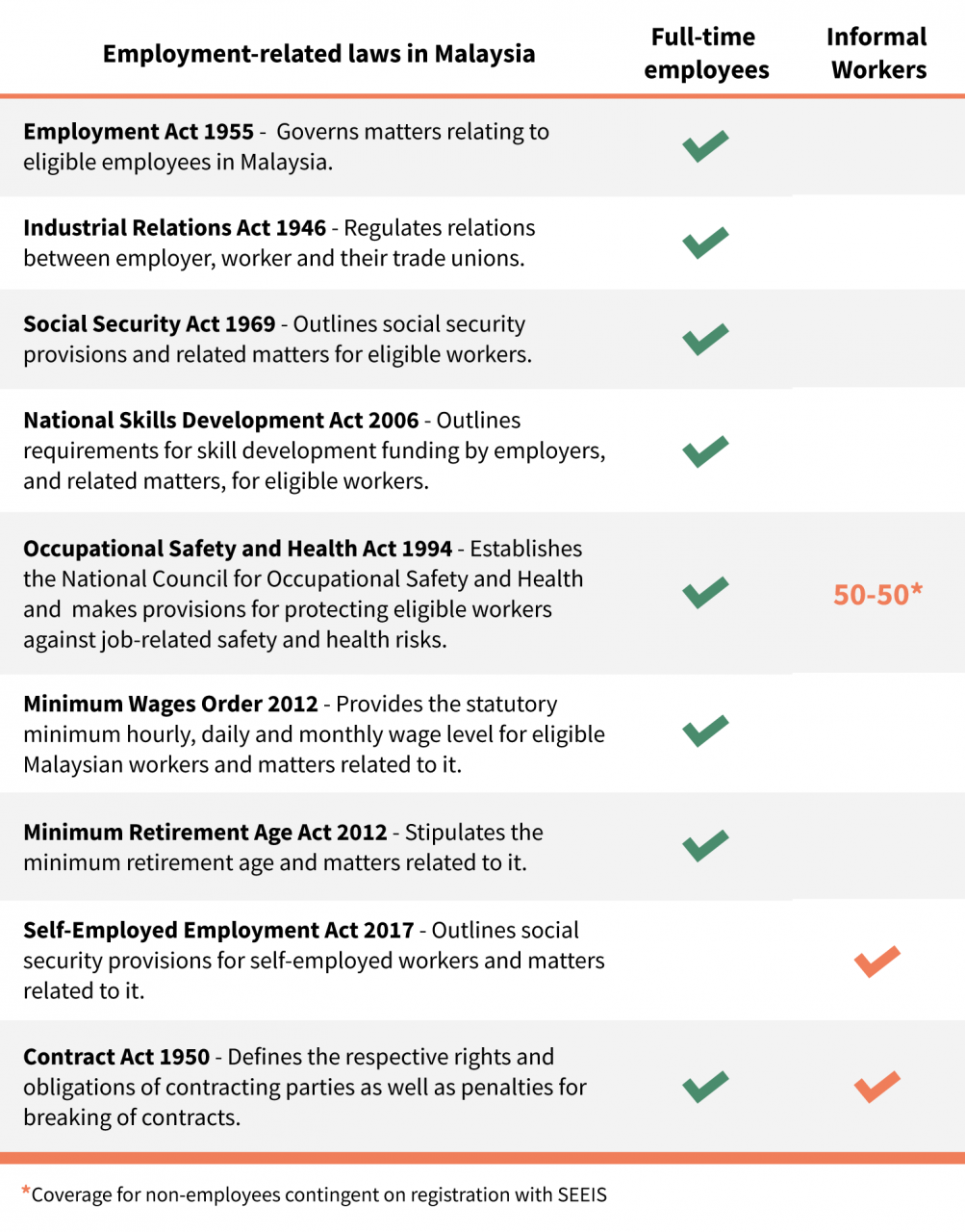
Firstly, the two worker classifications in existence today are insufficient. Today, you are either a formal employee (full-time or part-time*) governed by the Employment Act 1955 and other related legislation or a contractor reliant on the Self-Employed Employment Act 2017 and the Contracts Act 1950 (Figure 4). There is yet a classification that captures the distinct power relationship of a third but growing class of workers i.e. dependent contractors.

*Note: Although current laws and regulations do cover part-time employees, the designation is difficult to enforce in practice.


Figure 4: Current Laws Applicable To Malaysian Workers

Secondly, the premise of employment status and legislation today hinges too much on formalisation, i.e. whether one has a contract of employment or is registered as self-employed. Having an understanding of employment status based on a test of employer control and worker dependence would be a truer way of classifying workers rather than whether or not an employment contract exists (Figure 5).


Figure 5: Definition Of ‘Employee’ Comparison

Malaysia should take care to avoid major classification pitfalls. By applying the lens of power relationships to employment classification, we can have a more grounded and structured understanding of the range of employment status today. More importantly, with a clear understanding of the different power relationships underlying key employment classes, we can also have a more honest discussion of what is fairly owed to different types of workers by employers vs. the government.

Which brings us to the next question, namely what are fair work conditions for they key categories of employment power relationships? As a reference, we looked to the Oxford Internet Institute’s Fair Work Initiative which outlines five core principles of fair work: fair pay, fair working conditions, fair contracts, fair management and fair representation (Figure 6).


Figure 6: Fair Work Principles

Adapted from the Fair Work Initiative, The Oxford Internet Institute.

Putting together fair work principles and the power relationship framework enables policymakers to prescribe employment regulations best suited to the characteristics of each employment classification. What are minimum ‘fair work’ provisions owed to employees, whether formal or informal? What are minimum ‘fair work’ provisions owed to independent contractors vs. dependent contractors? 

In subsequent instalments of this research series, we will propose examples of what fair work principles could look like for the three major employment classifications we’ve proposed namely, employee, independent contractor and dependent contractor.

Updated laws need updated policy frameworks

At the time of writing, countries including France, Spain, and the Netherlands have reclassified some informal gig workers as employees. However, the grounds for classification are not the same across these jurisdictions – the judgements very much depend on local definitions of ‘employee’, ‘contractor’ and ‘gig worker’, amongst other factors. In some cases, having overly broad definitions for ‘gig worker’ led to unanticipated consequences; in the case of California for example, many freelancers lost their job after the passing of AB 5, as their ‘employers’ could not afford to reclassify them as employees as mandated by the new law (which has since been overturned).

Malaysia should heed and extract the right lessons from these court rulings. The key policy decision is not whether to formalise workers or whether to have specific gig worker legislation. Rather, it is to clarify how we’re thinking about employment classification, in ways that capture the evolving dynamics of employment in Malaysia. Only in this way can we adequately fix or bridge the gaps in our current laws to ensure fair work for workers today and to address those left behind.

The landmark UK Supreme Court ruling on Uber in February this year provides an instructive example of employment classification based on (i) power relationships and (ii) transcending the employee-vs.-independent contractor dichotomy.

Following a suit brought by a group of ex-Uber e-hailers, the UK Supreme Court ruled to reclassify a group of 40,000 Uber UK drivers as “workers” entitled to minimum wage, holiday pay and other benefits, due to the management practices imposed on the workers at the time, such as inability to negotiate fares and access job details before they accept the job. Two aspects of this ruling should be noted:

(i) The importance of underlying power relationships. The ruling applied only to a specific group of Uber e-hailing drivers who worked with Uber before 2016 which experienced company policies resulting in lower job autonomy compared to later groups of Uber drivers.

(ii) A ‘third’ classification. The ruling classified the affected e-hailing drivers as ‘workers’, a designation that reflects a higher degree of flexibility relative to ‘employees’. Nevertheless, this designation still comes with its set of rights and benefits as articulated by the UK’s labour laws.

How do we define fair pay for each employment classification? Stay tuned for the next instalment of this research series.

A Year Of Living Under COVID-19

In Part 1 of our COVID-19 and well-being study published on 4 March 2021, we found that more than half of surveyed respondents reported experiencing worsened mental well-being over the past year. Women and people under 35 years old were the most impacted by negative mental health within this period, a finding in line with global studies. Part 1 also showed a clear relationship between physical and mental well-being; those who reported worsened mental well-being over the past year were more likely to also report worsened physical well-being.

In this Part 2 of the research series, we explore the impact of the ‘new normal’ living conditions on mental health. In particular, we found that the number of people you live with and the frequency of working from home have a significant effect on a person’s mental health.

Note: Respondents’ mental health or well-being was measured against their responses to the DASS-21 questionnaire. For more details on how the DASS-21 questionnaire was applied, as well as the study’s overall methodology, please refer to Part 1.

Living Alone and Mental Well-being

Overall, respondents living alone experienced worse mental well-being compared to those who live with others (Figure 1). A high proportion, 78%, of those who live alone reported levels of depression compared to 52%-60% of those who live with others. In terms of severity, 38% of those living alone reported severe and extremely severe depression compared to a lower 23%-28% of those living with others.

The pattern is similar for stress; 60% of those living alone self-reported varying levels of stress compared to 32%-46% of those who live with others. In terms of severity, 28% of respondents living alone experienced severe and extremely severe stress compared to 13%-20% of those living with others.

Notably, this pattern is slightly different for anxiety. In terms of overall incidence, respondents who live alone do not appear to show significantly higher levels of anxiety compared to respondents who live with others. In terms of severity, however, respondents who live alone do show higher levels of severe and extremely severe anxiety at 44%, compared to 24%-33% of those who live with others.

Figure 1: Number of People in Household and Mental Well-being

These findings are consistent with global studies that have found correlations between living alone and psychological distress. The American Psychological Association (APA) attributes this to social isolation, which has been found to have very real health implications such as the increased risk of heart disease and amplified depression.

It is important to note that living alone does not necessarily mean one would experience loneliness or social isolation, but it may present greater mental health risks for certain groups. In sociologist Eric Klinenberg’s study of social isolation and the impact on public health, he found that demographic groups such as men, the elderly, and low-income communities who live alone are more at risk of feeling isolation or loneliness.

Work from Home Frequency and Well-being

When the Movement Control Order (MCO) started last year, the government reported that 33.5% of Malaysian workers began working from home. This change in working mode for many Malaysians has evidently had an effect on workers’ mental well-being (Figure 2). Respondents to our study who work from home every day reported higher depression and stress scores compared to those who work less days from home or who do not work from home at all.

64% of respondents who work from home every day reported levels of depression compared to 53%-55% of those who work from home less frequently or not at all. In terms of severity, 30% of respondents who work from home daily reported severe and extremely severe depression compared to 20%-26% of respondents who work from home less frequently or not at all.

The pattern is similar for stress where 50% of those who work from home every day reported levels of stress compared to 35%-38% of respondents who work from home less frequently or not at all. In terms of severity, however, the differences in severe stress levels between respondents who work from home daily compared to those who work from home less frequently are less marked.

The differences in incidences of anxiety, between those who work from home daily compared to those who work from home less frequently or not at all, is marginal. As with the findings on living alone and anxiety outlined above, similarly here, anxiety is potentially driven more by factors other than working from home arrangements.

Figure 2: Work From Home Frequency and Mental Well-Being

What are the challenges of working from home every day? Singaporean psychologist Jeanette Lim shared that during the COVID-19 pandemic, there was an observable trend of mental health issues stemming from overworking and isolation as a result of working from home. Although working from home may be preferred by some workers, the mental health effects of working from home will need to be a key consideration as companies and the government weigh on policies allowing for flexible working arrangements post-pandemic.

Policy Considerations

The findings above point to the effects of social isolation on Malaysians’ mental health over the past year, as represented by the depression and stress levels of those living alone and those working from home on a daily basis. While other factors also contribute to one’s mental health, the importance of social interaction in daily life may be under-estimated relative to more visible factors, like employment or income changes.

In recent years, mental health in general has been widely discussed by the government, mental health NGOs and public figures. However, in order to address the particular mental health effects of the past year under COVID-19, there should be more awareness amongst policymakers and the general public around specific and unseen risks such as social isolation. Initiatives such as public campaigns could inform the public on ways to deal with social isolation, such as reminding individuals who live alone to keep in touch with their loved ones or to seek social interactions in their communities, while abiding to pandemic-related SOPs.

Public health campaigns should also extend to companies to educate them on the challenges of working from home daily. While companies could endorse flexible working arrangements, further support should be given, for example by instituting policies or practices that support regular checks and maintenance of employee well-being.

Apart from public and corporate awareness on social isolation, there should also be more physical spaces that promote being outside and enable safe social interactions. In an editorial published last year, we discussed a rethinking of urban spaces to accommodate for mental well-being, particularly pro-social spaces such as neighbourhood futsal courts that improve the physical lifestyles and relationships in the communities they are built in.


In the final and third part of our study, we will present our findings on how COVID-19’s impact on the financial and employment situations of many Malaysians has affected their mental well-being.

If you are experiencing emotional or mental health difficulties, get support and help on these hotlines: Mercy Malaysia and the Ministry of Health Crisis Preparedness and Response Centre’s psychosocial support hotline at 03-29359935. Ministry of Women and Family Development’s Talian Kasih hotline at 15999 or WhatsApp 019-2615999.

Bahagian 2: Sokongan Terhadap Hukuman Mati di Kalangan Rakyat Malaysia – Bila dan Untuk Apa?

Muat turun Laporan Penuh ‘Apakah Pendirian Sebenar Rakyat Malaysia Tentang Hukuman Mati?’

Dalam bahagian pertama laporan kami mengenai persepsi terhadap hukuman mati di Malaysia, kami telah kongsikan beberapa sorotan menarik, antaranya, bahawa majoriti kecil (60% daripada kesemua responden) merasakan hukuman mati masih diperlukan di dalam sesebuah masyarakat. Walau bagaimanapun, sejumlah yang agak besar juga iaitu kira-kira satu pertiga daripada responden berada di atas pagar tentang isu ini.

Sokongan untuk hukuman mati sebenarnya lebih bersyarat dan tersirat berbanding dengan dapatan tinjuauan ‘ya/tidak’ yang mudah. Melalui laporan ini, kami kongsikan dapatan kajian kami yang lebih menghalusi persepsi terhadap hukuman mati – termasuk hukuman mati mandatori – dengan mengambil kira pelbagai faktor termasuklah jenis kesalahan, keseriusan jenayah dan juga niat tertuduh. Kami juga telah menguji pandangan responden atas hukuman yang dianggap adil untuk contoh jenayah yang diadaptasi dari kes-kes sebenar.

Hukuman mati bagi jenayah kejam, dengan niat dan berbentuk ‘peribadi’

Sokongan bagi hukuman mati jauh lebih tinggi untuk jenayah kejam terhadap individu seperti kes pembunuhan dan rogol (73% daripada kesemua responden) berbanding dengan terrorisme atau genosid (47% daripada kesemua responden), meskipun jumlah yang terbunuh dalam situasi kedua mungkin lebih tinggi daripada situasi pertama. Hal ini sekali lagi menunjukkan peranan perasaan kasihan untuk mangsa individu serta keluarga mereka dalam sokongan terhadap hukuman mati.

Secara amnya, sokongan responden terhadap hukuman mati melonjak dengan peningkatan tahap keseriusan dan niat penjenayah. Kesalahan yang mempunyai sokongan tertinggi bagi hukuman mati adalah ‘pembunuhan dengan niat’. 85% daripada responden memilih hukuman mati sebagai hukuman maksimum dan yang paling setimpal untuk jenayah ini, dengan hampir separuh daripada kesemua responden memilih hukuman mati mandatori – satu kadar yang signifikan.

Nota. Pilih ikon ‘gear’ di bahagian bawah kanan carta untuk melihat responden berdasarkan demografik mereka, atau tekan pada setiap bulatan untuk maklumat lanjut.

<iframe src='https://flo.uri.sh/story/781929/embed' title='Interactive or visual content' frameborder='0' scrolling='no' style='width:100%;height:600px;' sandbox='allow-same-origin allow-forms allow-scripts allow-downloads allow-popups allow-popups-to-escape-sandbox allow-top-navigation-by-user-activation'></iframe><div style='width:100%!;margin-top:4px!important;text-align:right!important;'><a class='flourish-credit' href='https://public.flourish.studio/story/781929/?utm_source=embed&utm_campaign=story/781929' target='_top' style='text-decoration:none!important'><img alt='Made with Flourish' src='https://public.flourish.studio/resources/made_with_flourish.svg' style='width:105px!important;height:16px!important;border:none!important;margin:0!important;'> </a></div>

Jelas bahawa niat penjenayah adalah penting kepada responden. Berbanding dengan jenayah dengan niat, hanya 42% daripada responden memilih hukuman mati bagi kes-kes yang mengakibatkan kecederaan teruk atau kematian tanpa niat atau secara tidak sengaja, manakala hanya 4% daripada responden memilih hukuman mati mandatori bagi kesalahan tersebut.

<iframe src='https://flo.uri.sh/story/781946/embed' title='Interactive or visual content' frameborder='0' scrolling='no' style='width:100%;height:600px;' sandbox='allow-same-origin allow-forms allow-scripts allow-downloads allow-popups allow-popups-to-escape-sandbox allow-top-navigation-by-user-activation'></iframe><div style='width:100%!;margin-top:4px!important;text-align:right!important;'><a class='flourish-credit' href='https://public.flourish.studio/story/781946/?utm_source=embed&utm_campaign=story/781946' target='_top' style='text-decoration:none!important'><img alt='Made with Flourish' src='https://public.flourish.studio/resources/made_with_flourish.svg' style='width:105px!important;height:16px!important;border:none!important;margin:0!important;'> </a></div>

Apabila fakta kes dikemukakan, pendirian responden terhadap hukuman mati bertukar menjadi lebih sederhana dari pendirian awal mereka, walaupun ia melibatkan kes pembunuhan yang dirancang. Dengan menggunakan fakta dari kes sebenar (yang disusun semula bagi membuang butiran nama atau identiti pihak-pihak terlibat), kami menguji sentimen responden tentang hukuman yang setimpal untuk senario di mana mangsa penderaan rumahtangga didapati bersalah membunuh penderanya. Hanya 27% daripada responden memilih hukuman mati untuk situasi ini : perbezaan yang ketara berbanding 85% responden yang memilih hukuman mati bagi pembunuhan dengan niat. Kewujudan faktor-faktor mitigasi atau pengurangan seperti ini amat penting untuk mengubah pendirian responden ke atas hukuman mati.

<iframe src='https://flo.uri.sh/story/781951/embed' title='Interactive or visual content' frameborder='0' scrolling='no' style='width:100%;height:600px;' sandbox='allow-same-origin allow-forms allow-scripts allow-downloads allow-popups allow-popups-to-escape-sandbox allow-top-navigation-by-user-activation'></iframe><div style='width:100%!;margin-top:4px!important;text-align:right!important;'><a class='flourish-credit' href='https://public.flourish.studio/story/781951/?utm_source=embed&utm_campaign=story/781951' target='_top' style='text-decoration:none!important'><img alt='Made with Flourish' src='https://public.flourish.studio/resources/made_with_flourish.svg' style='width:105px!important;height:16px!important;border:none!important;margin:0!important;'> </a></div>

Bandingkan dengan kes pemuda berperwatakan lembut (kes T. Nhaveen, disusun semula bagi membuang butiran identiti) yang meninggal dunia akibat diserang oleh rakan sebayanya; contoh ini ternyata mengundang kecaman yang lebih tinggi dari para responden kerana kekurangan faktor mitigasi atau pengurangan. 66% daripada responden memilih hukuman mati. Namun begitu, kurang daripada seperempat responden memilih hukuman mati mandatori walaupun sifat kes tersebut begitu kejam.

<iframe src='https://flo.uri.sh/story/781987/embed' title='Interactive or visual content' frameborder='0' scrolling='no' style='width:100%;height:600px;' sandbox='allow-same-origin allow-forms allow-scripts allow-downloads allow-popups allow-popups-to-escape-sandbox allow-top-navigation-by-user-activation'></iframe><div style='width:100%!;margin-top:4px!important;text-align:right!important;'><a class='flourish-credit' href='https://public.flourish.studio/story/781987/?utm_source=embed&utm_campaign=story/781987' target='_top' style='text-decoration:none!important'><img alt='Made with Flourish' src='https://public.flourish.studio/resources/made_with_flourish.svg' style='width:105px!important;height:16px!important;border:none!important;margin:0!important;'> </a></div>

Bagi kesalahan berkaitan dadah, sokongan terhadap hukuman mati kebanyakannya untuk kepala sindiket

Persepsi mengenai hukuman mati dan hukuman setimpal dapat dikatakan paling relevan untuk kesalahan berkaitan dadah. 73% daripada banduan yang menunggu hukuman mati pada hari ini adalah untuk kesalahan mengedar dadah.

Namun, bagi pengedar dadah secara kecil-kecilan atau mereka yang membeli untuk penggunaan peribadi, sokongan responden untuk menjatuhkan hukuman mati terhadap mereka agak rendah. Hanya 35% daripada responden memilih hukuman mati sebagai hukuman setimpal untuk pengedar kecil-kecilan, dan hanya 21% memilih hukuman mati untuk mereka yang membeli untuk penggunaan peribadi.

<iframe src='https://flo.uri.sh/story/782637/embed' title='Interactive or visual content' frameborder='0' scrolling='no' style='width:100%;height:600px;' sandbox='allow-same-origin allow-forms allow-scripts allow-downloads allow-popups allow-popups-to-escape-sandbox allow-top-navigation-by-user-activation'></iframe><div style='width:100%!;margin-top:4px!important;text-align:right!important;'><a class='flourish-credit' href='https://public.flourish.studio/story/782637/?utm_source=embed&utm_campaign=story/782637' target='_top' style='text-decoration:none!important'><img alt='Made with Flourish' src='https://public.flourish.studio/resources/made_with_flourish.svg' style='width:105px!important;height:16px!important;border:none!important;margin:0!important;'> </a></div>
<iframe src='https://flo.uri.sh/story/782641/embed' title='Interactive or visual content' frameborder='0' scrolling='no' style='width:100%;height:600px;' sandbox='allow-same-origin allow-forms allow-scripts allow-downloads allow-popups allow-popups-to-escape-sandbox allow-top-navigation-by-user-activation'></iframe><div style='width:100%!;margin-top:4px!important;text-align:right!important;'><a class='flourish-credit' href='https://public.flourish.studio/story/782641/?utm_source=embed&utm_campaign=story/782641' target='_top' style='text-decoration:none!important'><img alt='Made with Flourish' src='https://public.flourish.studio/resources/made_with_flourish.svg' style='width:105px!important;height:16px!important;border:none!important;margin:0!important;'> </a></div>

Seperti jenayah yang menyebabkan kecederaan teruk dan kematian, niat dan keseriusan juga mendorong sokongan untuk hukuman bagi kesalahan berkaitan dadah. 63% daripada responden memilih hukuman mati bagi kesalahan pemerdagangan dadah berskala besar dengan 28% daripada kesemua responden memilih hukuman mati mandatori.

Terdapat belas ihsan yang lebih terhadap mereka yang ditangkap menjadi keldai atau penyeludup dadah. Hanya 15% daripada responden menyokong hukuman mati terhadap mereka yang membawa dadah tanpa pengetahuan. Sokongan terhadap hukuman mati meningkat kepada 38% bagi penyeludup dadah yang bertindak secara sengaja, sama seperti tahap sokongan yang ditunjukkan bagi jenayah pemerdagangan dadah berskala kecil yang dinyatakan di atas.

<iframe src='https://flo.uri.sh/story/782643/embed' title='Interactive or visual content' frameborder='0' scrolling='no' style='width:100%;height:600px;' sandbox='allow-same-origin allow-forms allow-scripts allow-downloads allow-popups allow-popups-to-escape-sandbox allow-top-navigation-by-user-activation'></iframe><div style='width:100%!;margin-top:4px!important;text-align:right!important;'><a class='flourish-credit' href='https://public.flourish.studio/story/782643/?utm_source=embed&utm_campaign=story/782643' target='_top' style='text-decoration:none!important'><img alt='Made with Flourish' src='https://public.flourish.studio/resources/made_with_flourish.svg' style='width:105px!important;height:16px!important;border:none!important;margin:0!important;'> </a></div>
<iframe src='https://flo.uri.sh/story/782647/embed' title='Interactive or visual content' frameborder='0' scrolling='no' style='width:100%;height:600px;' sandbox='allow-same-origin allow-forms allow-scripts allow-downloads allow-popups allow-popups-to-escape-sandbox allow-top-navigation-by-user-activation'></iframe><div style='width:100%!;margin-top:4px!important;text-align:right!important;'><a class='flourish-credit' href='https://public.flourish.studio/story/782647/?utm_source=embed&utm_campaign=story/782647' target='_top' style='text-decoration:none!important'><img alt='Made with Flourish' src='https://public.flourish.studio/resources/made_with_flourish.svg' style='width:105px!important;height:16px!important;border:none!important;margin:0!important;'> </a></div>

Jelas, apabila dikemukakan dengan faktor-faktor mitigasi yang diambil dari contoh kes sebenar, pendirian responden terhadap hukuman mati dan kesalahan kecil berkaitan dadah sebelum ini bertukar menjadi lebih sederhana. Sebagai contoh, hanya 14% daripada responden memilih hukuman mati bagi seorang remaja yang ditangkap dengan 600 gram kanabis*.

<iframe src='https://flo.uri.sh/story/782650/embed' title='Interactive or visual content' frameborder='0' scrolling='no' style='width:100%;height:600px;' sandbox='allow-same-origin allow-forms allow-scripts allow-downloads allow-popups allow-popups-to-escape-sandbox allow-top-navigation-by-user-activation'></iframe><div style='width:100%!;margin-top:4px!important;text-align:right!important;'><a class='flourish-credit' href='https://public.flourish.studio/story/782650/?utm_source=embed&utm_campaign=story/782650' target='_top' style='text-decoration:none!important'><img alt='Made with Flourish' src='https://public.flourish.studio/resources/made_with_flourish.svg' style='width:105px!important;height:16px!important;border:none!important;margin:0!important;'> </a></div>

*Kes sebenar yang mana seorang pemuda berusia 18 tahun daripada isi rumah yang berpendapatan rendah dijatuhkan hukuman mati kerana mengedar dadah.

Beberapa perbezaan yang ketara antara demografik

Jantina. Wanita lebih cenderung berbanding lelaki untuk menyokong hukuman mati bagi penjualan dadah berskala kecil dan pengangkutan dadah secara sengaja.

Umur. Mereka yang berusia 45 tahun ke atas adalah lebih bersikap menghukum terhadap pesalah dadah berbanding mereka yang berusia bawah 45 tahun. Semakin berusia seseorang responden, semakin cenderung mereka untuk mengenakan hukuman mati kepada pesalah dadah.

Tahap Pendidikan. Pemegang ijazah sarjana muda lebih cenderung untuk memilih hukuman mati bagi pengedar dadah berskala kecil berbanding mereka yang berpendidikan menengah.

Sokongan bagi hukuman mati sebenarnya lebih rendah dan lebih bersyarat dari dijangka

Seperti yang dilihat dalam Bahagian 1 laporan kajian kami, rakyat Malaysia secara umumnya bersifat konservatif dalam pandangan mengenai jenayah dan hukuman. Majoriti (60%) masih percaya bahawa hukuman mati diperlukan dalam sebuah masyarakat berbanding hanya 4% daripada responden yang percaya bahawa hukuman mati tidak patut dilaksanakan langsung. Sebilangan besar daripada responden memegang kepada prinsip pembalasan (71%) dan juga pada kepercayaan pencegahan (85%).

Namun begitu, pendirian rakyat Malaysia terhadap hukuman mati, terutamanya hukuman mati mandatori, semakin menurun apabila berhadapan dengan kesalahan yang berbeza keseriusan dan niat. Sokongan untuk hukuman mati menurun lagi apabila diberi konteks atau faktor mitigasi di sebalik sesuatu jenayah.

Sebagai gambaran menyeluruh mutakhir: sebanyak 60% daripada responden percaya bahawa hukuman mati diperlukan dalam masyarakat, tetapi hanya 1% daripada para responden memilih hukuman mati mandatori sebagai hukuman yang setimpal untuk semua senario jenayah yang kami kemukakan. Kurang daripada 10% dari kalangan responden memilih hukuman mati mandatori dalam senario jenayah berkaitan dadah.

Garis panduan untuk kadar penjatuhan hukuman di Malaysia jelas tidak selari dengan pertimbangan orang ramai, terutamanya bagi kesalahan berkaitan dadah. Dengan kemunculan marijuana perubatan, isu hukuman setimpal dan keadilan hanya akan menjadi lebih meruncing.

Pada awal tahun 2020, sebuah Jawatankuasa Khas yang diketuai oleh Tan Sri Richard Malanjum untuk mengkaji semula hukuman alternatif bagi hukuman mati mandatori telah mengemukakan cadangan mereka kepada kerajaan Pakatan Harapan ketika itu. Mantan Menteri Undang-undang Datuk Liew Vui Keong juga telah berjanji untuk mengemukakan cadangan kepada Jemaah Kabinet untuk perbincangan sebelum membawa hal tersebut ke Parlimen.

Kami berharap agar kerja-kerja Jawatankuasa Khas tersebut diteruskan di bawah kerajaan semasa dan kami menuntut arah dasar yang jelas serta ingin menyaksikan kemajuan yang lebih nyata dalam menutup jurang antara peruntukan dalam undang-undang dan pertimbangan kolektif mengenai apa yang dimaksudkan sebagai hukuman yang adil. Berdasarkan kes seperti Dr. Ganja dan beratus lagi yang kini menunggu hukuman mati, jelaslah bahawa banyak lagi kerja-kerja perundangan yang perlu diteruskan walaupun dalam kesibukan mengurus ‘norma baharu’ dunia Covid-19. The Centre juga menyokong agar kajian pendapat orang ramai yang lebih terperinci lagi dijalankan, bukan sahaja bagi merakam pendapat umum dengan lebih menyeluruh tetapi juga untuk memberi sokongan kepada penggubal dasar dan undang-undang untuk membuat pembaharuan dasar dan undang-undang yang lebih baik.

Emel pandangan atau cadangan anda ke editorial@centre.my.

Bahagian 1: Sejauh Manakah Rakyat Malaysia Menyokong Hukuman Mati?

Muat turun Laporan Penuh ‘Apakah Pendirian Sebenar Rakyat Malaysia Tentang Hukuman Mati?’

Pada tahun 2018, kerajaan Pakatan Harapan pada ketika itu telah mengumumkan penghapusan hukuman mati untuk semua kesalahan yang menetapkan hukuman tersebut. Langkah ini, yang dilihat sebagai progresif oleh sebahagian masyarakat Malaysia, juga ada menerima reaksi negatif dari orang ramai. Mengeruhkan keadaan pada masa itu juga adalah beberapa kenyataan dasar yang bertentangan dan mengelirukan.

Sejak pengumuman tersebut, Malaysia telah mengalami pertukaran kerajaan dan masih lagi mengalami cabaran pandemik global Covid-19. Sepertimana isu-isu lain, persoalan tentang hukuman mati seolah-olah lenyap dari muka penggubalan dasar dan kelihatan seperti tiada resolusi.

Berdasarkan pandangan-pandangan yang ditonjolkan dalam pelbagai sidang akhbar, memorandum dan petisyen di ruang-ruang awam, pendirian rakyat Malaysia berkenaan isu hukuman mati boleh diandaikan sebagai ‘konservatif’. Pungutan-pungutan suara yang pernah diadakan sebelum ini juga menyokong andaian tersebut. Sebagai contoh, satu undian awam dikelolakan akhbar telah melaporkan bahawa sejumlah besar, iaitu 82% daripada responden, menentang pemansuhan hukuman mati.  

Walau bagaimanapun, adakah kefahaman rakyat Malaysia berkenaan hukuman mati benar-benar jelas, dan adakah pendirian mereka benar-benar tegas mengenai hukuman mati? Dan sejauh manakah kita dapat mengukur sentimen orang ramai tentang isu yang rumit dan penuh emosi ini berdasarkan undian setuju/tidak bersetuju yang mudah?

Kami di The Centre ingin mengetahui dengan lebih lanjut pendirian masyarakat berkenaan isu pengadilan ataupun hukuman yang setimpal. Oleh itu, kami telah cuba mencari jawapan kepada persoalan-persoalan tersebut melalui satu kajian yang lebih mutakhir.

Primer kami merumuskan isu berkenaan dengan hukuman mati di Malaysia. 

Tentang Kajian Kami

Bersama rakan kerja tinjauan lapangan kami iaitu Hometrics, The Centre telah menjalankan satu tinjauan secara meluas antara 29 November 2019 dan 6 Disember 2019 untuk mengumpul pendapat orang ramai terhadap hukuman mati. Kami telah mengkaji kepastian pandangan mereka dengan meneliti reaksi mereka terhadap jenis-jenis kesalahan yang membawa kepada hukuman mati, kewujudan faktor-faktor yang menggalak atau mengurangkan sokongan kepada hukuman mati, dan juga hukuman yang wajar bagi beberapa senario yang berasaskan kes-kes sebenar.

Tahukah anda:
Sebilangan besar kes hukuman mati di Malaysia adalah kerana kesalahan berkaitan dadah.

Soalan-soalan di dalam borang tinjauan diadaptasi daripada tiga kajian sedia ada berkenaan hukuman mati iaitu tinjauan pendapat umum yang meluas di Malaysia oleh Profesor Roger Hood pada tahun 2013,  kajian di Singapura yang dilaksanakan oleh penyelidik di National University of Singapore (NUS) pada 2018, serta skala sikap terhadap hukuman mati yang dijalankan oleh Kevin O’Neil dan  pasukan penyelidik beliau dari Amerika Syarikat.

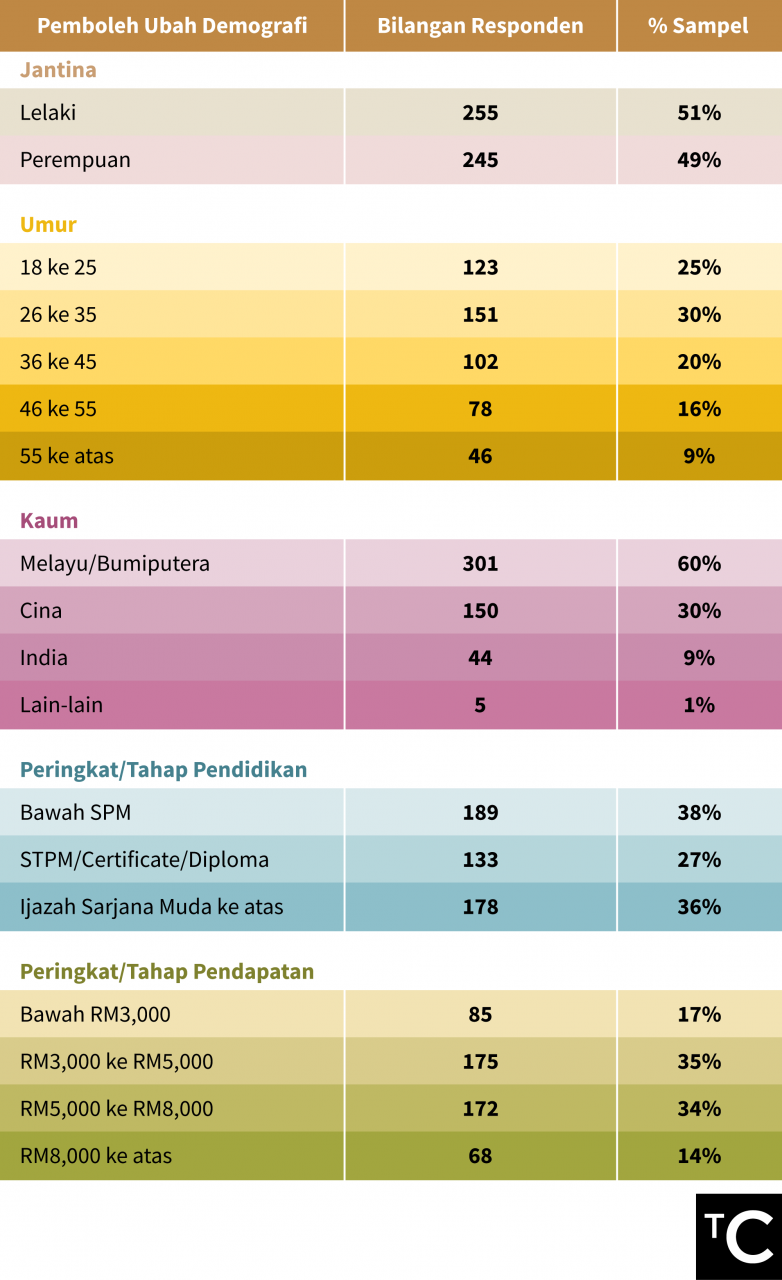
Tinjauan dalam pilihan Bahasa Malaysia, Bahasa Inggeris dan Mandarin ini telah dijalankan melalui 500 wawancara tatap muka di Semenanjung Malaysia dengan pecahan jantina, umur, kumpulan etnik yang mirip pecahan senegara. Pecahan demografi responden adalah seperti berikut:

Catatan: Oleh kerana kekangan tertentu, tinjauan tatap muka ini hanya dijalankan di Semenanjung Malaysia sahaja.

Majoriti berpendapat hukuman mati harus wujud, tetapi ramai juga di atas pagar

Para responden disoal jika mereka berpendapat bahawa hukuman mati merupakan suatu keperluan dalam sesebuah masyarakat. Majoriti yang kecil, 60%, bersetuju atau sangat bersetuju dengan pernyataan ini. Walau bagaimanapun, 31% daripada para responden, satu jumlah yang agak signifikan, mengaku berada di tengah-tengah iaitu bukan setuju tetapi juga bukan tidak setuju. Hasil ini menunjukkan bahawa persepsi rakyat Malaysia tentang hukuman mati tidaklah seperti gambaran yang diperolehi melalui undian dalam talian. Apabila tinjauan dilakukan berdasarkan pecahan demografi Malaysia, didapati bahawa ramai juga rakyat Malaysia sebenarnya tidak pasti mengenai isu hukuman mati.

Nota Capaian: Pilih ikon ‘gear’ di bahagian bawah kanan  carta untuk melihat para responden berdasarkan demografik mereka atau tekan pada setiap bulatan untuk melihat maklumat lebih lanjut.

<iframe src='https://flo.uri.sh/story/781635/embed' title='Interactive or visual content' frameborder='0' scrolling='no' style='width:100%;height:600px;' sandbox='allow-same-origin allow-forms allow-scripts allow-downloads allow-popups allow-popups-to-escape-sandbox allow-top-navigation-by-user-activation'></iframe><div style='width:100%!;margin-top:4px!important;text-align:right!important;'><a class='flourish-credit' href='https://public.flourish.studio/story/781635/?utm_source=embed&utm_campaign=story/781635' target='_top' style='text-decoration:none!important'><img alt='Made with Flourish' src='https://public.flourish.studio/resources/made_with_flourish.svg' style='width:105px!important;height:16px!important;border:none!important;margin:0!important;'> </a></div>

Bagi mengesahkan pendirian umum mereka terhadap keperluan hukuman mati, para responden juga diminta untuk menyatakan jika pendirian atau pendapat mereka terhadap hukuman mati adalah kukuh. 59% daripada para responden bersetuju atau sangat bersetuju bahawa mereka mempunyai pandangan yang kukuh atau tegas terhadap hukuman mati. Namun, selebihnya, iaitu 41% tidak berapa pasti— satu lagi perincian penting. 

<iframe src='https://flo.uri.sh/story/781658/embed' title='Interactive or visual content' frameborder='0' scrolling='no' style='width:100%;height:600px;' sandbox='allow-same-origin allow-forms allow-scripts allow-downloads allow-popups allow-popups-to-escape-sandbox allow-top-navigation-by-user-activation'></iframe><div style='width:100%!;margin-top:4px!important;text-align:right!important;'><a class='flourish-credit' href='https://public.flourish.studio/story/781658/?utm_source=embed&utm_campaign=story/781658' target='_top' style='text-decoration:none!important'><img alt='Made with Flourish' src='https://public.flourish.studio/resources/made_with_flourish.svg' style='width:105px!important;height:16px!important;border:none!important;margin:0!important;'> </a></div>

Sokongan untuk hukuman mati didorong prinsip ‘pencegahan’ dan ‘pembalasan’

Kajian-kajian di peringkat global yang dijalankan atas persepsi masyarakat tentang hukuman mati telah mengenal pasti empat faktor utama atau kepercayaan yang mendorong sokongan atau tentangan terhadap hukuman mati: pembalasan, pencegahan, pragmatisme dan pemulihan.

Sokongan rakyat Malaysia terhadap hukuman mati umumnya didorong oleh kepercayaan mereka dalam prinsip pencegahan. Majoriti yang amat ketara, iaitu sebanyak 85% daripada para responden, percaya bahawa hukuman mati mampu menyebabkan seseorang untuk berfikir dua kali daripada melakukan sesuatu jenayah. Kepercayaan pada prinsip pencegahan ini adalah agak kuat dalam sesetengah masyarakat, namun tiada bukti yang kukuh sehingga kini yang menunjukkan bahawa hukuman mati mempunyai kesan pencegahan.

<iframe src='https://flo.uri.sh/story/781688/embed' title='Interactive or visual content' frameborder='0' scrolling='no' style='width:100%;height:600px;' sandbox='allow-same-origin allow-forms allow-scripts allow-downloads allow-popups allow-popups-to-escape-sandbox allow-top-navigation-by-user-activation'></iframe><div style='width:100%!;margin-top:4px!important;text-align:right!important;'><a class='flourish-credit' href='https://public.flourish.studio/story/781688/?utm_source=embed&utm_campaign=story/781688' target='_top' style='text-decoration:none!important'><img alt='Made with Flourish' src='https://public.flourish.studio/resources/made_with_flourish.svg' style='width:105px!important;height:16px!important;border:none!important;margin:0!important;'> </a></div>

Kepercayaan kepada prinsip pembalasan juga tinggi – 71% daripada responden menyatakan mereka akan merasa puas hati jika pesalah jenayah-jenayah tertentu menebus dosa dengan nyawa mereka. Menariknya, pegangan kepada prinsip pembalasan ini lebih kepada keinginan responden untuk mendapatkan keadilan bagi keluarga mangsa (73% responden) berbanding keadilan bagi pihak masyarakat (60% responden).

<iframe src='https://flo.uri.sh/story/781690/embed' title='Interactive or visual content' frameborder='0' scrolling='no' style='width:100%;height:600px;' sandbox='allow-same-origin allow-forms allow-scripts allow-downloads allow-popups allow-popups-to-escape-sandbox allow-top-navigation-by-user-activation'></iframe><div style='width:100%!;margin-top:4px!important;text-align:right!important;'><a class='flourish-credit' href='https://public.flourish.studio/story/781690/?utm_source=embed&utm_campaign=story/781690' target='_top' style='text-decoration:none!important'><img alt='Made with Flourish' src='https://public.flourish.studio/resources/made_with_flourish.svg' style='width:105px!important;height:16px!important;border:none!important;margin:0!important;'> </a></div>
<iframe src='https://flo.uri.sh/story/781696/embed' title='Interactive or visual content' frameborder='0' scrolling='no' style='width:100%;height:600px;' sandbox='allow-same-origin allow-forms allow-scripts allow-downloads allow-popups allow-popups-to-escape-sandbox allow-top-navigation-by-user-activation'></iframe><div style='width:100%!;margin-top:4px!important;text-align:right!important;'><a class='flourish-credit' href='https://public.flourish.studio/story/781690/?utm_source=embed&utm_campaign=story/781690' target='_top' style='text-decoration:none!important'><img alt='Made with Flourish' src='https://public.flourish.studio/resources/made_with_flourish.svg' style='width:105px!important;height:16px!important;border:none!important;margin:0!important;'> </a></div>
<iframe src='https://flo.uri.sh/story/781711/embed' title='Interactive or visual content' frameborder='0' scrolling='no' style='width:100%;height:600px;' sandbox='allow-same-origin allow-forms allow-scripts allow-downloads allow-popups allow-popups-to-escape-sandbox allow-top-navigation-by-user-activation'></iframe><div style='width:100%!;margin-top:4px!important;text-align:right!important;'><a class='flourish-credit' href='https://public.flourish.studio/story/781711/?utm_source=embed&utm_campaign=story/781711' target='_top' style='text-decoration:none!important'><img alt='Made with Flourish' src='https://public.flourish.studio/resources/made_with_flourish.svg' style='width:105px!important;height:16px!important;border:none!important;margin:0!important;'> </a></div>

Secara perbandingan, kepercayaan terhadap prinsip pragmatisme dan pemulihan sebagai faktor di sebalik pendirian responden terhadap hukuman mati tidaklah begitu kuat. Dari segi pragmatisme, responden berbelah bahagi. Hanya 50% daripada responden bersetuju bahawa menjatuhkan hukuman mati lebih berkesan dari segi kos berbanding menjatuhkan hukuman penjara seumur hidup. Satu pencarian yang menarik dari tinjauan ini: pemegang ijazah lebih bersetuju bahawa hukuman mati adalah lebih berkesan dari segi kos berbanding dengan responden yang tidak memegang ijazah.

<iframe src='https://flo.uri.sh/story/781713/embed' title='Interactive or visual content' frameborder='0' scrolling='no' style='width:100%;height:600px;' sandbox='allow-same-origin allow-forms allow-scripts allow-downloads allow-popups allow-popups-to-escape-sandbox allow-top-navigation-by-user-activation'></iframe><div style='width:100%!;margin-top:4px!important;text-align:right!important;'><a class='flourish-credit' href='https://public.flourish.studio/story/781713/?utm_source=embed&utm_campaign=story/781713' target='_top' style='text-decoration:none!important'><img alt='Made with Flourish' src='https://public.flourish.studio/resources/made_with_flourish.svg' style='width:105px!important;height:16px!important;border:none!important;margin:0!important;'> </a></div>

Responden berbelah bahagi mengenai pemberian peluang kedua

Walaupun 60% daripada responden menyokong hukuman mati secara umumnya, terdapat majoriti yang lebih tinggi, iaitu sebanyak 83%, yang bersetuju dengan idea pemenjaraan seumur hidup sebagai hukuman.

<iframe src='https://flo.uri.sh/story/781774/embed' title='Interactive or visual content' frameborder='0' scrolling='no' style='width:100%;height:600px;' sandbox='allow-same-origin allow-forms allow-scripts allow-downloads allow-popups allow-popups-to-escape-sandbox allow-top-navigation-by-user-activation'></iframe><div style='width:100%!;margin-top:4px!important;text-align:right!important;'><a class='flourish-credit' href='https://public.flourish.studio/story/781774/?utm_source=embed&utm_campaign=story/781774' target='_top' style='text-decoration:none!important'><img alt='Made with Flourish' src='https://public.flourish.studio/resources/made_with_flourish.svg' style='width:105px!important;height:16px!important;border:none!important;margin:0!important;'> </a></div>

Namun begitu, pada masa yang sama, hanya 39% daripada responden bersetuju untuk memberi peluang kedua kepada penjenayah yang telah dijatuhkan hukuman penjara seumur hidup. Hanya 41%, iaitu kurang daripada setengah daripada para responden, bersetuju dengan pengurangan tempoh hukuman atau pengampunan. Hasil ini memberi gambaran bahawa jumlah yang agak signifikan bersikap agak tegas terhadap mereka yang telah didapati bersalah.

<iframe src='https://flo.uri.sh/story/781777/embed' title='Interactive or visual content' frameborder='0' scrolling='no' style='width:100%;height:600px;' sandbox='allow-same-origin allow-forms allow-scripts allow-downloads allow-popups allow-popups-to-escape-sandbox allow-top-navigation-by-user-activation'></iframe><div style='width:100%!;margin-top:4px!important;text-align:right!important;'><a class='flourish-credit' href='https://public.flourish.studio/story/781777/?utm_source=embed&utm_campaign=story/781777' target='_top' style='text-decoration:none!important'><img alt='Made with Flourish' src='https://public.flourish.studio/resources/made_with_flourish.svg' style='width:105px!important;height:16px!important;border:none!important;margin:0!important;'> </a></div>

Beberapa perbezaan demografik yang menarik

Kumpulan etnik. Responden Cina adalah 16% lebih cenderung untuk menyokong hukuman mati berbanding responden Melayu/Bumiputera, manakala responden India adalah 18% lebih cenderung untuk menyokong hukuman mati berbanding responden Melayu/Bumiputera.

Tahap pendidikan. Responden berpendidikan tinggi adalah 45% lebih cenderung untuk menyokong hukuman mati berbanding responden berpendidikan menengah. 

Tahap pendapatan. Responden yang mempunyai pendapatan isi rumah RM8,000 dan ke atas adalah 23% kurang cenderung untuk menyokong hukuman mati berbanding responden yang mempunyai pendapatan isi rumah bawah RM3,000.

Kekalkan tapi jangan laksanakan?

Hanya 4% daripada responden kepada tinjauan kami percaya bahawa hukuman mati patut tidak dilaksanakan langsung berbanding 60% daripada responden yang percaya bahawa hukuman mati masih diperlukan dalam sesebuah masyarakat. Adakah hal ini berpunca daripada kepentingan simbolik hukuman mati dalam rang undang-undang kita? Dalam editorial kami yang lalu, kami telah membuat hipotesis bahawa kewujudan hukuman mati adalah penting dari segi simbolik untuk kebanyakan rakyat Malaysia tetapi soal pelaksanaannya adalah lebih rumit.

Kami dapati bahawa hipotesis di atas sedikit sebanyak disokong oleh hasil tinjauan kami. Pendapat rakyat Malaysia atas pelaksanaan hukuman mati – termasuk hukuman mati mandatori – sangat bergantung kepada jenis kesalahan serta kehadiran faktor-faktor lain. Baca selanjutnya di Bahagian 2 laporan kami.

Emel pandangan atau cadangan anda ke editorial@centre.my

Malaysia’s Fake News Ordinance: Rigid Rules For A Nuanced Problem

On 12th March, Malaysia’s federal government gazetted the Emergency (Essential Powers) (No. 2) Ordinance 2021. The ordinance makes it an offence for any person to spread fake news relating to the Covid-19 pandemic and the proclamation of the Emergency. According to Communications and Multimedia Minister Datuk Saifuddin Abdullah, the ordinance is necessary, as fake news may cause panic or concern among the public, especially during the roll-out of the National Covid-19 Immunisation Programme. De facto Law Minister Datuk Seri Takiyuddin Hassan has also pledged that the ordinance is only for the short term, as it will cease by six months after the Emergency is lifted.

However, there has been no shortage of criticism towards the government over the ordinance, especially given that it prescribes a hefty fine of up to RM500,000 as well as a maximum jail sentence of 6 years for offences such as “creating” and “publishing” fake news. Civil society organizations and lawyers, among others, have voiced concerns over its potential impact on civil liberties in the country. It has also been pointed out that the ordinance mirrors the repealed Anti-Fake News Act, which had also sparked public uproar in 2018. 

To date, Malaysia is among the 17 countries around the world which have introduced legislation to criminalise fake news. Germany, Singapore, and Russia, for example, introduced such laws within the past three years which, like Malaysia, have attracted sharp criticism regarding potential restriction on free speech. There is also concern that such laws would encourage misuse and abuse of power.

At the heart of the criticism is the concern over the vague definition of what constitutes fake news, the proportionality of punishment, as well as the neutrality in enforcing such laws. These issues are similar to the problems in managing hate speech, which we at The Centre researched in-depth last year.

‘Fake news’ should be defined through levels of ‘seriousness’

The ordinance defines fake news as “any news, information, data, or report which is wholly or partly false relating to Covid-19 or the proclamation of Emergency, whether in the form of features, visuals, or audio recordings, or any other form capable of suggesting words or ideas.” 

This definition, however, does not capture the nuances of information disorder in the public domain. Some content is not actually fake; it could be genuine information which is either used out of context or weaponised with malicious intent. 

Information disorder is mainly understood under three main categories that vary by intention to harm: misinformation, disinformation, and malinformation.

Types Of Information Disorder
Misinformation: Dissemination of false information without intention to harm
Disinformation: Dissemination of false information with intention to harm
Malinformation: Dissemination of genuine information meant to cause harm

What distinguishes such content from one another is the intention to deceive, and criminal penalties should only be reserved for ‘serious’ types of fake news — where there is the highest intention to harm through disinformation and malinformation. The definition of fake news needs to have a classification aspect that captures its impact or seriousness so that the risk of overreaction and under-reaction can be minimised. We highlighted a similar issue in our research on hate speech last year; to manage hate speech or other types of information disorder effectively, defining and classifying speech by their ‘seriousness’ are prerequisites to outlining proportionate responses to them.

Should all ‘fake news’ be treated the same?

The ordinance stipulates hefty fines and lengthy jail terms for those found guilty of creating or sharing ‘fake news’. This is in addition to other related legislation in Malaysia, such as Section 505 of the Penal Code and Section 233 of the Communications and Multimedia Act, which already carry similar punishments.

While criminal penalties are necessary in dealing with ‘serious’ levels of disinformation, they are unsuitable for managing ‘less serious’ forms of information disorder. Under the current ordinance, a misinformed person who shared certain false information with others out of genuine concern (e.g. rumoured Covid-19 spread at a location) might be faced with the same penalties as someone who shared false information with intent to discredit Covid-19 vaccines.

‘Less serious’ forms of information disorder should be addressed by more preemptive and rehabilitative measures such as public education and the issuance of pre-sharing warnings by media platforms, among others. In our research, we also stressed on the necessity of a whole-of-society response including civil society-led programs (such as an NGO-led fact checker) as well as a national arbiter in the form of an independent commission or tribunal.

Managing ‘fake news’ with a more cohesive approach

It is undeniable that in times of vaccine misinformation and Covid-19 skepticism,  unchecked information disorder may potentially bring serious repercussions to public safety and order. Nonetheless, the ordinance sends a message that Malaysia overly relies on punitive measures. 

Fines and jail time should only be used for the highest intention to deceive through ‘fake news’. A whole-of-society approach is needed to tackle information disorder effectively and proportionately. The various types of Covid-19 related information disorder can and should be addressed if we are to balance freedom of expression with the responsibilities of living with a global pandemic.

*This piece also appeared as an op-ed on Malay Mail and The Rakyat Post.

A Year Of Living Under COVID-19

Since the pandemic began last year, the lives of many Malaysians have been upended. For thousands, COVID-19 wreaked direct havoc via bodily infection. For millions of others, the pandemic took a toll on their overall mental and physical health.

Last year, we set out to investigate how the pandemic and the first MCO affected the mental health of Malaysians. We found that over half of our respondents experienced negative mental health. How has the situation changed now, almost a year later? We replicated last year’s study and expanded the scope to include questions on physical health and financial well-being.

In this Part 1 of the research series, we present findings on how the year-long pandemic has affected the overall mental and physical well-being of Malaysians. Part 2 will present findings on the impact of living conditions and work-from-home arrangements while Part 3 will present findings on financial well-being.

About The Study

The study was conducted via an online survey distributed using a snowball sampling method between 4 February to 14 February 2021. The survey was available in Malay, English and Mandarin. 

Given that a snowball sampling method was used, responses to this study do not represent a nationally stratified sample. Hence, we advise readers to interpret the results with this limitation in mind. Similar to our previous study last year, the DASS-21 questionnaire was used to measure mental well-being, specifically the presence and severity of depression, anxiety, and stress.

Developed by researchers at the University of New South Wales in Australia, the DASS-21 questionnaire (a shortened version of the original 42-question list) measures mental well-being based on individuals’ self-assessment of their mental state:

Depression is ascertained via self-reported levels of general dissatisfaction, hopelessness, and lack of interest. Anxiety is ascertained via self-reported levels of reactions to physical situations and the general experience of anxiety. Stress is ascertained via self-reported levels of difficulty in relaxing, agitation, impatience, and over-reactiveness.

*DASS-21 questionnaire table used in our study: https://forms.gle/cTryAn9sx6gvh63U8

The DASS-21 questionnaire does not diagnose depression, anxiety, or stress as a medical condition. While the DASS-21 evaluations can be used by non-psychologists for research such as this study, clinical decisions based on the scores can only be made by experienced clinicians alongside extensive clinical examination.

The scores from the DASS-21 questionnaire can be classified into levels of severity ranging from normal, mild, moderate, severe, to extremely severe (see Figure 1 below).

Figure 1: DASS-21 Scale

Source: PsyToolkit

936 responses were collected during the study period of which 2 were rejected due to duplication, leaving a sample of 934 responses.

52% of the respondents were female, representing a good gender balance. 50% of respondents were under 35 years of age. Ethnically, 76% were Malay/Bumiputera. Geographically, 74% of respondents came from Central states, which skews this study’s findings more towards urban dwellers. 

Figure 2: Respondent Demographics

Overall Mental Well-Being

IMPORTANT NOTE: The responses of the DASS-21 questionnaire measures the intensity of general feelings of depression, anxiety, or stress as reported by respondents. This study is not medically diagnostic. Any clinical diagnosis of mental health or mental illness needs to be done by a qualified professional.

We begin by looking at overall mental well-being levels as reported by respondents via the DASS-21 questionnaire. As shown in Figure 3, depression and anxiety levels are clearly higher overall than stress levels.

58% of respondents reported experiencing levels of depression with 26% reporting severe and extremely severe levels of depression. 56% of respondents reported experiencing levels of anxiety with 31% reporting severe and extremely severe anxiety – the highest among severely felt emotions. Stress appears to have the lowest scores comparatively. 42% of respondents reported experiencing levels of stress with 19% reporting severe and extremely severe stress.

Figure 3: Overall Depression, Anxiety and Stress Scores

A side-by-side comparison with our study last year shows that respondents’ scores representing depression, anxiety and stress are higher this year (Figure 4 below). 58% of respondents reported levels of depression in this year’s study compared to 48% of respondents last year. 56% of respondents reported levels of anxiety this year compared to 45% of respondents last year, while 42% of respondents reported levels of stress this year against 34% of respondents last year. ‘Severe’ and ‘extremely severe’ levels of depression, anxiety and stress as reported by respondents this year also show a marked increase compared to last year.

Figure 4: DASS-21 Score Comparison, 2021 vs. 2020

The above comparison does need to be read with caution as the sample composition between last year and this year is slightly different, as is typical with the snowball sampling method*. While this is not strictly a longitudinal study, the comparison between both years’ well-being scores does indicate a high likelihood of worsened mental well-being overall among the general population within the last year.

Note: Total number of respondents of last year’s study is 1,084 vs. 934 respondents this year. This year’s study sample had a smaller female base at 52% vs. 66% last year and a smaller Malay/Bumiputera demographic (76% compared to last year’s 81%).

In addition to the DASS-21 questionnaire, we also asked respondents how they themselves perceived their mental well-being compared to last year. A significant proportion, 43%, reported no change in their mental well-being but an almost similar proportion, 42%, felt that their mental state had worsened. Only 15% stated that their mental well-being had improved over the past year.

Figure 5: Respondent Self-Perception of Mental Well-being Compared to Last Year

Respondents’ own impressions of how their mental health has changed over the past year correlate very closely to their DASS-21 scores. As shown in Figure 6 below, the incidence and severity of self-reported levels of depression, anxiety and stress are much higher for respondents who felt worse in their mental well-being compared to those who felt better or no change in their mental state within the last year.

Figure 6: Overall Mental Well-being and Relationship with DASS-21 Scores

An interesting point to note is the level of depression, anxiety and stress experienced by those who felt ‘better’ or ‘no change’ in their mental well-being compared to last year. 39% of these respondents feel some level of depression, 39-47% feel some level of anxiety and 22-23% feel some level of stress. This indicates that feeling comparatively ‘better’ mentally does not necessarily mean escaping varying levels of depression, anxiety or stress. A longitudinal study would be necessary to determine whether these are effects from the global pandemic or a base level of mental well-being for Malaysians overall.

Demographic Differences

Significant demographic differences in mental health effects were clearly seen. One significant difference is gender; more women than men reported experiencing levels of negative mental health. The second major demographic difference is age. Those from younger age groups i.e. ages 18-34 reported worse mental well-being compared to those in older age groups.

Gender

Figure 7 shows the gender differences in reported levels of depression, anxiety and stress. Women reported experiencing significantly worse mental well-being than men across the board. 

Figure 7: Differences in Mental Well-being According to Gender

More women, 64%, reported experiencing levels of depression compared to 52% of men. In terms of severity, 32% of women reported severe or extremely severe depression compared to 20% of men.

Similarly for anxiety, 61% of women respondents reported experiencing levels of anxiety compared to 50% of their male counterparts. In terms of severity, 37% of women self-reported severe and extremely severe anxiety, compared to 24% of men.

For stress, 50% of women self-reported levels of stress compared to 34% of men. In terms of severity, 22% of women reported experiencing severe and extremely severe stress compared to 15% of men.

There were also gender differences in respondents’ self-assessment of their mental state this year vs. last year. As shown in Figure 8 below, 45% of women reported experiencing worse mental well-being compared to 39% of men. However, slightly more women, 17%, reported better mental well-being compared to men, at 13%.

Figure 8: Differences in Respondent Self-Perception of Mental Well-being Compared to Last Year, by Gender

Age

Younger age groups self-reported significantly higher levels of negative emotions compared to older age groups. As seen in Figure 9a, a whopping 70% to 72% respondents under the age of 35 reported signs of depression compared to 28% to 49% of those in age groups 35 years and above. In terms of severity, age groups under 35 years old reported two to three times more severe or extremely severe depression compared to those aged 35 years and above. The generational difference is quite stark; a worrying 40% of respondents in the 18-24 age group reported severe and extremely severe levels of depression compared to a much lower 9% amongst respondents aged 55 and above.

Figure 9a: Differences in Reported Depression Levels by Age Group

Figure 9b shows similar differences for anxiety, where 66% to 70% of respondents under 35 self-reported levels of anxiety compared to 34% to 48% of those in older age groups. In terms of severity, again, respondents under 35 reported an alarming 40% to 49% of severe or extremely severe anxiety, two to four times higher than those aged 35 and above. 

Figure 9b: Differences in Reported Anxiety Levels by Age Group

The pattern continues with regard to stress, with 56 to 61% of those under 35 self-reporting levels of stress, approximately two to three times the stress levels of older age groups. In terms of severity, again, respondents under 35 reported 25% to 31% of severe or extremely severe stress, compared to 8% to 13% amongst those aged 35 and above.

Figure 9c: Differences in Reported Stress Levels by Age Group

The age difference is also clearly seen in respondents’ self-assessment of their mental state this year vs. last year. 51% to 55% of respondents below 35 reported worse mental well-being compared to 22% to 37% of those aged 35 and above. Older age groups particularly those aged 45 years and above appear to be coping comparatively well, with 73% to 78% reporting no change or better mental well-being over the last year.

Figure 10: Differences in Respondent Self-Perception of Mental Well-being Compared to Last Year, by Age

Contributing Factors

We asked study respondents to name 3 major factors affecting their current mental state. Across all respondents, irrespective of how their mental well-being changed in the last year, one factor was selected much more than others: thoughts about the future (see Figure 11 below). In fact, uncertainty about the future appears to affect those who reported worse mental well-being more than those who reported no change or better mental well-being. 

Unsurprisingly, financial situation is another top 3 factor for respondents of all levels of well-being. Perhaps more interestingly, the country’s economic and political direction was selected as a top 3 factor by those who reported no change or worse mental well-being. Malaysia’s economic and political instability could be manifested in the country’s mental health levels, though further study would be needed in order to draw a clearer conclusion.

Figure 11: Top 3 Contributing Factors of Mental Well-being

Physical Health Changes During the COVID-19 Pandemic

In tandem with mental well-being, we also looked at how the physical well-being of Malaysians changed over the past year. 49% of the respondents stated that there has been no change, while 32% reported their physical well-being worsening over the past year. Only 19% reported their physical state improving.

Out of the 32% who self-reported their physical well-being worsening over the year, the most frequent choice selected as a top 3 contributing factor was the amount of unhealthy food and beverages consumed (65%). Other top 3 factors selected, in decreasing order, are the amount of cigarettes smoked (55%), the amount of sleep (54%), the frequency of physical exercise (52%) and the quality of sleep (51%).

Figure 12: Respondent Self-Perception of Physical Well-being Compared to Last Year

Figure 13 illustrates a positive relationship between respondents’ mental and physical well-being. Respondents who reported better mental well-being also reported better physical well-being (61%) and vice versa – many respondents who reported worsened mental well-being also reported worsened physical well-being (59%).

Figure 13: Relationship Pattern between Respondents’ Physical and Mental Well-being

To better understand the different ways in which the physical health of Malaysians has changed, we also asked respondents to state changes in key lifestyle behaviours. Sleep and frequency of physical activity appear to have worsened the most.

Figure 14: Changes in Health and Lifestyle Behaviours

Note: ‘Amount of cigarettes smoked’ were indicated only by respondents who reported as smokers. Self-reported smokers comprise only 13% of the total sample.

Lifestyle behaviours correlate closely with respondents’ DASS-21 scores. Taking quality of sleep as one example (Figure 15 below), we can see that depression, anxiety and stress scores are significantly higher in both occurrence and severity for respondents that report worse levels of sleep quality compared to respondents who report no change or better sleep quality. Similar patterns in DASS-21 scores are seen across all the lifestyle behaviours outlined above.

Figure 15: Relationship between Quality of Sleep and Mental Well-being

Policy Considerations

This study reveals the troubling though not unexpected finding that overall well-being has suffered over the last year of living with a global pandemic. Though not a strictly representative sample, our study does point to a high possibility that mental and physical states have worsened overall over the past year, with a concerning proportion of people reporting severe and extremely severe levels of depression, anxiety or stress. This impact is not equally felt: women and age groups under 35 in particular are disproportionately affected and need special support.

Uncertainty about the future appeared to be the top contributing factor to mental well-being, and although this may progressively improve for some in the course of this year, certain demographics may be facing much more uncertainty than others, such as those graduating from secondary school or university, or those whose jobs are being replaced by pandemic-driven digitalisation.

The connection between mental health and physical health is also clear, one that needs much more policy recognition and attention. The consistent patterns seen between DASS-21 scores with lifestyle behaviours is particularly noteworthy: negative trends in sleep, physical activity and food quality have a tremendous impact on respondents’ mental states (and perhaps also vice versa).

Currently, most of the conversation concerning the pandemic revolves around the just-launched vaccination program and restarting the economy. However, how do we respond and support those who have been, and may likely continue to be, badly affected both mentally and physically by the wider repercussions of the pandemic?

More targeted access to mental health support and facilities is important, especially for groups identified to be more vulnerable than others, i.e. younger age groups, and women. Grassroots movements to increase awareness and encourage help-seeking behaviours among these vulnerable groups should be encouraged and where needed, funded.

Outreach programmes should also encourage preventative health behaviours by making clear the link between mental and physical well-being. This could extend to educating communities on the importance of sleep, nutrition, and exercise, and ways to improve them. While all these initiatives take place, it is important to continue bridging available mental well-being support resources to those who feel overwhelmed by uncertainty about their futures.


In Part 2 of our study, we focus on the impact of living conditions and work-from-home arrangements during the pandemic, while Part 3 will present our findings on how the COVID-19 pandemic has impacted the financial and employment situations of many.

If you are experiencing emotional or mental health difficulties, get support and help on these hotlines: Mercy Malaysia and the Ministry of Health Crisis Preparedness and Response Centre’s psychosocial support hotline at 03-29359935. Ministry of Women and Family Development’s Talian Kasih hotline at 15999 or WhatsApp 019-2615999.

Covid-19 Clusters in Overcrowded Prisons and The Role of Malaysia’s Drug Laws

Out of the six Malaysian prisons hit by Covid-19 outbreaks by October last year, four were found to be operating at overcapacity. As of 3 November 2020, Malaysia’s prisons were reported to house over 40% more than their intended capacity of 46,420 individuals. The situation is particularly severe for some institutions such as the Alor Setar Prison, which was reported to be operating at twice its capacity. 

Covid-19 has laid bare the costly consequences of many long-standing issues, including the state of Malaysia’s prisons. The spread of Covid-19 within prisons, aptly described by Permatang Pauh MP Nurul Izzah as “ticking timebombs”, underscores the issue of overpopulation in prisons as well as the unsanitary and dilapidated conditions of these institutions.

*We previously wrote about the impact of overcrowded living spaces for migrant workers in Malaysia here.

In response to the prison-related Covid-19 clusters, on 15 December 2020 the Home Ministry announced that 10,000 inmates have been sent to rehabilitation centres while 11,000 undocumented migrants will be deported this year. Parliament has also taken notice. Late last year, a Joint Select Committee on the Reform of Prisons and Detention Centres, a joint effort between the Dewan Rakyat and the Dewan Negara, was formed specifically to tackle prison overcrowding. 

Prison overcrowding is undoubtedly a complex and multifaceted issue. The Parliamentary Joint Select Committee and the Home Ministry may be considering a range of solutions, including additional investment in infrastructure. However, before Malaysia considers adding to the current stock of prisons, we strongly propose that policymakers address one crucial and very relevant factor: the over-incarceration of minor drug offenders.

Filling up prisons with low-level drug offenders?

Public health experts have been sounding the alarm on the risks posed by COVID-19 and prison overcrowding. Sandra Chu, Director of Research and Advocacy at the Canadian HIV/AIDS Legal Network, noted that simple possession charges resulting in jail time would put such offenders in an even more dangerous situation during a pandemic. Dainius Pūras, a UN Special Rapporteur, went as far as to call for a moratorium on the enforcement of laws criminalising drug use and possession to reduce the risks involved.

In the case of Malaysia, the sheer numbers serve to support these concerns. The population of drug offenders in Malaysian prisons has long been significant – unsurprising given Malaysia’s very strict drug laws. An estimated two thirds of inmates in Malaysia’s prisons are convicted for drug-related offences.

Today, imprisoned drug offenders include everyone from traffickers, to individuals convicted for possession, to those who happened to test positive for drugs in a urine test. It does not take much to be sent to prison for drugs. Speaking to CodeBlue, consultant psychiatrist Dr Sivakumar Thurairajasingam said that public medical officers would immediately consider a suspected drug user to be ‘dependent’ on drugs if a test result comes back positive, even if it was the suspect’s first time trying narcotics. As for drug possession, small amounts of non-hardcore drugs such as marijuana could also land a person in prison.

Penalties for minor drug offences in Malaysia

Drug possession: Under the Dangerous Drugs Act, a person found with under 5 grams of poppy seeds or marijuana could face up to 5 years in jail or a maximum fine of RM20,000, or both.

Drug use: Two laws currently govern offences involving drug use, the Dangerous Drugs Act and the Drug Dependants (Treatment and Rehabilitation) Act. Under the Dangerous Drugs Act, drug users face a maximum fine of RM5,000 and a jail sentence of up to two years, while under the Drug Dependants (Treatment and Rehabilitation) Act, drug users are put through mandatory rehabilitation as well as supervision for a total of four years.

According to Section 38(B) of the Dangerous Drugs Act, a drug user would first have to serve the sentence under Section 15 of the same act, before undergoing supervision under the Drug Dependants (Treatment and Rehabilitation) Act.

The outbreak of Covid-19 in prisons appears to have forced corrective action on drug offender over-incarceration, by necessity. The Prison Department has outlined mitigation measures including transferring 2,800 minor drug offenders to temporary facilities, and requesting for others to be placed on the perimeter of prisons for them to be rehabilitated.

These are clearly temporary measures, and addressing prison overcrowding beyond Covid-19 will take more than ad hoc inmate transfers to makeshift facilities. A more sensible and long-term solution is needed for minor offenders, particularly minor drug offenders. It bears repeating that an estimated two-thirds of Malaysia’s current prison population is made up of drug offenders. If we assume conservatively that only half of that number is made up of minor drug offenders (the number is likely higher; as of 2017 56% of inmates were reportedly in jail for minor drug offences), removing that proportion would have significantly eased overcrowding in the four Covid-19 hit prisons as illustrated below:

Sources: Parliamentary reply by the Home Minister on 17 June 2019; statement by the Director General of the Prisons Department on 6 October 2020. Simple calculation by The Centre. Prison population figures as of June 2019.

Slow march to rehabilitation

The rationale and effectiveness of Malaysia’s drug laws have been increasingly questioned, particularly for minor drug offences. Even before Covid-19 there have been calls to review Malaysia’s drug laws and to take on a more cure-based approach to drug addiction. Prominent figures, including infectious disease specialist Prof Dato’ Dr Adeeba Kamarulzaman, Spiritually Enhanced Drug Addiction Rehabilitation (SEDAR) Program head Dr Rusdi bin Abdul Rashid, and Director of USM’s Centre for Drug Research Prof Dr Vicknasingam Kasinather have long been vocal advocates of medically treating and rehabilitating drug users in Malaysia.

Real policy and legislative reform work on the other hand has been taking some time. In 2017, then Minister in the Prime Minister’s Department Datuk Seri Azalina Othman first mooted a sentencing review for different levels and seriousness of drug possession and trafficking. In 2019, a special committee comprising the Health Ministry, the Youth and Sports Ministry as well as the National Anti-Drugs Agency (AADK) was set up and had reportedly agreed to work towards removing criminal penalties against minor drug offenders.

More recently, the Perikatan Nasional government is said to have deliberated a new law to replace the Drug Dependants (Treatment and Rehabilitation) Act later this year. The new law plans to place drug users in rehabilitation and treatment programs instead of prison. Nevertheless, drug use still falls under the purview of the Dangerous Drugs Act and until relevant provisions under this Act are amended, it remains to be seen whether the announced new law will be cohesive and effective.

In addition and very importantly, there is still the remaining issue of minor drug possession offences. Until this is addressed, disproportionate sentencing and overcrowded prisons may still be a likely state of affairs.

Drug Decriminalisation is the removal of criminal charges and penalties such as prison sentences for possessing and/or using small quantities of narcotics.

The concept has strong proponents as well as critics. Activists such as the Malaysian Drug Policy Reform Alliance advocate it, citing local studies that showed the comparative cost and effectiveness of prison vs. drug rehabilitation. Others such as the former IGP Tan Sri Dato’ Musa Hassan and criminal lawyer Datuk Rosal Azimin Ahmad have argued that the move would encourage drug use and further burden law enforcers.

Will COVID-19 change our approach?

The pandemic has served as a deadly reminder of issues long overdue. Drug law reform is necessary, not only because of prison overcrowding, but also for a simpler reason: effectiveness. Progressive drug policies have proven to lower the burden on criminal justice systems and decrease drug use, among other benefits. Portugal provides a clear example: after decriminalising drugs in 2001, the country reported significant reductions in overdoses, HIV infection, and drug-related crimes. Similar benefits are also seen in Switzerland; nearly three decades after decriminalising drugs, the country recorded an 80% drop in new heroin users.

A number of jurisdictions have begun moving towards more progressive drug policies. The US state of Oregon decriminalised all drugs late last year. Australia introduced a draft bill last December to decriminalise personal possession of drugs. Advocates have welcomed the bill, saying that drug users will gain better access to healthcare while alleviating the strain on Australia’s criminal justice system. 

As Malaysia battles Covid-19, a concrete plan to amend our punitive drug laws is more crucial than ever. A rehabilitative system would not only alleviate the vast population of drug offenders in prison right now, but also bring about a more effective approach to dealing with drug dependency.