Pada bulan April tahun ini, sebulan selepas Perintah Kawalan Pergerakan (PKP) pertama dikuatkuasakan, The Centre telah membuat kajian tentang bagaimana PKP mempengaruhi kesejahteraan mental orang ramai di Malaysia. Tidak mengejutkan apabila kami mendapati bahawa mereka yang telah mengalami pengurangan pendapatan melaporkan perasaan kemurungan, kegelisahan dan stres yang lebih tinggi daripada mereka yang tidak mengalami apa-apa perubahan atau ada peningkatan dalam pendapatan mereka.
Beberapa kajian akademik telah membuktikan bagaimana masalah masalah kewangan dan masalah kesihatan mental berkait rapat. Dapatan kajian ini boleh kita jadikan asas bagi menangani masalah ini secara lebih proaktif. Kami mencadangkan pendekatan yang lebih bersepadu dalam merangka program bantuan, yang melibatkan institusi kewangan dan juga perkhidmatan kesihatan mental.
Masalah Yang Meruncing
Sebelum kita berbincang tentang pendekatan yang perlu diambil, mari kita lihat latarbelakang masalah ini.
Hubungan antara kesihatan mental dan masalah kewangan saling berkaitan. Sebagai contoh, seseorang yang mempunyai banyak hutang mungkin akan lebih terdedah kepada emosi negatif seperti kemurungan atau kegelisahan. Gangguan emosi ini boleh mempengaruhi kemampuan beliau untuk menguruskan hutangnya dengan berkesan. Pengurusan hutang yang lemah boleh menjurus kepada pertambahan bebanan kewangan, lantas menambah risiko mengalami emosi negatif yang lebih teruk lagi – dan kitaran ini akan berlanjutan.
Bagi mereka yang sedia ada masalah kesihatan mental, bebanan kewangan boleh memburukkan lagi keadaan. Tambahan pula, di kalangan mereka yang berpendapatan rendah, masalah kesihatan mental ini selalunya tidak dikesan. Hasil penyelidikan oleh Mental Health Foundation UK menunjukkan bahawa risiko masalah kesihatan mental adalah lebih tinggi di kalangan mereka yang berada di taraf sosio-ekonomi rendah. Kehilangan pekerjaan dan jumlah hutang yang meningkat secara mendadak akibat kesan ekonomi pandemik Covid-19 boleh menyebabkan krisis kesihatan mental di kalangan mereka yang rentan dari segi kewangan.
Oleh kerana masalah kesihatan mental dan kewangan saling berhubungkait, respons kita sewajarnya mengambil kira kaitan ini dan seterusnya, memastikan ada saluran bantuan yang mengambilkira kedua-dua aspek ini.
Memperbaiki Sistem Sokongan
Buat masa sekarang, seseorang yang menghadapi masalah kesihatan mental mungkin akan mendapatkan bantuan dari kaunselor atau pakar psikiatri. Individu yang mengalami masalah kewangan pula akan berurusan dengan bank untuk menyelesaikan masalah kewangan tersebut; mereka juga boleh dirujuk kepada agensi seperti AKPK untuk pengurusan kewangan berhemat. Mereka yang menghadapi masalah ini mungkin tidak menyedari bahawa kedua – dua masalah tersebut adalah berkaitan, dan seterusnya mendapatkan bantuan untuk menyelesaikan satu masalah sahaja.
Kita perlu mengambil langkah yang, pertamanya, akan meningkatkan kesedaran masyarakat tentang hubungan antara masalah kewangan dan kesihatan mental. Ini juga boleh membantu usaha untuk menghilangkan stigma berkaitan isu ini , dan mengalakkan orang ramai lebih terbuka untuk mendapatkan bantuan sewajarnya.
Kita juga memerlukan sistem atau rangkaian yang membolehkan rujukan silang antara pihak yang menangani masalah kewangan dengan mereka yang menyediakan perkhidmatan kesihatan mental. Sudah tentu, pegawai pinjaman kewangan tidak boleh menjadi ahli psikologi, dan sebaliknya – tetapi rujukan silang ini bermakna seseorang individu itu boleh mendapatkan bantuan yang bersesuaian dengan keadaan yang mereka sedang alami.
Yang penting, kita dapat memberi panduan tepat serta maklumat berguna dan seseorang yang menghadapi masalah kewangan boleh diberi pilihan untuk mendaftar untuk mendapatkan bantuan kesihatan mental dan sebaliknya.
Program Sinergi Sosial (SSP) yang dilancarkan oleh Perkeso pada tahun 2018, adalah contoh bagaimana respons bersepadu dapat dirancang. Program ini menghimpunkan beberapa agensi dan organisasi yang bekerjasama di bawah pendekatan ‘no-wrong-door’. Program ini membolehkan rujukan silang antara pihak-pihak untuk menyelesaikan pelbagai masalah yang dihadapi oleh pelanggan.
Pelan Jangka Panjang: Garis Panduan Bersama
Walaupun kaunselor kewangan bukan pakar kesihatan mental dan sebaliknya, namun terdapat ruang untuk membina rangkaian perkongsian pengetahuan dan seterusnya membangunkan garis panduan bersama supaya barisan hadapan di kedua-dua sektor lebih bersedia dalam menangani masalah ini.
Contoh garis panduan yang dimaksudkan sudah wujud di beberapa negara, terutamanya di Eropah yang terkesan dengan krisis kewangan pada tahun 2008. Money Advice Liaison Group di UK menyediakan garis panduan untuk organisasi dan barisan hadapan ketika berurusan dengan pengguna yang mengalami masalah kesihatan mental serta kewangan. Sementara itu, Mental Health First Aid Australia menyediakan garis panduan berasingan untuk kakitangan institusi kewangan, akauntan, kaunselor kewangan dan profesional kesihatan mental ketika berurusan dengan individu yang mempunyai masalah kesihatan mental dan kewangan.
Di Malaysia, portal MyHealth memberikan panduan am mengenai hubungan antara hutang dan kesihatan mental, tetapi masih ada ada banyak ruang untuk penambahbaikan bagi mencapai tahap garis panduan yang disebutkan di atas tadi.
Akhir kata
Ketua Pengarah Pertubuhan Kesihatan Sedunia (WHO) menyarankan negara-negara prihatin dan mengutamakan penyediaan yang mencukupi bagi menangani masalah kesihatan mental dalam merangka respons terhadap pandemik Covid-19. Ini membuka peluang untuk kita memikirkan semula bagaimana kita mendekati isu-isu yang berkaitan dengan kesihatan mental. Pendekatan dan pola pemikiran berintegrasi perlu untuk menguruskan cabaran-cabaran ini. Kegagalan untuk mendekati kesihatan mental melalui pendekatan yang lebih bersepadu akan menyebabkan usaha – usaha di lakukan terperangkap dalam ‘gelembung’ yang berasingan, dan seterusnya tidak dapat memanfaatkan orang ramai.
Back in April this year, a month after the first Movement Control Order came into force, The Centre initiated a study to understand how the lockdown was affecting the mental well-being of ordinary Malaysians. Among the key findings, we saw (unsurprisingly) that those who reported decreased incomes were more likely to report feelings of depression, anxiety and stress than those who experienced no change or improvements in income.
Although Malaysia’s official unemployment rate is starting to show signs of improvement, the sense of financial stability on the ground is still fragile. With the end of the blanket loans moratorium coming up this 30th September, it is not a major stretch to say that the risk of household financial distress and the accompanying mental health effects will be high.
Research linking financial distress with mental health issues is well established, particularly from countries badly hit by the 2008 financial crisis. Given existing research as well as what we know of current economic conditions, how can we manage a potential impending crisis more proactively?
To deal with the intertwined issue of financial well-being and mental health, we propose a much more integrated approach in public outreach involving financial institutions and mental health services.
Downward Spiral
But first, a broader look.
The relationship between mental health and financial distress is mutually reinforcing. For instance, someone with high levels of debt could be susceptible to negative emotions like depression or anxiety which may, in turn, impair their ability to manage their debt effectively. The debt problem would then continue to mount, putting them at risk to even more severe negative emotions and the cycle goes on.
Worse yet, financial distress could further compound the illness of someone with existing mental health conditions, which often goes undiagnosed particularly amongst lower income groups. Research by the Mental Health Foundation UK shows that even during non-pandemic times, there is an increased risk of mental health issues the lower one’s socioeconomic standing. The jobs and debt fallout from a pandemic could well cause a clinical mental health crisis among financially vulnerable groups.
Mental health and financial issues do not exist in silos. An appropriate response must also recognise how the two are intertwined and build linkages between relevant channels and stakeholders.
Breaking Down the Silos
Currently, someone facing mental health issues may seek help from mental health helplines or professionals. Similarly, an individual undergoing financial distress may deal with their bank or other loan providers to resolve the issue; some may be referred to agencies such as AKPK for debt counselling. Many troubled individuals may not even be aware that the two issues could be linked and may only seek assistance for one problem, if at all.
We need measures that, firstly, increases public awareness of the relationship between financial distress and mental health. Apart from the benefit of increasing public awareness, it would also help to destigmatise the two problems and make it seem more acceptable for people to seek help.
Secondly, we need a system or network that allows for cross-referrals between relevant parts and actors in financial services with those in mental health services. Of course, loan officers should not be psychologists, or vice versa! The key point is to give timely guidance or helpful information at these common public touchpoints, where someone facing financial issues could be given the option of signing up for mental health assistance and vice versa.
The Social Synergy Programme (SSP), launched by Perkeso in 2018, is an example of how an integrated response can be structured. The program brings together a number of different parties – mostly government agencies – that work together under a ‘no-wrong-door’ approach. The programme allows for cross-referrals between parties to resolve various issues faced by the client (while still adhering to PDPA requirements).
Longer Term: Shared Guidelines
While financial counselors are not mental health experts and vice versa, nonetheless there is space for knowledge-sharing and the development of shared guidelines so that frontliners in both sectors are more equipped to deal with the linkages and issues.
Such guidelines already exist in a number of countries, especially in Europe as a result of the fallout from the 2008 financial crisis. The Money Advice Liaison Group in the UK has best practice guidelines for organisations and frontliners when dealing with consumers experiencing both mental health and debt difficulties. Mental Health First Aid Australia meanwhile provides separate guidelines for financial institution staff, accountants, financial counsellors and mental health professionals when dealing with individuals with mental health and financial issues.
In Malaysia, the MyHealth portal provides broad guidance on the link between debt and mental disturbance but there is space for much more to be developed.
Conclusion
The Director-General of the World Health Organization has called for significant investment into mental health as part of the response to the pandemic. This unprecedented moment should also give us the impetus to rethink how we approach issues interlinked with mental health. An integrative approach and mindset will be needed to manage these challenges, or there will be many more who fall through the silo-driven gaps.
Note: As part of our CSR efforts, we are supporting pilot projects that put in place more integrated approaches towards managing financial distress and mental health. If you would like to be a project partner, please contact us at editorial@centre.my.
On 30th July last year, The Centre opened their virtual doors with the intention to be a think tank dedicated to researching policy issues from a centrist point of view. Twelve months, a change in government and a global pandemic later, our doors are still open and we stand by our founding objective more than ever (and even more virtually as we continue to observe social distancing SOPs).
It’s been a tumultuous year but it has also been a promising one for us. Response to the research, writing and policy positions we’ve put forward has been encouraging. We’ve been able to pursue interesting research questions within resource and data gathering constraints. We’ve even managed to have some fun along the way.
And so we’re beyond grateful and humbled for the many experiences we’ve had so far. Here are our top 5 learnings as a Malaysian start-up think tank during an immensely eventful year.
1: ‘How’ is sometimes a more important question than ‘what’.
It is really difficult to define what a think tank is, partly because so many different types of organisations fit the description. Some focus on primary research while some mainly do advocacy while others do some combination of the two plus other activities.
We like On Think Tank’s take, which is that think tanks exist to influence policy. As a definition it’s perhaps overly simple but it does lead us to the more productive question of howbest we can influence policy.
Given the focus of other think tanks as well as the composition of The Centre’s pioneer team of researchers, we decided to complement Malaysia’s policy ecosystem with a blend of survey-based research, textual & behavioural analysis and investigative journalism. The work should also be accessible, which is why we integrate illustrations, Instagram stories, quick polls, online calculators and other fun stuff.
2: Diversity is critical.
For a small team, The Centre’s full-time crew is quite diverse in terms of gender, ethnicity and political leanings. This diversity is by design – without diversity, the work would definitely suffer from bias or ignorance.
Case in point: a stock image we published drew pointed criticism from some readers who felt that the photo maligned Malays. Ordinarily we would’ve caught it but some of our ‘sensitivity experts’ were busy that day and the rest of the team was blissfully unaware of the mini-bomb in our midst. Diversity, people! (and time management).
3: Making sure the work translates is tricky.
One of the things we wanted to do from the outset was to provide more Bahasa Malaysia content so that the discussion can transcend urban English-speaking bubbles. Making the material accessible for a BM audience however is not straightforward.
We’ve occasionally attracted criticism on the quality of our Bahasa Malaysia writing – and quite rightly so! Vocabulary can be an issue. Official translations as per Dewan Bahasa dan Pustaka aren’t necessarily terms everyone is familiar with (perlindungan sosial, anyone?) and don’t always flow well in a piece.
But more importantly, there is a significant difference in thinking and writing in English vs. in Bahasa Malaysia. There is the issue of nuance and sensibility that goes beyond just finding the right words. As we’re increasingly discovering, rather than translating from one language it is sometimes just better to write a fresh new piece in the intended language.
4: Influencing policy is hard.
The job isn’t done and dusted when your research report is ready and you’ve pressed publish. Rather, that’s when the hard work begins. It’s one thing to put your proposal out into the world, quite another to have the right people take notice. And even when the right people sit up and take notice, things change outside our control that can impact progress or the relevance of our work.
Influencing policy and effecting change is a marathon, not a sprint – you have to have persistence, always adapt and be in it for the long haul.
5: Asking the right questions is very hard.
Everything we do begins with a research question about a known problem or a challenge. In order to correctly grasp the nature of the problem however, we need to ask the right questions, which is easier said than done.
Before you can ask the right questions, you need to have a good understanding of the subject matter at hand. This requires innate curiosity and diligence of course, but it also requires an ability to be objective and non-partisan. At the same time, you also need to keep yourself in check so that you don’t go down research rabbit holes and get lost.
It’s a delicate balance and having colleagues that can challenge and probe your thinking is key (which is why diversity is crucial: see point 2).
So there you have it, the top 5 things we’ve learned in a year of think-tanking. We’ve got more exciting research coming up as we begin our second year. We thank you profusely for your continued support so far and we hope you stay tuned for more!
Tanggal 30 Julai tahun lalu, The Centre secara maya telah memotong reben pelancaran dan memulakan usaha untuk menjadi pusat penyelidikan yang mengupas pelbagai isu dasar dengan pendekatan sentris. Setahun yang penuh peristiwa telah berlalu, di mana kita senegara menyaksikan pertukaran kerajaan dan pandemik dunia. Namun, pintu (maya) kami masih terbuka dan kami masih berpegang teguh pada matlamat asal kami – dengan penjarakan sosial yang diperlukan.
Dua belas bulan yang begitu menarik, tetapi tidak dapat dinafikan ia juga merupakan satu tahun yang menggalakkan untuk The Centre. Kami dapat melaksanakan beberapa tinjauan yang menghasilkan penemuan berguna, dalam lingkungan batasan-batasan sumber dan data yang biasa dihadapi para penyelidik. Sambutan terhadap hasil kajian, penulisan dan cadangan dasar The Centre juga rata-ratanya memberangsangkan. Antara hari yang tertekan dan penuh stress, ada juga hari yang seronok dan penuh dengan kepuasan kerja.
Oleh itu, kami amat bersyukur untuk segala pengalaman, baik pahit atau manis, sepanjang tahun pertama penubuhan The Centre. Di sini, kami kongsikan 5 pengajaran hasil setahun beroperasi sebagai sebuah pusat penyelidikan bebas.
1: ‘Bagaimana’ adalah soalan yang lebih penting daripada ‘apa’.
Apakah itu sebuah think tank?Soalan ini agak sukar dijawab, lebih-lebih lagi dalam Bahasa Malaysia di mana terjemahan yang tepat lagi memuaskan untuk frasa ini tidak wujud (kami memilih ‘pusat penyelidikan bebas’). Malah, soalan ini sukar dijawab dalam Bahasa Inggeris juga kerana pelbagai jenis organisasi memakai deskripsi think tank untuk menjenamakan pelbagai aktiviti, dari kajian ke kempen advokasi.
Kami cenderung kepada tafsiran On Think Tanks yang mencadangkan bahawa think tank adalah organisasi yang wujud untuk mempengaruhi dasar. Definisi ini mungkin terlalu mudah, tetapi ia membawa kepada soalan yang lebih produktif: bagaimana cara terbaik bagi mempengaruhi dasar?
Mengambil kira sumbangan think tank atau pusat penyelidikan yang lain di Malaysia, tambahan pula latar belakang serta kemahiran pasukan penyelidik The Centre sendiri, kami mengambil keputusan untuk menumpukan usaha kami kepada kajian berbentuk tinjauan atau survei, analisa teks dan tingkah laku, dan kewartawanan mendalam. Kami juga merasakan bahawa sebarang hasil kajian harus diterbitkan dalam bentuk yang mudah dibaca. Oleh itu, kami cuba sejauh mungkin untuk mengolah hasil iringan yang menarik seperti kartun ilustrasi, cebisan Instagram, tinjauan singkat di media sosial, kalkulator online dan banyak lagi.
2: Kepelbagaian adalah sangat penting.
Pasukan penyelidik The Centre sebenarnya agak kecil tetapi terdiri daripada pelbagai gender, bangsa dan haluan politik. Kepelbagaian ini bukanlah satu kebetulan. Untuk memastikan bahawa hasil kajian tidak terlalu memihak kepada sesuatu sudut pandangan, kami cuba menghimpunkan pasukan yang berlainan latar belakang dari hari pertama.
Sebagai contoh: salah satu gambar stok yang kami gunakan untuk karangan mengenai pelanggaran PKP telah menerima kritikan daripada beberapa pembaca yang merasakan bahawa gambar tersebut memperlekehkan orang Melayu. Kebiasaannya, kami agak berhati-hati dalam hal-hal ini tetapi malangnya, ‘pakar-pakar kepekaan budaya’ dalam pasukan kami sibuk dengan tugasan lain pada hari itu. Mereka yang lain pula benar-benar tidak menyedari bahawa gambar itu mampu menaikkan kemarahan sesetengah pembaca. Pokoknya, kepelbagaian itu penting (dan juga pengurusan masa).
3: Adakalanya, menterjemah tidak memadai.
Sejak pengasasan The Centre, salah satu matlamat kami adalah untuk menyediakan lebih banyak hasil kajian dan penulisan dalam Bahasa Malaysia supaya kesedaran dan perbualan tentang soal dasar melangkaui kumpulan-kumpulan yang aktif dalam Bahasa Inggeris. Walaubagaimanapun, penghasilan bahan dalam Bahasa Malaysia, lebih-lebih lagi bila diterjemah daripada Bahasa Inggeris, bukanlah usaha yang mudah.
Boleh dikatakan bahawa kami tidak lagi terkejut atau terguris bila menerima kritikan yang tajam atas mutu penulisan kami dalam Bahasa Malaysia – kami akui, ia wajar! Kata terjemahan rasmi bagi frasa-frasa tertentu, seperti yang terkandung dalam Dewan Bahasa dan Pustaka, adakalanya tidak diketahui atau digunakan dengan meluas (contohnya: bandingkan social protection dengan perlindungan sosial).
Tetapi isu yang lebih penting adalah perbezaan dalam cara fikiran apabila dizahirkan dalam Bahasa Malaysia berbanding Bahasa Inggeris. Ia bukan sahaja sekadar mencari perkataan yang sesuai, tetapi lebih kepada cara penghayatan dan seni komunikasi dalam bahasa itu sendiri. Seringkali kami terpaksa mengakui bahawa menterjemah dari satu bahasa ke bahasa yang lain tidak memadai dan apa yang diperlukan adalah penulisan semula, dengan mukasurat yang kosong, dalam bahasa yang dikehendaki.
4: Mempengaruhi dasar itu sukar.
Tahniah – setelah bertungkus lumus selama beberapa bulan, kajian anda telah disempurnakan dan laporan anda telah diterbitkan. Malangnya, ini tidak bermakna kerja anda sudah selesai, malah usaha yang sebenar baru bermula. Laporan anda perlu dibaca dan diterima oleh individu-individu yang berkepentingan, dan ini tidak boleh dijamin oleh sesiapa. Meskipun anda bernasib baik dan laporan anda mendapat perhatian pihak-pihak berkepentingan, peristiwa di luar kawalan masih boleh berlaku, seterusnya menggendalakan sebarang kemajuan yang telah tercapai.
Mempengaruhi dasar dan mengejar penambahbaikan adalah acara larian jarak jauh yang memerlukan stamina, kegigihan dan kesediaan untuk menyesuaikan diri dengan keadaan yang boleh berubah.
5: Mengolah soalan yang bernas adalah amatsukar.
Setiap usaha kajian bermula dengan soalan asas tentang sesuatu masalah atau cabaran yang mahu ditangani. Mengolah soalan asas yang bernas, iaitu soalan yang memahami sifat dan ciri-ciri sesuatu masalah atau cabaran, adalah penting tetapi sukar.
Untuk memahami sesuatu masalah atau cabaran dengan baik, seorang penyelidik perlu mempunyai rasa ingin tahu yang semula jadi, ketekunan dan juga kebolehan untuk menilai sesuatu perkara secara objektif dan tidak berpihak. Seorang penyelidik juga perlu berhati-hati supaya tidak mengejar sesuatu jalan fikiran dengan terlalu mendalam sehingga ‘sesat’ dan matlamat kajian asal dikelirukan.
Oleh sebab itu, mempunyai rakan sekerja yang boleh menyoal dan mencabar jalan fikiran dengan cara yang membina adalah sangat penting (kepelbagaian lagi: rujuk pengajaran nombor 2).
Inilah 5 pengajaran utama bagi kami di The Centre daripada setahun sebagai pusat penyelidikan bebas di Malaysia. Terima kasih kepada semua pembaca atas segala sokongan yang diberikan. Nantikan kajian kami yang akan datang!
Malaysia’s investment into public transportation, particularly the MRT network, has significantly improved transit coverage for thousands of urban dwellers. And although ridership is now slightly lower due to lingering pandemic fears, usage will gradually increase if we continue to keep the number of COVID-19 active cases under control.
While MRT investments are a positive development, it is not a complete solution towards ensuring public transit coverage. Our research pieces published last year highlighted a range of more ordinary gaps in transit coverage such as the lack of bus routes, neighbourhood bus stops and safe walkways. Many areas are effectively ‘transit deserts’ due to these mundane yet critical reasons – especially low-income areas where the need for affordable and efficient public transportation is highest.
Improving public transportation and transforming more areas into ‘transit oases’ would be greatly facilitated if the gap between supply and demand was made more transparent. As an initial step in this direction, we’ve designed a pilot transit density map for the benefit of commuters, policymakers and planners alike.
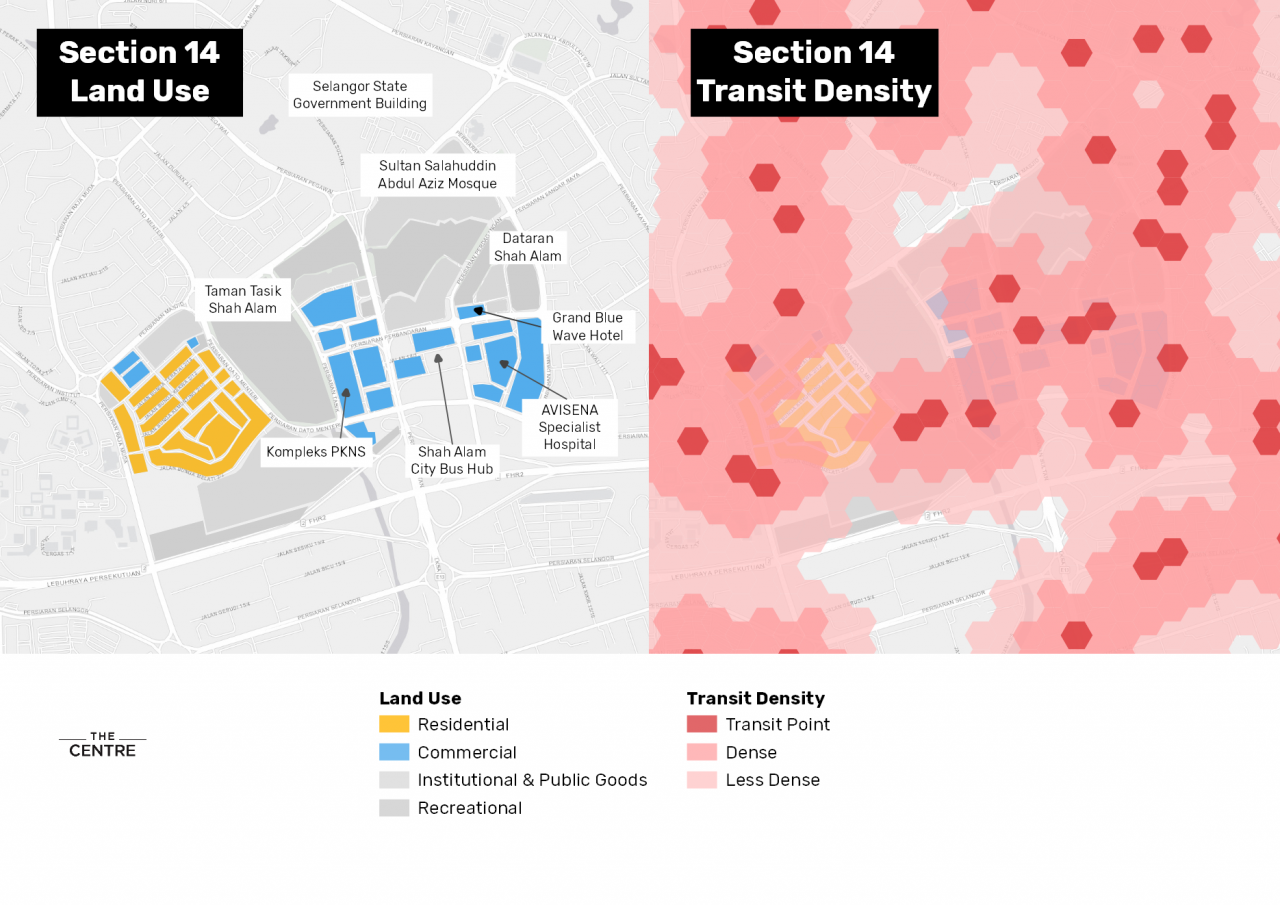
For this mini-study, we focused on the central Shah Alam township, one of the country’s first planned townships and a mature area comprising well developed residential, commercial and public institutions areas.
A key feature of our pilot transit density map is the visualisation of public transport coverage together with the area’s average income, as represented by median property prices. The combination of public transport coverage with property prices is vital to quickly show gaps in service coverage particularly for lower-income urban dwellers.
Our study to construct a transit density map for central Shah Alam saw us gathering, constructing, combining and mapping out three different data sets.
The first data set comprises Geographic Information Systems (GIS) data of bus stops as buses are the main mode of public transportation in the township. Bus services are provided by RapidKL and the Selangor state government. Two KTM Komuter stations are also included in this data.
The next key component is the integration of Shah Alam City Council’s (MBSA) land-use data of central Shah Alam. Land-use data indicates whether plots of land are residential, commercial, industrial, recreational or institutional in nature. These are important to indicate population or traffic density and the potential demand for public transportation.
Next, we compiled, calculated and integrated data on the median residential property prices in the township (Section 1 to Section 24), based on property transaction data from 2008 onwards. Ideally, detailed income data from the official census should be used but due to constraints in acquiring this level of data granularity (more on this later), we have taken residential property prices as a reasonable proxy for income and wealth levels. Residential properties include both landed and high-rise units.
Using GIS, these three different data components were developed and combined into one map for spatial visualisation and analysis.
Finally, the transit density of an area within the map was determined by analysing the area’s walkability or distance to the nearest transit stop*. Residential, commercial, recreational and institutional areas that had a high concentration of ‘walkable’ transit stops, i.e. within 400m to the nearest stop(s), are deemed to be well covered. Residential, commercial, recreational and institutional areas that were more than 400m away from the nearest stop(s) were considered to be underserved.
*The definition of transit density in this pilot study is based on a mainly spatial approach; it does not incorporate actual population data due to constraints. A more precise representation of the gap between demand and supply of public transportation would require the incorporation of detailed population density data, which we hope to pursue in future with data from Census 2020.
How to read and use the map
The landing page of the transit density map shows the default view of central Shah Alam township. Zoom in or out using the ‘+’ or ‘-’ button. Press the ‘home’ button to go back to the default view.
The coloured land plots indicate residential, commercial and other types of areas. Click the top right-hand side button for the land-use legend.
The ‘bus’ button on the right-hand side is the transit density button which allows you to filter areas by transit density. There are two views: by density grid or by radius from the nearest stop.
The ‘house’ button on the right-hand side is the residential property price button which allows you to filter areas by median property price ranges.
If you find this transit density map interesting or useful, please use the share icon to share or embed the map. If you do choose to embed, we kindly request that you credit The Centre.
What does the map tell us about Shah Alam’s transit coverage?
By interacting with this map, a commuter or planner could easily see differences in transit density and coverage across areas of potentially high demand, such as residential areas with lower incomes (represented by lower median property prices). Pairing the transit density map with local knowledge gives potential ways to turn ‘transit deserts’ into ‘transit oases’. The following are some examples:
Transit oases: Shah Alam’s busy commercial centres
Seksyen 7 is located behind Universiti Teknologi MARA’s (UiTM) main campus and Universiti Selangor (Unisel). There are seven bus routes serving Seksyen 7, covering a majority of the neighbourhood’s key areas. The area is popular with students making it the right type of neighbourhood to run a variety of bus routes in order to connect students to their residences, universities, commercial and public facilities and the wider township.
Another busy centre, Seksyen 14, is located at the heart of the township close to the Selangor state’s administrative centre. The PKNS Complex, the city’s first shopping mall, is here and serves as Shah Alam’s symbolic commercial centre. As a central location for the township, it makes sense for the city’s bus hub to be located here, with nine bus routes connecting the city centre to a broader network within and beyond Shah Alam.
Since transit coverage is already quite dense in these areas, improvement efforts would be quite targeted for example placement of additional bus stops or adding service frequency amongst others.
Pockets of transit deserts
Several locations throughout the township can be considered transit deserts i.e. residential or commercial areas with few or no bus routes. However, the underlying reasons for being a transit desert varies from area to area.
‘Village’ neighbourhoods with small road access
Kampung Padang Jawa in Seksyen 16 and Seksyen 17 is served mainly by narrow single-lane roads, allowing access only to small vehicles such as motorcycles, cars, and vans. A 2013 mobility study showed that residents in Kampung Padang Jawa prefer to travel by motorcycle, likely due to the neighbourhood’s narrow and winding roads.
Narrow road networks like those in Kampung Padang Jawa cannot accommodate the use of large public transport vehicles like buses. Could there be an opportunity to develop a micro-mobility solution to serve the area and other communities like Kampung Padang Jawa, such as mini-buses or feeder vans?
Kampung Padang Jawa is characterised by its network of narrow-roads.
Gated communities
At first glance Seksyen 13 looks like a transit desert but being a gated community, this may be due to low demand for public transportation from residents in these neighbourhoods. Residents in higher-income gated communities are more likely to use private vehicles to commute, making such areas a lower priority for service coverage.
Entrance to Sultan Abdul Aziz Shah Golf & Country Club, Section 13.
‘Needs further study’ neighbourhoods
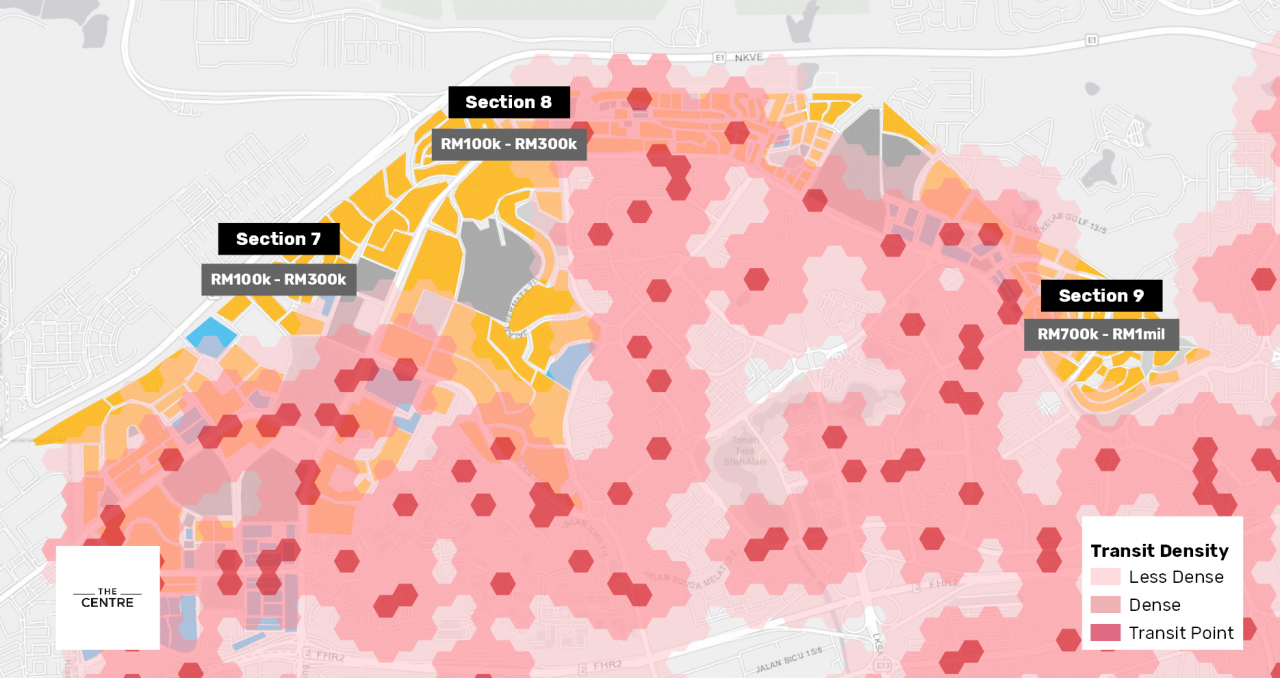
On the other hand, there are areas such as Section 7, 8 and 9 where the neighbourhoods are not gated, appear accessible to public transport vehicles, and yet still lack transit stops. Unlike Kampung Padang Jawa, the roads are large enough to accommodate a feeder bus. As indicated in the image below, there are areas within these sections which are lower-income (i.e. low median property prices), which would imply a demand for more cost-effective transportation. More local information would be needed to offer an explanation – we invite local residents to give us their views.
Neighbourhoods such as Section 9, 8 and 7 have accessible roads but do not have any transit points.
Transit density mapping as community engagement tool
While our pilot transit density map does not as yet incorporate service reliability or route adequacy, it does allow commuters to identify transit deserts in their respective townships and advocate for access and coverage. While this data is likely available to transport planners and service providers, it should be made available to the public who are at the receiving end of planning and policy decisions. When combined with other types of data such as population density, property price or income, it becomes an even more useful tool by which to prioritise public transport coverage.
The Malaysian government will be undertaking a nationwide census starting this month (July 2020). The data would be instrumental in preparing national development plans including for transportation planning. While the government and transportation service providers have recently made positive developments in data-sharing, we believe there is still more room for improvement and we advocate making census micro-data open for public use.
The holistic analysis of different types of data in transport planning, such as census, land-use and property price data would allow for more efficient transport planning. This transit coverage map presents one of the many ways we can utilise such data and contribute towards democratising transport planning and improving mobility.
While this study is limited to central Shah Alam, we see great potential in this transit density map being replicated and improved across city centres throughout Malaysia. If you are interested in expanding this project, we would be happy to discuss partnering opportunities. Drop us a line at aziff@centre.my.
Anak muda sering dinasihatkan supaya mendapatkan segulung ijazah atau diploma demi menjamin masa depan yang lebih baik. Namun dengan arus pendigitalan dan automasi pekerjaan, jaminan ini semakin rapuh. Apatah lagi bagi belia yang tidak memiliki ijazah dan diploma – apakah jalan atau pilihan yang paling baik bagi masa depan mereka?
Menurut Laporan Tinjauan Tenaga Buruh Malaysia 2019, 86% daripada tenaga buruh negara tidak mempunyai sijil pendidikan tinggi. Berdasarkan Laporan Statistik Siswazah 2018 serta Laporan Statistik Tahunan 2018, kami menganggarkan sekitar 77% rakyat Malaysia berusia 20-34 tahun, iaitu golongan belia, tidak memiliki ijazah atau diploma.
Lazimnya, golongan yang tidak memiliki ijazah atau diploma terlibat dengan pekerjaan separa mahir dan berkemahiran rendah. Sektor pekerjaan ini merupakan antara yang paling terancam oleh arus pendigitalan dan automasi, lebih-lebih lagi dalam dunia COVID-19. Tanpa sokongan yang berkesan untuk mempertingkatkan kemahiran mereka, golongan ini adalah antara yang paling berisiko untuk hilang mata pencarian.
Hakikatnya, pihak kerajaan telah lama menawarkan kursus kemahiran dan latihan semula dalam usaha menyelesaikan masalah pendapatan belia, termasuk belia tanpa ijazah. Tahun ini sahaja, RM14* bilion telah diperuntukkan untuk pelbagai program peningkatan kemahiran – sebanyak RM12 bilion dibawah Belanjawan 2020 dan tambahan RM2 billion lagi melalui pelan pemulihan ekonomi COVID-19 PENJANA.
*Angka ini tidak termasuk peruntukan untuk pelbagai program pembangunan keusahawanan dan inisiatif kemahiran di bawah agensi seperti Cradle Fund, Malaysian Global Innovation & Creativity Centre (MaGIC), Perbadanan Usahawan Nasional Berhad (PUNB), TEKUN, MARA, Yayasan Peneraju Pendidikan Bumiputera dan Unit Transformasi Masyarakat India Malaysia (MITRA).
Persoalannya, adakah usaha ini mencukupi untuk membolehkan anak muda, yang mempunyai latar belakang dan kebolehan yang berbeza-beza, untuk mempertingkatkan kemahiran mereka dan seterusnya, menikmati taraf hidup yang lebih baik? Kami menemubual beberapa orang belia bukan graduan untuk mengetahui sama ada mereka menggunakan kemudahan latihan kemahiran yang tersedia, dan jika tidak, mengapa?
Kami dapati bahawa belia yang tidak memiliki ijazah atau sijil boleh dibahagikan kepada beberapa kumpulan dan keperluan setiap kumpulan perlu difahami. Terdapat pelbagai faktor yang memainkan peranan dalam membolehkan sesuatu kumpulan belia mencapai dan mengguna kemudahan yang tersedia. Faktor-faktor ini perlu diambilkira untuk memastikan wang berbilion ringgit yang diperuntukkan untuk program-program latihan ini dapat memanfaatkan kumpulan sasaran sebenar dan mencapai tujuan mempertingkatkan taraf hidup belia.
Pandemik Kehilangan Pekerjaan
Sebelum meneliti faktor-faktor tersebut dengan lebih lanjut, mari kita lihat kedudukan Malaysia berbanding negara jiran dari segi mobiliti sosioekonomi (socioeconomic mobility). Malaysia berada di kelompok pertengahan, di kedudukan ke-43 dari 82 negara dalam Indeks Mobiliti Sosial Global (Global Social Mobility Index) 2020 Forum Ekonomi Dunia (WEF). Kita berada di hadapan jiran ASEAN seperti Vietnam (tangga ke 50), Thailand (55) dan Indonesia (67), namun masih di belakang Singapura (20).
Dengan kesan ekonomi dari COVID-19 yang semakin ketara, mampukah Malaysia memperbaiki atau sekurang-kurangnya mempertahankan kedudukan ini? Walaupun tiada negara yang terlindung daripada impak negatif pandemik ini, keadaan di Malaysia masih merisaukan. Angka rasmi menunjukkan seramai 168,300 rakyat Malaysia kehilangan pekerjaan dalam bulan April 2020 – peningkatan 28% dari bulan sebelumnya. Jabatan Perangkaan Malaysia meramalkan kadar pengangguran meningkat ke 5.5% tahun ini, dan Persekutuan Majikan-Majikan Malaysia (MEF) pula menjangkakan akan berlaku pembuangan pekerja secara besar-besaran tahun ini.
Organisasi Buruh Antarabangsa (ILO) menamakan 4 sektor, iaitu sektor penginapan dan makanan, pembuatan, peruncitan dan pentadbiran, sebagai yang paling terkesan dengan pandemik Covid 19. Pekerja muda pula paling berisiko untuk diberhentikan.
Untuk mereka yang pekerjaannya terjejas, pekerjaan gig menjadi sandaran, lebih-lebih lagi dengan permintaan yang bertambah buat masa sekarang. Tetapi bekerja gig bukanlah suatu kerjaya jangka masa panjang, dan ia tidak menawarkan penganjakan karier atau pendapatan. Dari aspek ini, tiada kata dua: untuk menjamin masa depan belia, kemahiran perlu dipertingkatkan supaya mereka mampu mendapatkan pekerjaan yang berkemahiran tinggi.
Memahami realiti di tahap akar umbi
Walaupun berbilion ringgit telah dilaburkan untuk program kemahiran dan latihan semula, kita masih belum ada kajian atau laporan jangka masa panjang tentang keberkesanannya dari segi impak sosioekonomi. Ini mungkin kerana ia merupakan suatu tugas yang agak mencabar. Dalam usaha memahami hanya satu dari berbagai cabang program ini, iaitu TVET, Kajian Pembangunan Pelan Induk Kebangsaan Latihan Teknikal dan Vokasional 2018 menggariskan beberapa isu. Antaranya, cabaran dalam tadbir urus program yang merentasi berbagai agensi dan kementerian di mana wujudnya perpecahan dan penduaan, serta ketiadaan piawaian untuk sistem penilaian.
Nyata, telah ada beberapa usaha yang telah dijalankan untuk memperbaiki keadaan, seperti penglibatan industri dalam membangunkan kurikulum latihan. Walau bagaimanapun, usaha ini datang dari perspektif penawaran (supply-side). Kami dapati kajian dari aspek permintaan (demand-side) agak berkurangan. Kita perlu menilai sama ada peluang latihan kemahiran dan latihan semula yang sedia ada memberi manfaat kepada golongan yang paling memerlukannya, iaitu golongan belia tidak berpendidikan tinggi. Adakah ia menepati apa yang mereka perlukan, dan jika tidak, mengapa?
Dalam merangka kajian yang lebih mendalam isu ini, kami telah memulakan usaha awal dengan menemubual beberapa orang anak muda yang tidak memiliki ijazah dalam lingkuan usia 20-30an. Hasil temubual-temubual ini menggariskan beberapa cabaran di peringkat akar umbi yang mempengaruhi usaha mempertingkatkan mobiliti sosioekonomi demografik ini.
Pertama: potensi pendapatan seseorang anak muda bukan graduan dipengaruhi oleh (1) latar belakang sosioekonomi keluarga mereka, (2) rangkaian sosial mereka dan (3) kemahiran berbahasa Inggeris. Bagi sesetengah belia, kewujudan ketiga-tiga faktor ini memberikan mereka keyakinan untuk tidak meneruskan pelajaran ke peringkat tinggi. Sebaliknya mereka memilih untuk menggunakan dayadiri untuk belajar sendiri secara dalam talian (yang rata-ratanya menggunakan Bahasa Inggeris sebagai bahasa pengantara). Mereka ini boleh menggunakan rangkaian sosial mereka seperti kenalan ibubapa atau kenalan sediri untuk mendapatkan pekerjaan, perantisan atau bimbingan. Pada masa yang sama, mereka dapat memanfaatkan persekitaran yang selesa dan stabil di rumah. Memiliki hanya satu dari tiga faktor ini pun cukup untuk mempengaruhi potensi mereka: contohnya – jika mahir berbahasa Inggeris, maka bahan dalam talian menjadi lebih mudah untuk dicapai.
Kedua: potensi pendapatan seseorang belia bukan graduan bergantung pada motivasi diri. Mereka yang lebih bermotivasi untuk memperbaiki taraf hidup mereka atau mempelajari kemahiran baharu akan menjadi lebih komited dan tidak berhenti separuh jalan. Motivasi ini pula didorong oleh kebolehan mereka untuk menggambarkan masa depan mereka – contohnya: boleh membayangkan pekerjaan atau kenaikan pangkat yang dapat dikejar sekiranya mereka menyertai sesuatu program latihan kemahiran. Ini juga dipengaruhi sedikit sebanyak oleh kenalan dan rangkaian sosial – melihat rakan atau saudara yang menikmati manfaat ini akan memberikan mereka keyakinan yang lebih.
Memikir semula pendekatan kepada penyediaan program kemahiran
Walaupun ini adalah hasil penemuan awal, kami berasa ia memberi gambaran asas bagaimana kita perlu memikirkan semula pendekatan yang diambil dalam usaha melatih atau melatih semula golongan belia yang tidak mempunyai ijazah atau sijil. (Kami sedang merancang untuk membuat kajian lanjut dengan sampel yang lebih meluas).
Golongan muda bukan graduan berbeza-beza dari segi potensi diri dan gaya pembelajaran. Memahami perbezaan-perbezaan ini boleh membantu kita mensasarkan program mengikut keperluan. Sebagai contoh, kita ambil program Global Online Workforce (GLOW) yang diadakan secara kerjsama dengan platform pembelajaran Coursera. Golongan bukan graduan yang mahir berbahasa Inggeris, mempunyai talian internet jalur lebar yang stabil, boleh belajar sendiri dan ada rangkaian sosial boleh mendapat manfaat dari program ini. Mereka yang tidak mempunyai ciri-ciri di atas mungkin memerlukan bantuan yang lebih komprehensif – bermula dari bimbingan kerjaya, kemudian menjalani latihan yang bersesuaian dengan gaya pembelajaran dan akhirnya bantuan penempatan kerja.
Dalam usaha menempatkan anak muda kita dalam pekerjaan yang berpendapatan tinggi, kita perlu memastikan bahawa apa yang ditawarkan dari segi program latihan, sejajar dengan apa yang mereka perlukan. Ini bermakna kepelbagaian golongan belia perlu diambil kira dalam membentuk program kemahiran dan latihan semula. Jika tidak, peruntukkan untuk peningkatan kemahiran ini mungkin terbazir, dan niat baik kekal sekadar niat tanpa membuahkan hasil.
Bahagian 2 kajian pekerja gig kami yang diterbitkan awal tahun ini telah membentangkan penemuan bahawa pekerja gig kurang mempunyai perlindungan sosial. Kajian kami yang disertai lebih daripada 400 pemandu e-hailing dan penghantaran mendedahkan bahawa 76% daripada mereka tidak mempunyai insurans kehilangan pekerjaan (seperti EIS), 59% responden tidak mempunyai simpanan untuk kecemasan, 59% tidak mempunyai tabungan hari tua atau persaraan, 57% tidak mempunyai insurans kesihatan peribadi dan 37% tidak mempunyai insurans kecederaan atau kemalangan semasa bekerja (Rajah 1). Secara keseluruhannya, satu dalam lima pekerja gig yang ditinjau tidak mempunyai apa-apa bentuk simpanan atau perlindungan sosial.
Rajah 1: Liputan skim perlindungan sosial dan simpanan pekerja gig
Satu kajian World Bank pada tahun 2019 juga mendapati bahawa kebanyakan pekerja tidak formal di Malaysia tidak mempunyai perlindungan sosial yang mencukupi. Salahsatu sebabnya adalah pendekatan berdekad lama terhadap pendaftaran skim-skim perlindungan sosial yang berasaskan pekerjaan, di mana majikan akan mendaftarkan pekerja sepenuh masa dalam skim simpanan persaraan di bawah KWSP dan insurans keselamatan pekerja di bawah PERKESO. Sesetengah majikan juga memberi subsidi atau memberi insurans kesihatan swasta kepada pekerja sepenuh masa.
Pendekatan ini adalah sesuai dan mencukupi jika kebanyakan pekerjaan dalam pasaran adalah pekerjaan formal atau sepenuh masa. Walau bagaimanapun, trend pekerjaan masakini semakin ke arah pekerjaan gig atau pekerjaan bebas. Data tenaga buruh Malaysia menunjukkan bahawa peratusan pekerjaan tidak formal atau ‘pekerja akaun sendiri’ telah meningkat daripada 17.4% pada tahun 2008 kepada 19.4% pada tahun 2018 (Rajah 2).
Nota: Artikel ini akan menggunakan istilah pekerja bekerja sendiri, pekerja akaun sendiri, pekerja tidak formal dan pekerja bebas secara bergantian.
Rajah 2: Bilangan dan peratusan pekerja sendiri mengikut tahun
Menurut Khazanah Research Institute (KRI), trend pekerja tidak formal yang semakin meningkat di Malaysia mengisyaratkan satu transformasi asas dalam pasaran tenaga buruh. Dan jika pekerjaan bebas atau pekerjaan ‘gig’ menjadi pekerjaan utama sebahagian besar pekerja di Malaysia, pendekatan semasa terhadap perlindungan sosial akan menjadi semakin tidak berkesan untuk melindungi pekerja. Mutakhir ini, hanya 38% pekerja Malaysia dilindungi oleh skim persaraan KWSP atau skim pencen awam; majoriti daripada 62% pekerja yang tidak dilindungi adalah pekerja yang bekerja sendiri.
Pertimbangan dasar
Sebagai tindak balas kepada trend pekerjaan sendiri dan pekerjaan gig, kerajaan di seluruh dunia telah mula melaksanakan penambahbaikan dasar bagi melindungi pekerja tidak formal. Di Malaysia, antara langkah-langkah tersebut adalah pelancaran Skim Keselamatan Sosial Pekerjaan Sendiri (SEEIS) di bawah PERKESO dan Skim i-Saraaan di bawah KWSP.
SEEIS adalah skim insurans kecederaan dan kemalangan di tempat kerja manakala i-Saraan adalah skim simpanan persaraan; kedua-duanya adalah untuk pekerja yang bekerja sendiri. Menurut Akta Keselamatan Sosial Pekerjaan Sendiri 2017 SEEIS adalah mandatori bagi sebahagian jenis atau kumpulan pekerja sendiri. Skim i-Saraan merupakan skim sukarela.
Maksud ‘mandatori’ di sini bermakna pekerja sendiri tersebut mesti menyertai skim ini. Namun begitu, mereka tidak akan didaftarkan secara automatik. Ini adalah titik yang halus tetapi penting. Skim yang mandatori atau wajib, tanpa pendaftaran automatik, meletakkan tanggungjawab untuk mendaftar dan menyumbang kepada skim tersebut pada pekerja itu sendiri. Memandangkan sifat manusia, kebanyakan pekerja sendiri tidak akan mendaftar untuk skim tersebut secara proaktif atau sukarela.
Pendekatan berbentuk mandatori hanya berkesan jika penguatkuasaan adalah ketat (contoh: pengutipan cukai pendapatan). Tanpanya, pendaftaran ke dalam sebarang skim perlindungan sosial akan kekal rendah. Dengan itu, tidak menghairankan bahawa walaupun SEEIS adalah ‘mandatori’, hanya 18% daripada kira-kira 250,000 pemandu e-hailing dalam negara yang menyertai skim tersebut. Malah, untuk mencapai kadar ini sahaja, pemantauan pematuhan turut melibatkan lawatan pemeriksaan, amaran dan tindakan mahkamah.
Oleh demikian, pendekatan berpaksikan pendaftaran automatik serta caruman automatik putat dipertimbangkan dengan serius dan mendalam.
Pendekatan ini telah diambil dalam beberapa program keselamatan sosial di seluruh dunia bagi memastikan penyertaan dan litupan yang lebih meluas. Satu kajian oleh Clark dan Young di Vanguard mendapati bahawa kadar penyertaan dalam pelan penjimatan dan pelaburan meningkat hampir dua kali ganda dengan pendaftaran serta caruman automatik berbanding pelan berbentuk sukarela. Pelaksanaan pendaftaran serta caruman automatik sesuai terutamanya dengan platform gig kerana syarikat tersebut sudahpun mempunyai infrastruktur data serta saluran kewangan yang mencakupi ribuan pekerja sendiri.
Kajian pekerja gig kami menunjukkan bahawa kebanyakan pekerja gig sanggup membenarkan platform gig memotong daripada pendapatan gig mereka untuk pelbagai jenis skim perlindungan sosial. Bagaimanakah kita boleh meningkatkan kadar penyertaan sebenar dalam skim perlindungan sosial seperti i-Saraan dan juga SEEIS yang ‘mandatori’? Selain daripada pendaftaran automatik, reka bentuk caruman juga penting. Mungkin lebih sesuai jika caruman dibuat dengan jumlah yang kecil dari minggu ke minggu supaya tidak terlalu dirasai, berbanding caruman setiap bulan yang akan dirasai dengan ketara.
Adakah skim sukarela efektif?
Bolehkah skim perlindungan sosial sukarela melindungi pekerja tidak formal secara mencukupi? Di negara lain, telah mula muncul inisiatif di mana pekerja tidak formal bekerjasama dan berunding untuk mendapatkan perlindungan sosial. Contohnya, Freelancers Union di Amerika Syarikat telah berunding dengan syarikat insurans untuk menubuhkan Trupo yang menawar insurans kemalangan semasa bekerja dan pergigian dengan premium yang rendah kepada ahli persatuan mereka. Begitu juga New York Taxi Workers Alliance di Amerika Syarikat yang merunding berdasarkan saiz kesatuan mereka untuk memperoleh kadar diskaun bagi perkhidmatan undang-undang, kewangan dan khidmat kesihatan untuk ahli-ahlinya.
Di Malaysia, Malaysia e-Hailing Drivers Association (MeHDA) telah memanfaatkan saiz organisasinya untuk menawarkan kadar lebih rendah untuk perkhidmatan penyelenggaraan kenderaan dari bengkel terpilih. MeHDA juga sedang berunding dengan syarikat kereta untuk menawarkan kadar sewa kereta yang lebih murah kepada pemandu e-hailing. Langkah-langkah ini masih jauh lagi daripada apa yang diperlukan sebagai perlindungan sosial, namun cara pendekatannya mungkin dapat dipanjangkan kepada skim-skim perlindungan sosial di masa depan.
Beberapa platform gig juga cuba memikul membantu di bawah sepanduk ‘tanggungjawab korporat;’. Apabila undang-undang Assembly Bill 5 diluluskan di California, Amerika Syarikat, platform gig Uber, Lyft dan platform lain telah mengumpulkan dana sebanyak USD100 juta dan menjanjikan perlindungan pekerja termasuk ‘jaminan pendapatan bersih’ untuk pemandu yang merekodkan 20 jam kerja seminggu.
Di Malaysia pula, Grab Malaysia telah bekerjasama dengan KWSP untuk mempromosikan program simpanan persaraan sukarela i-Saraan dengan tambahan 5% (maksima RM80 setahun) atas sumbangan tahunan pemandu.
Namun begitu, pemerhati industri ada mendedahkan kepada kami bahawa penyertaan dalam inisiatif tersebut, walaupun dengan insentif yang ditawarkan, adalah sangat rendah. Ia berbalik kepada hujah asal kami: apabila liputan sesuatu skim perlindungan bergantung kepada inisiatif dan kemahuan pekerja untuk menyertai, ia tidak akan merealisasikan potensi skim itu. Pendekatan yang serasi dengan sifat manusia dalam hidupan harian adalah amat penting bagi memastikan penyertaan meluas.
Pendaftaran dan caruman secara automatik
Pendekatan cara sukarela atau mandatori untuk mendaftar dalam skim-skim perlindungan sosial telah, setakat ini, menunjukkan batasnya.
Bagi meningkatkan liputan sistem perlindungan sosial terutamanya atas pekerja gig dan pekerja bebas lain, kami boleh memodelkan Skema Keselamatan Sosial Umum Perancis. Skim ini mendaftar sesiapa yang berusia 16 dan ke atas secara automatik dengan memberikan nombor keselamatan sosial. Skim ini memberikan pelbagai jenis perlindungan termasuk perkhidmatan kesihatan, insurans keselamatan pekerja, dan faedah-faedah untuk persaraan dan keluarga.
Dengan sistem ini, adalah menjadi tanggungjawab setiap majikan untuk memastikan bahawa caruman ditolak secara automatik setiap kali pekerja dibayar.
Masa terbaik untuk menaiktaraf sistem perlindungan sosial negara adalah sekarang. Malaysia harus mengambil tindakan segera terhadap trend informalisasi pasaran tenaga buruh. Walaupun kami menyokong usaha sektor swasta dalam menggalak pendaftaran dalam skim perlindungan sosial secara sukarela, tetapi malangnya ia bukan penyelesaian yang mencukupi.
Kami menyokong usaha untuk melaksanakan sistem pendaftaran dan potongan automatik bagi memastikan liputan perlindungan sosial untuk semua pekerja.
Emel pandangan atau cadangan anda ke editorial@centre.my.
We propose mental well-being elements be explicitly integrated in future revisions of policies, regulations and guidelines dealing with the design and building of public housing, public amenities and public spaces. It is crucial that mental well-being as part of the built environment should not be taken for granted , because as the Covid-19 MCO has shown, the impact of this can be far-reaching and long lasting.
The built environment refers to urban spaces and infrastructure designed for human activity. The term built environment encompasses how various items, such as parks, buildings, streets and residential and work spaces are designed. It concerns the space’s impact on human and environmental health.
Mental well-being and the built environment
Well-being weaknesses in residential spaces
During the MCO, news reports on public low-cost housing residents revealed that families were living in cramped spaces and unsanitary conditions. These shortcomings are not new, and have been highlighted before the MCO. A 2018 study showed that low-cost housing residents stated that their housing design was not sensitive or conducive towards their personal and social needs. They were also unhappy with badly-maintained amenities. Studies have shown that these shortcomings in living environments have a long-term negative impact on mental well-being.
In the design process, architects often explore holistic approaches and solutions to integrate mental well-being and community life into the built environment. This is clearly reflected in the objectives and scope of work outlined by the housing and urban well-being committee of the Malaysian Institute of Architects (PAM). Despite this effort, why do we still see weaknesses in housing units, especially in public low-cost housing?
Architects we have spoken to indicated that these shortcomings often occurs at the planning and design phase. While official design guidelines may have features that indicate an implicit understanding of mental well-being, very often, this does not translate into the final product, as guidelines are not binding. An initial design goes through several filtering phases where the concept is adjusted based on cost, design feasibility, regulations and client expectations. Often, explicit well-being features are only included if it is desired or requested by the client.
Extending residential spaces: shared amenities
In addition to the residential spaces, amenities also contribute towards the mental well-being of its residents. Low-cost public housing is typically high-rise, where by design, there are limits to an individual’s access to spaces such as gardens, unlike in landed residentials. This is a longstanding area of concern for low-cost housing residents: a University Malaya study of low-cost housing residents identified access to amenities and a well-designed interior environment as a priority.
Thus, the inclusion of amenities in low-cost public housing, such as balconies or garden spaces, plays a pivotal role in addressing the mental well-being needs of its residents.
We also need to think about how public spaces affect the social life and well-being of those using the space. Design interventions such as social spaces, meeting points, activity spaces or even street lighting are parts of the larger picture of urban design. These elements contribute towards positive well-being, both individually and in communities.
As an example, as part of making Kuala Lumpur more pedestrian-friendly, the city council announced pedestrianising 10 major roads in the city by 2025. This is commendable, as pedestrianising urban spaces is shown to improve well-being by encouraging walking and making streets safer. Yet, despite the Kuala Lumpur City Council’s efforts, traffic experts indicate that walkability in the city is still not as safe nor as accessible as it should be.
What might be the consequences of not heeding well-being in public urban design? A 2011 study of Kuala Lumpur shows that the lack of proper urban planning may potentially turn the metropolis into a heat island. This is supported by studies showing how this phenomenon results in adverse health effects on urban communities. The same study makes recommendations for increasing green spaces in the city to manage the negative effects of the built environment.
Green spaces and urban well-being
Beyond urban concrete and glass, green spaces are also an important feature of the built environment. A body of research has shown that the importance of green spaces and mobility in the urban environment also contributes towards the overall well-being of urban communities.
By the same token, green spaces such as parks are increasingly shrinking and fragmented due to aggressive development. A body of literature has shown how green spaces in urban areas contribute to overall well-being alongside promoting public health activities in the communities.
A local study of green spaces in Kuala Lumpur confirms this relationship, where residents who have benefited from these green spaces called for continued funding for these parks. Unfortunately, green spaces in Kuala Lumpur are fragmented, occupying only 35% of 243 km2 total areas in the city.
Incorporating mental well-being into the built environment
How can we implement more comprehensive well-being features into the design of our interior and exterior spaces? The first step is to recognise where the existing gaps are.
One framework proposed by The Centre of Urban Design and Mental Health, known as Mind the GAPS deliberately integrates mental well-being into urban design. The framework operates on four aspects: accessibility to green spaces, active spaces, pro-social spaces and safety and security.
Existing guidelines in Malaysia already incorporate some of the above aspects: however, this needs to be better integrated as part of an active process rather than merely a box-ticking exercise. While the guidelines imply an acknowledgment of mental well-being in the built environment, this often translates poorly in reality, as evidenced in the examples of shrinking green spaces, and lack of public low-cost housing amenities to name a few.
In the following section, we use the Mind the GAPS framework to highlight potential areas where changes can be made, so that mental well-being is more explicitly incorporated in our policies, regulations and guidelines.
Aspect 1: Accessibility to green spaces
Green spaces, an area of vegetation in an urban environment, is typically realised as parks or gardens. The provision of green spaces are currently designated in planning guidelines of state governments, although its form differs depending on where it is being built.
More weightage should be given to designing green spaces into the built environment, not simply as a checkbox but as a consideration for well-being. In cities such as London, the expansion and preservation of green spaces are designed into policy. London aims to have 50% of green spaces in the city by 2050, recognising its benefits. In fact, a 2017 study on the economic value of health benefits that London’s urban communities get is £27 for every £1 spent on public green spaces.
Currently, Malaysia is implementing its Low Carbon Cities Framework, which is a holistic approach towards environment sustainability. There is an opportunity to update the framework to also accommodate for urban mental well-being. Examples can include enforcing a binding green spaces target, and redirecting taxes to the development of green spaces.
Aspect 2: Activate active spaces
While parks may serve as spaces for exercise; active spaces can also be realised through more minor design interventions such as accessible footpaths to encourage walking, or even bicycle lanes in the city. Studies have shown how physical activities contribute to better mental health.
Although bicycle lanes are already designed into select spaces of Kuala Lumpur, the experience of using it is less than ideal as these lanes are typically blocked by private vehicles or its usage is not respected. In these cases, enforcement paired with design interventions are necessary to make these active spaces safe to use.
As an example, the New York City Planning Department published guidelines on integrating active spaces into every aspect of urban life, both social and economic. The guidelines take into account walkability to amenities, pedestrian access and optimal stair locations to name a few.
While Malaysia does not have any guidelines directly addressing the implementation of active spaces in design guidelines, the government acknowledges the need of a healthy society. This is exemplified by the MyHEALTH portal aimed at increasing public awareness towards physical well-being. There is an opportunity here for the government to examine how the built environment can contribute towards the encouragement of healthier physical and mental lifestyles.
Aspect 3: Pro-social spaces
The importance of pro-social spaces – spaces designed to encourage a sense of community – is supported by studies showing that social ties improve mental health. American sociologist Eric Klinenberg calls these “social infrastructure”- shared spaces where people meet one another, form connections and develop a sense of community.
Examples of pro-social spaces are neighbourhood libraries or community centres, or smaller scale interventions such as street furniture. In America, public libraries are seen as “opportunity institutions”. Vulnerable communities, such as migrant communities, the elderly or homeless, access public libraries to attend community classes, get help with job applications and access a range of community resources otherwise not available to them.
In Malaysia, public libraries are still exclusively regarded as spaces of knowledge. This limitation of imagining a library’s role limits the potential for a design approach that considers these spaces as pro-social. Refreshing our approach to the built environment, as well as how we think of “social infrastructures”, allow us to encourage community developments in these spaces.
Other examples are internet centres established in low-cost housing areas. While its core purpose is to encourage digital literacy among underserved communities, there is also an underlying pro-social aspect, where if designed well, can function as an informal community space.
From a policy perspective, there are efforts by the government to address the development of community life. This is done through the National Community Policy. However, the document lacks any indication in which the built environment is seriously considered in improving well-being in communities. There is an opportunity to implement pro-social spaces into local authorities’ design guidelines and allow for an acknowledgement of the built environment in developing communities.
Aspect 4: Safety and security
This aspect of the framework is concerned with building a safe and secure environment, or “safe spaces” that contribute to one’s mental well-being.
In part of design guide and implementation, Australia’s Northern Territory extensively outlines community safety and how that can be realised in the built environment. The guideline examines the use of spaces and outlines well-being considerations to contribute towards safer, more realised community life.
Currently, state by-laws address safety design pragmatically. For example, fire safety design guidelines discuss space use and design interventions extensively. While this is commendable, improvements can be made to also extend this same principle across well-being, where explicit consideration is given towards smaller built environment elements such as pathways, lighting and amenities maintenance.
Design guidelines should account for safety in a more holistic perspective, as opposed to addressing the specific safety issues to be solved in the built environment.
Conclusion
Various studies have shown how spaces, interior or exterior, influence mental health and well-being. Green spaces such as parks and rooftop gardens are not simply part of the urban feature: they are important in contributing towards the urban community’s mental well-being. The same goes to design interventions such as safe and accessible public amenities that encourage the fostering of community life. The Mind the GAPS framework discussed above provides for these different aspects of urban well-being.
Currently, well-intentioned well-being considerations do not necessarily fully translate into the built environment. There is a need here to embrace mental well-being prominently in the planning and design process of the built environment. To enable this, mental well-being considerations need to be explicitly integrated it into design guidelines, policies and regulation, and where possible, make these considerations binding.
This is key in realising safer, thriving spaces for urban communities to grow in. And as Malaysia moves into rapid urbanisation in the coming decades, these urban spaces are more important than ever.
Earlier this month, Prime Minister Muhyiddin Yassin announced PENJANA, a stimulus package intended to help the country recover from the economic fallout of COVID-19. Among its initiatives is the MY30 public transit pass, a much cheaper version of the MY100 pass, which allows unlimited travel across Klang Valley’s bus and rail services.
As a way to help ease the burden of those who rely on public transportation, the measure is a welcome one especially given the prospects of prolonged economic difficulty. At the same time however, PENJANA also offered a sales tax exemption for car purchases, a move that’s understandably targeted to stimulate private consumption and shore up the local automotive sector, but somewhat contradicts the spirit and message for public transportation.
Malaysia has the second-highest car ownership rate in ASEAN. Conversely, public transport usage in metropolitan areas is relatively low; a 2015 World Bank study showed that only 17% of Klang Valley commuters use public transportation compared to 62% in Singapore and 89% in Hong Kong. This statistic could be higher now with the expansions of Klang Valley’s MRT and LRT networks but it is unlikely that we are close to achieving the stated goal of 40% public transportation modal share.
If the government is serious about achieving this target, stronger policy measures are needed.
Reinstilling confidence
Public transportation naturally suffered during the Movement Control Order (MCO). Ridership numbers dropped 80% for KTMB and 66% for RapidKL buses, not only due to the MCO’s Standard Operating Procedures (SOP) such as halving maximum passenger numbers and seating capacity, but also because of the general public’s fear of contracting the virus.
This fear could have been better managed as Malaysia moved into a new normal under the Recovery MCO phase. On 9th June 2020, in what appeared to be an executive decision, Rapid KL announced a return to full seating capacity on its trains. In a matter of hours, the announcement was quickly withdrawn after the Home Ministry rebuked Rapid KL for making unauthorised changes in the SOP. Just two days later, however, the government themselves announced that public transportation services would no longer need to run at half-capacity.
This evident lack of alignment and coordination between service providers and the government was not very reassuring to commuters. In addition and perhaps more importantly, the public health and safety justification for returning to full capacity was never clearly communicated.
American studies have shown that public transportation is associated with higher COVID-19 death rates. However, studies in other countries have shown that public health measures such as wearing masks is key in managing the virus transmission in public transportation vehicles. Bottomline: real evidence of the safety of public transportation needs to be weighed, communicated and repeated if increasing ridership is a genuine target.
Solutions to improve commuter experience
The MY30 public transit pass is a great financial incentive to use public transportation. But as outlined in studies, including a brief overview by The Centre last year, there are other costs associated with using public transport: time, comfort, stress to name some key ones. While the expansion of MRT and LRT lines is important, it is not the entire commuter experience story. Insufficient feeder services to major stations as well as inconvenient routes are long-standing issues. Safe pedestrian access to transit points, both in terms of physical walkways as well as protection from street crime like snatch thefts, is another.
As part of the solution, we argued for increasing the use of open data to help commuters plan their journey better as well as give real-time feedback. This would ideally enable public transport service providers to allocate resources, fleets and frequencies to areas and routes needed most.
The government recently announced a collaboration with Google Maps to allow commuters to see real-time location of buses, a positive development. However, more can be done. For example, the government could create a data platform where commuters can vote for routes and service timings as well as provide real-time overall feedback. Such a platform would put commuters at the heart of public transit planning, allowing operators to respond more efficiently with improved routes, frequencies, and perhaps even type of vehicle.
Restating policy commitments
In this new post-pandemic reality shaped by COVID-19, there is a need to clarify the National Transport Policy. Does the National Transport Policy 2019-2030 still hold? What remains as priorities and what needs to be changed?
Beyond the MY30 public transit pass, the government’s policy thinking and commitment on public transportation needs to be made clear and followed up with credible action. Even with the challenges posed by COVID-19, there is a real opportunity to reshape public transport and achieve the modal share targets that have been set.
The long-standing notion that a diploma or degree will virtually deliver upward socioeconomic mobility has been increasingly eroding with the rise of digitalisation and job automation. For non-degree holders, the probability of climbing up the socioeconomic ladder is likely to be worse.
According to the 2019 Labour Force Survey Report, 86% of the Malaysian labour force comprise non-graduates. From the 2018 Graduate Statistics Report and the 2018 Statistics Yearbook, we estimate that around 77% of those aged 20 to 34 do not have a diploma or degree. We can safely infer therefore that the majority of new entrants to the labour market will not have tertiary qualifications.
Non-graduates typically take up semi- and low-skilled occupations, and are at the highest risk of being displaced by the forces of digitalisation and automation. These forces are expected to accelerate in a Covid-19 world. It is more urgent than ever to support young workers with few qualifications to upgrade their occupational skills. However, it is easier said than done.
The government has long pushed upskilling and retraining to be the solution for the socioeconomic mobility problem of non-graduate workers (and increasingly of degree holders as well). Just this year alone, the Federal government had allocated more than RM14 billion on various skills development programmes – over RM12 billion* under Belanjawan 2020 and an additional RM2 billion through the recently announced Covid-19 economic recovery plan PENJANA.
*This figure excludes allocations to the myriad entrepreneurship development programmes and skilling initiatives under agencies such as Cradle Fund, Malaysian Global Innovation & Creativity Centre (MaGIC), Perbadanan Usahawan Nasional Berhad (PUNB), TEKUN, MARA, Yayasan Peneraju Pendidikan Bumiputera and the Malaysian Indian Transformation Unit (MITRA).
Allocations for programs are of course necessary, but are they enough to ensure that young people, of different backgrounds and abilities, get appropriately ‘upskilled’ and on to better incomes? Through some exploratory interviews, we asked whether young non-graduates were accessing the upskilling opportunities that are reportedly available and if not, why not.
Based on these conversations, we at The Centre found a rich diversity of youths with varying socioeconomic mobility potential. We saw that some non-degree holders are better positioned than others due to various factors. Understanding these factors is key towards ensuring that the billions allocated in training programs benefit the most problematic segments and deliver the promise of better incomes.
The job loss pandemic
But first, let’s consider the macro picture. On the surface, Malaysia is middle of the pack in socioeconomic mobility, ranked 43rd out of 82 on the World Economic Forum (WEF)’s Global Social Mobility Index 2020. According to the Index we are ahead of regional peers Vietnam (50th), Thailand (55th), and Indonesia (67th), though behind Singapore (20th).
Can we keep this up or even improve with the impact of Covid-19 on the economy? Doubtless, no countries are spared from the grim effects of the virus but it looks very negative for Malaysia so far: 168,300 people were officially jobless in April 2020, a 28% increase from the previous month. DOSM forecasts Malaysia’s unemployment rate to rise to 5.5% this year. More ominous still, the Malaysia Employers Federation (MEF) believes a great retrenchment is on the horizon.
According to the International Labour Organisation (ILO), accommodation and food services, manufacturing, retail and administrative activities will be the four hardest-hit sectors worldwide in this pandemic, with young workers being the most vulnerable to layoffs.
Some jobs will eventually come back like flight attendants and hotel workers. But some semi- or low-skilled jobs will likely face severe and permanent shrinkage in demand such as retail staff and clerical support workers, due to changing consumer preferences or greater technological adoption or both.
In the meantime, gig work has become a prevalent fallback to make ends meet due to the sustained demand for some gig services like food delivery. Nevertheless, these types of gig work are neither sustainable as long-term occupations, nor upwardly mobile. There is no escaping it: skills need to be upgraded for higher-value jobs that will continue to be in demand.
Understanding ground-level factors to inform top-down programming
The billions in training allocations fund a myriad of occupational training and upskilling opportunities but there has yet to be a comprehensive longitudinal study of its impact on participants’ socioeconomic mobility. This could be due to the sheer magnitude of the challenge – on TVET alone, the 2018 Report on Technical and Vocational Education & Training (TVET) outlined massive governance challenges such as fragmentation and duplication across ministries and agencies, a lack of a standard evaluation system, and many others.
There have been notable developments such as the setting up of industry-led bodies to co-develop training curriculums. While work on the supply side of training and upskilling continues, we note however that there is limited research on the demand side of the equation. Are current retraining and upskilling opportunities benefiting groups who need it the most, particularly youth with no tertiary qualifications? And if not, why not?
In preparation for a more in-depth study on this topic, we carried out exploratory interviews with several non-graduates in their 20s and early 30s from a variety of backgrounds. A few key points emerged giving us some insight into the ground-level challenges of raising the socioeconomic mobility of this demographic.
Firstly, young non-graduates’ earning potential appeared to be very much driven by parents’ educational and income background, the richness and helpfulness of social networks and their English proficiency. For some, the presence of all three factors gave them the confidence to forgo a degree altogether, trusting in their ability to self-direct their learning with online courses (mostly in English), tap their networks for jobs or apprenticeships or guidance, while at the same time being supported by a somewhat stable home environment. Having even one out of three still helped prospects greatly, particularly useful social networks or having sufficient English proficiency to read or view online learning materials.
Secondly, while almost everyone would agree that upskilling is important or necessary, having real motivation to achieve better socioeconomic status or skill mastery is a key driver in committing to training programs. And often, it is those who can envision a clear job or business opportunity that would be the most motivated and would act upon it.
Rethinking our training and upskilling approach
These are still initial themes which we hope to confirm and develop with further study and an expanded sample. Nevertheless, they do point to some ways in which to rethink our approach to training and upskilling young non-graduates.
Segmenting young workers by their potential for socioeconomic mobility and their learning styles is crucial towards understanding which programs could work for different segments. To put this into perspective, take the Global Online Workforce (GLOW) program, a partnership with the online learning platform Coursera. Young non-graduates with good English proficiency, stable internet access, independent learning styles and useful social networks would benefit the most from this great program. Those who aren’t as fortunate will need more comprehensive interventions, from career guidance to training to job placement.
Gig platforms have seen a surge in applicants over the last 3 months, indicating the economic and jobs fallout from the pandemic. But as one of our interviewees said, “no one wants to do these jobs forever”. To move young workers into higher-earning occupations, we need to ensure that supply-side improvements of training and upskilling programs are matched by an understanding of the practical problems faced by different target groups. Otherwise, more fiscal allocations for upskilling and retraining programmes will be a waste of good intentions and scarce resources.